Sermon: Walking in the Way of Righteousness
By Joanna Shenk
Psalm 85:8-13
A few weeks ago I was having a conversation with a loved one in which they asked me if I thought holiness and righteousness were important… or if I valued them as a Christian. I can’t remember exactly how they said it, but it was said in a way that assumed I probably didn’t think they were important. I explained to them that it was frustrating to be asked the question in that way because it put me on the defensive… like I needed to prove something to them. To their credit, they understood and agreed it made for better conversation if they asked me how I understand holiness and righteousness or what has been my journey with those things.
As far as conversations go with this relation, such inquires aren’t typical. Normally they don’t ask me questions like this since they know we’re at different places theologically and neither of us like conflictual exchanges. But they felt it necessary to broach the conflict in this case since it was about whether or not they could come to my ordination service, whenever that happens, because I (and this congregation) support same-sex partnership and marriage.
In asking the holiness and righteousness question they were assuming that I didn’t value those things since my ethics around sex and partnership are different than what they believe to be biblical. I’m sure many of us have encountered these kinds of conversations with relatives or other people in our lives.
We didn’t have time to really delve into the holiness and righteousness deal on that phone call and I was relieved because I didn’t really know what to say in the moment. It’s been a while since I’ve thought about those words. I don’t think that means I don’t value them, I just haven’t worked my way back to where I started and articulated how I got to where I am now.
So when I saw the lectionary this week included a passage with the word righteousness a few times, I jumped on it. I wanted to find out what the word means to me now… and what it might mean for us.
But frankly it’s been a hard week to write a sermon. What do I say in light of the sexist manifesto from the former Google employee and the threats going back and forth between Trump and North Korea and the white supremacist violence that manifested in Charlottesville over the weekend?
I was feeling the weight of all this when I showed up to David Solnit’s art space yesterday morning. He and I talked about it a bit while we were setting up for the art build. He noted that it’s crazy how a thousand or so racist people can get so much media coverage and there’s barely a blip when 10s of 1,000s, if not millions, march and advocate for a healthier world year after year after year. His point was that many, many more people show up for love than those who show up for hate.
So that’s what a group of us did yesterday, seven were under the age of 15 and thirteen were older than that. Together the 20 of us created the banners that are displayed on the alter table and which you’ll get to see in all their glory at the art show next week. We didn’t bring them back with us yesterday because they are still drying and need to be rigged up.
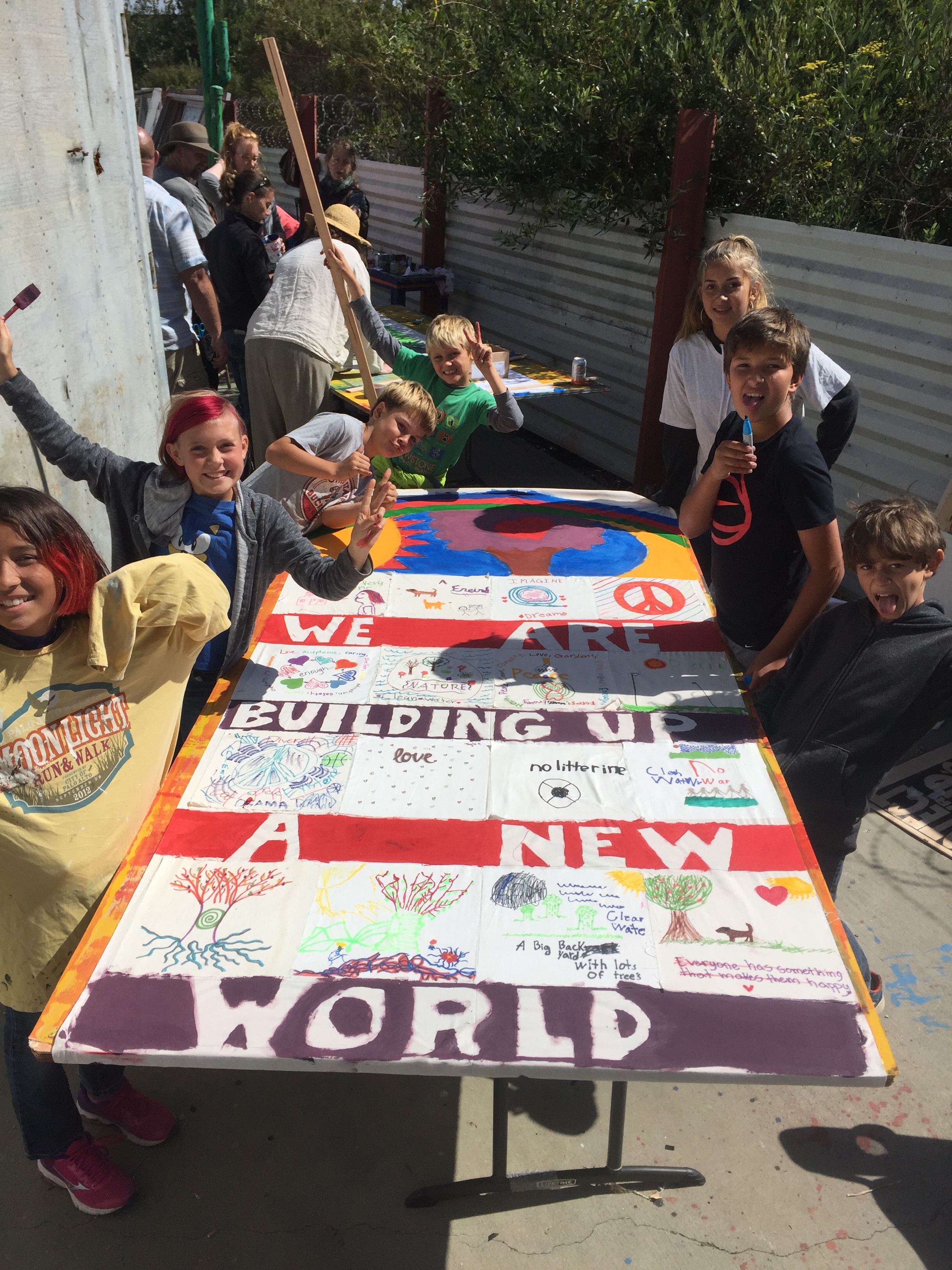
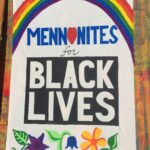
When we were working on our art creation yesterday David noted that we were moving at a fast clip. He said what we accomplished in four hours usually takes groups at least a couple of days. As I’ve thought more about that since then, I realized we could work quickly since we trust each other. We have a sense of who we are as a community and an understanding of what we want to be about in the world. This is a powerful gift we posses. Our commitment to each other and to the way of Jesus, which is hard work at times, empowers us to mobilize with skill and agility when circumstances demand it.
You could say we were walking in the way of righteousness as we made the banners. We were creating righteous art. The Hebrew word for righteousness is about right relationship and walking in the way of God. Whereas a lot of Christianity has interpreted righteousness as a strict moral code… like, “I don’t do that or that or that… therefore I’m righteous,” the Hebrew points more to a way of being in the world that results in shalom. Being a righteous people is about being a people in right relationship with each other and with the Divine.
One Hebrew scholar pointed out that this idea of righteousness being a path makes sense to the nomadic people for which it was written. As a people who traveled circuits through the wilderness, they knew that if someone got off the path they could be lost to hunger, thirst or predators. To stay alive one had to be on the right path.
What is our call on the path of righteousness today? What relationships are broken? What needs to be made right? Again this week one answer is very clear, the relationships across racial lines are broken and further shattering. No amount of political correctness can bandage this wound. We must work for healing by addressing the deep roots of white supremacy in this country.
Even prior to the violent chaos of Charlottesville, I was thinking a lot about this. I’m still working on my Vincent Harding book, which will be titled “The Movement Makes Us Human.” The title is based on a quote from him in the interview. In one of the chapters we talk about whiteness and the potential gifts of whiteness in the work of racial healing. I found his words challenging in 2011 when we had the conversation and still challenging now.
He said, “I remember, one year I was teaching and we were dealing with a lot of the terminology that was coming out of the Black Power period. And people were talking in the churches about the “gift of Blackness.” And I asked my predominantly white class, how would they describe the “gift of whiteness?” Or, is it only Black people who are gifted in their racial, cultural identity. Is there any gift to whiteness? They had some struggles over that one. Some of them started out with seeing it only as a curse and not a gift. And if it’s not a gift, what kind of a God is this?”
Whereas the movement teaches us how to be human by breaking through the barrier of racial division, white supremacy dehumanizes us. It is the body of death from which all people need liberation. White supremacy is the curse, not white people.
Vincent Harding’s wisdom points towards an approach that invites people and communities to learn to be in right relationship by taking up an appropriate amount of space. “The fear,” he said, “that is deeply engrained now in white America is the fear of not being able to set the agenda anymore and having to work out some kind of collaboration, real collaboration that would requires everybody to make adjustments.”
White supremacy is lethal and unnatural, because it assumes that whiteness gets to take up all the space, be seen as normal and set every agenda. If that is not happening then white supremacy declares that white people are under attack. In its inhumanity white supremacy has stripped away the cultural and ethnic histories of people now considered white. It has erased their ancestral wisdom and cut them off from knowing their origin stories while offering the lie of superiority in exchange.
In the interview Dr. Harding talked about his experience with Mennonites during the era of the Southern Freedom Movement. He said he became increasing uncomfortable with the feeling of being someone’s Negro. “There was probably some sense,” he said, “among some Mennonites that, ‘This is our Negro. And we’re just happy to have him talking to us even though we don’t always listen. But you know, he’s talking to us.’”
This is an example of Mennonites centering and normalizing whiteness. He was allowed to be present but was not allowed to set the agenda, since his perspective was usually “too radical” as a person of color. But Mennonites still wanted him around because it made them feel like they weren’t racist like other white people.
So what would righteousness look like in this case? How does one move toward right relationship? I think it starts with self-reflection… how might I or we be perpetuating that which we’re seeking to undo? And then figuring out to whom we are accountable on the journey of righteousness… the journey of becoming human.
“Part of the essence of nonviolent struggle at its best,” he reflected “is seeking to transform our own ways of thinking… Not only the structures of oppression go up in flame, but our own internal structures of oppression need to be set on fire as well.”
My experience of accountability has been powerful as friends of color have named the ways I center and normalize whiteness. It is a gift to have people in my life who are willing to take the risk to invite me into a deeper humanity by challenging my racism. It is painful and messy and transformative.
For those who are white, there is a great opportunity to untangle being white from white supremacy. How different of a conversation it would be if the white people who gathered in Charlottesville were angry at white supremacy for cutting them off from their ethnic heritage and ancestral wisdom. As they were chanting “You will not replace us” their pain was screaming, “We have been dehumanized by trading our histories for white supremacy. We don’t know who we are.” There is deep pain and insecurity when people act out in these ways.
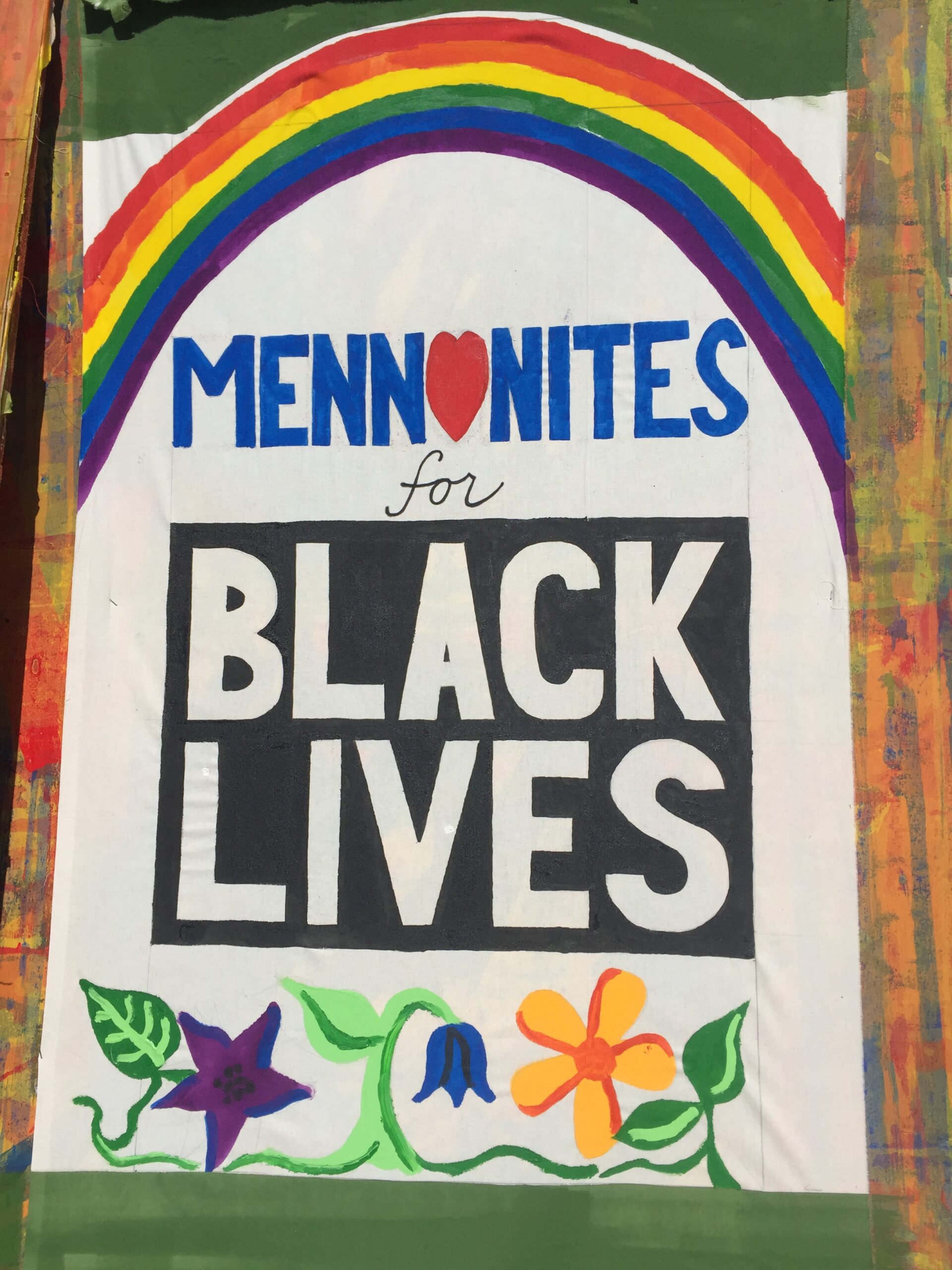
So part of the path of righteousness is understanding the pain. Some are called to speak to that pain and come alongside white people who are misdirecting their rage. Another part of the path is knowing our histories and ethnicities whether we are white or people of color, so that white supremacy cannot define us. Another part is embodying the world we know is possible. Our banners articulate this: Mennonites for Black Lives; No Ban, No Wall; We Are Building Up a New World; First Mennonite Church of San Francisco in Solidarity. Yet another part might be mobilizing together as a community for justice, as we did when we were creating the art. We carry with us the gift of community that empowers us to act boldly.
I want us to take a moment to reflect on what this means, both as individuals and as a community. I know there’s a lot to chew on. We’ll listen to a song by Sweet Honey in the Rock and as we do. I invite you to listen for what the Spirit is saying.
Play, “Beatitudes”
The Beatitudes were one way Jesus was teaching people to be human. Jesus walked in the way of righteousness. Our Anabaptist foreparts walked in the way of righteousness. Harriet Tubman walked in the way of righteousness. Fannie Lou Hamer walked in the way of righteousness. Coretta Scott King walked in the way of righteousness. Dolores Huerta walks in the way of righteousness. Winona LaDuke walks in the way of righteousness. We walk in the way of righteousness.
Sometimes it is a struggle. Sometimes we’re tired. Sometimes it’s overwhelming. And sometimes we have dance parties with our best friend over WhatsApp video because that’s what lifts our spirits enough to write a sermon. Or maybe, that last one is just me yesterday evening. But I’m totally up for doing it again, if anyone is interested. We have been given the gift of life during this time in history, so let’s be alive!
Vincent Harding would often say that if we keep hungering and thirsting for the right way, for righteousness, that we would be filled. Let’s be a righteous people together. Amen.