
Sermon: These Are Their Names
Matthew 9:35–10:4
There is a beach in Waikiki — one of the most commercialized stretches of sand on earth— where four large stones sit behind an iron fence. I’m guessing most people walk past them without a second glance. The only reason I know of them is because Sarah Rezny told me about them and the story behind them.
More than five hundred years ago, four healers traveled from Tahiti to the shores of Oahu. Their names were Kapaemahu, Kapuni, Kinohi, and Kahaloa. They were mahu — people of dual male and female mind, heart, and spirit. In Hawaiian and Polynesian culture, this duality was not incidental to their gift. It was understood as the source of it. They were beloved for their gentle ways. They traveled throughout the islands and healed the sick using a variety of methods. When they finally departed, the people placed four stones on the shore of Waikiki, one for each healer. According to the tradition, the healers transferred their spiritual and healing power into those stones before they left.
Then Christian missionaries arrived, and the story was suppressed. The mahu were pushed to the margins. The role of gender fluidity in Hawaiian culture was erased. And eventually, in 1941, a bowling alley was built directly over the stones. They were buried for two decades, but later recovered by Hawaiian elders after the bowling alley was demolished. They are there now, if you know to look.
I begin here not as a detour from our scripture, but as a way of opening our ears to it, because the story you are about to hear also talks about healing and about the transmission of healing power to specific, named people.
“Then Jesus went about all the cities and villages, teaching in their synagogues and proclaiming the good news of the kindom and curing every disease and every sickness.”
Some of us may have heard this passage or one like it so many times that it has become almost scriptural wallpaper. So I want to slow down and ask a question that perhaps we don’t ask often enough: How? How did Jesus cure every disease and every sickness?
Polynesian Indigenous cosmology has a concept called mana — a foundational spiritual energy and life force that permeates the universe. A person can possess mana, be a conduit of it. It is not magic. It is an inherited or cultivated spiritual authority, deepened through practice. For healers, it can be deepened through immersion in the knowledge and craft of healing, through working with the body’s more subtle energies, through knowledge of herbal remedies, through ceremony and song, through healing touch.
I have met people with healing mana. I have felt it in their presence. And I believe Jesus had it. When people like this heal in ways that seem miraculous to Western eyes, perhaps it is not that the laws of nature have been suspended. Perhaps it is that we are witnessing dimensions of reality our biomedical framework wasn’t built to see.
I also think it’s really important to understand that healing in the world Jesus inhabited means something different from how our culture tends to view healing. In the ancient Jewish world, illness was never just a private, physical problem. To be sick was to be diminished — in body and energy, but also in one’s capacity to participate fully in the life of the community because your body could no longer show up fully for the rhythm of work and worship and celebration that wove people together. A person could also be sick because the society around them was sick. So to transform that society was also to heal sick bodies and minds.
So to heal someone was therefore never just to fix a body. It was to restore them to relationship, to reweave them into the fabric of community life, to bring their society into right relationship. Healing was always physical, social, and spiritual. Jesus is healing within this wholistic understanding.
When Jesus saw the crowds, he had compassion for them, because they were harassed and helpless, like sheep without a shepherd.”
The Greek word for compassion here is splanchnizomai. It is one of the most physical words in the New Testament. It comes from splanchna, which means the intestines, the bowels, the viscera. What it describes is not a polite feeling of concern but a gut-wrenching, body-level response to the suffering of another. Jesus sees the crowds — harassed and helpless — and something moves in his depths. It’s like his body responds before his mind decides anything.
I think this matters for understanding how Jesus healed. He was not operating within a system designed for efficiency and clinical distance, the kind of system our modern healthcare workers have to navigate, often against their own instincts. He was someone whose nervous system was permeable to the suffering around him. He let it move him. Many healing traditions understand this kind of embodied compassion not as a precondition to healing but as part of the healing itself. To be truly seen, truly received, by another who does not flinch from your pain is already medicine.
“Then Jesus said to his disciples: The harvest is plentiful, but the laborers are few; therefore ask the God of the harvest to send out laborers into the harvest.’
Notice the sequence. Jesus has just been moved in his gut by what he sees. But he doesn’t immediately act. He tells his disciples to pray, to ask the God of the harvest to send laborers. Prayer comes before action. The disciples must first orient themselves toward the Source before they can become conduits of it. Only then does Jesus summon his disciples and give them authority.
Then Jesus summoned his twelve disciples and gave them authority over unclean spirits, to cast them out, and to cure every disease and every sickness.
The Greek word here for authority is exousia. We translate it as authority, but it is not the authority of a credential or a granting of institutional permission. Exousia is more like a capacity that flows from one’s being, an authority that arises from who you are and what you are aligned with. It is closer to what we might mean when we say someone has a presence that heals. This exousia is also something that can be transmitted to other people through the person that has this kind of presence.
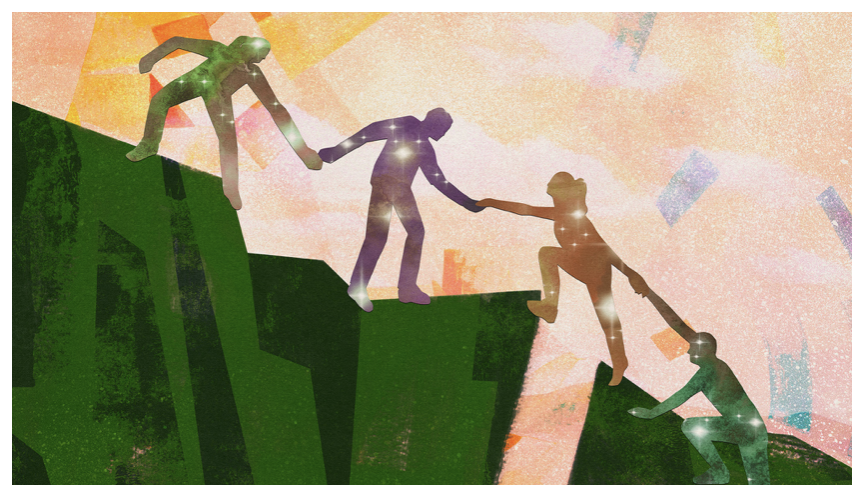
Jesus is not deputizing the disciples, he is drawing them into participation in the same Reality he inhabits. He is saying: “You can access this Source, too. The compassion that moves in my gut — you can let it move in yours. The exousia that flows through me — it can flow through you.”
Keep in mind these disciples are not religious leaders or trained healers. They are not people, like Jesus, known for having this incredible spiritual charisma. They are fishermen, tax collectors, ordinary people. One of them will betray Jesus. Matthew makes sure we know that from the beginning. The exousia is given to this very human, very complicated, very particular group of people not because they are exceptional, but because they are willing to follow Jesus and are willing to be sent by him.
These are the names of the twelve apostles: first, Simon, also known as Peter, and his brother Andrew; James son of Zebedee, and his brother John; Philip and Bartholomew; Thomas and Matthew the tax collector; James son of Alphaeus, and Thaddaeus; Simon the Cananaean, and Judas Iscariot, the one who betrayed him.
Matthew now does something that seems almost administrative, but is actually a statement about how God works in the world. He lists the disciples with this exousia, the ones who will be sent. By name. Every one. This recitation declares that the healing authority of God does not travel through abstractions. It moves through specific, named, flawed, beloved people, people with histories and siblings complications and shadows.
The Tahitian healing tradition understood this too. The healers were not nameless conduits. They were Kapaemahu, Kapuni, Kinohi, Kahaloa. Named. Specific. So specific that when it was time to leave, they spent a full cycle of the moon fasting, praying, chanting, and by so doing transferring their very names, and their healing power, into the four great stones.
So I want to end by doing what Matthew does. I want to name those people who have been given authority to heal and proclaim. I invite you to turn to the person next to you and say their name.
You may think you don’t have the authority to heal. But you do. I have seen you do it.
I have seen you listen without turning away as someone shares the story of their suffering. I have seen you put your hand on the shoulder of someone who is grieving or hold them as they cry. I have seen you care for someone recovering from surgery — bringing food, helping them walk, doing their laundry. I have seen you sing and record a favorite hymn for someone who hasn’t been able to get to church for months. I have seen you help pass measures that help Latina seniors have access to affordable housing.
In all these ways, you have exercised your authority to heal — not merely to cure a sick body, but to lift someone’s spirit when they could have sunk into despair, to knit them back into the life of this community when they could have felt very alone, to enact laws that help heal society.
And if you need more evidence — look no further than the prayers of the people from almost any Sunday. Each one is a window into your healing work.
For instance, Stephanie and Kinari came before us carrying the weight of a melanoma diagnosis, and we held them in prayer for many week. Last Sunday, we learned that Stephanie’s surgery got all of the melanoma. She is healing well.
Karen asked us to pray for Frank — her literacy student for twelve years — as he navigates the legal system and searches for work. And then Karen and Sharon accompanied Frank to his court hearing the next day. Twelve years of sitting with someone, teaching them to read. Walking with him into a courtroom. Could you imagine how frightened and alone he might have felt without them? If that is not healing, I do not know what is.
You have this healing authority not because you are exceptional, but because you know that healing is much more than a cured body. Because you are trying to follow Jesus and are willing to be sent. Because you show up when there is pain and need. Because you willing to be moved. Because the harvest is plentiful and the laborers are needed, and here we are, the ones willing to work.
Thanks be to God