Sermon: Jesus believes in us
Matthew 14:22-33
In the neighborhood where I grew up in Ohio there was a cul-de-sac on our street where we would often play. After a rain storm a big puddle would form on one edge of the cul-de-sac and we loved to splash around in it.
When I was probably around seven years old I heard this story about Jesus walking on water for the first time. I thought to myself, “I have a lot of faith and I believe that Jesus is the Son of God, so I’m going to walk across the puddle, and I won’t sink like Peter did.” I clearly remember standing at the edge of the puddle and preparing myself. Then I stepped on the water and… my foot went right down to the asphalt.
I was so disappointed, especially in myself for not having enough faith. Given how this story is traditionally interpreted, it kind of sets people up for failure. As a seven year old, I had all the key ingredients. I had faith like a child (which is what Jesus encourages us to have) and I truly believed with all my heart that Jesus was the Son of God.
I don’t remember processing this experience with anyone when I was a kid. So it’s interesting to now consider other angles through which to understand this story. Specifically, I want to wrestle with the larger context in which the story is found as well as the ecology of the story.
Some of you may remember that a couple years ago Sheri and I did an Eastertide sermon series we called Rewilding Jesus. The goal of the series was to unearth feral images and ideas about Jesus who was a Jewish prophet deeply rooted in his place and community and who was undomesticated by Empire.
I read through those sermons again in preparation for this Sunday, and commend them to you. They speak of Jesus as the bread of life and the true vine – a source of sustenance not just for our souls but for our bodies as well. He went away from cities, temples, and even villages into the wilderness to be reshaped (or decolonized one could say) by the Creator. He followed in the footsteps of his feral cousin John the Baptist, who ate bugs and wild honey.
He was designated in the gospel of John as the Word. “In the beginning was the Word, and the Word was with God, and the Word was God.” The Word translates to Logos in Greek and to Hokmah in Hebrew. Hokmah is the embodiment of wisdom, and is gendered as female. Hokmah “is the whole of wild nature, the Great Mother.” She is the grand ecosystem of earth in all her swarming, teeming, flowing, erupting vastness. In Jewish cosmology, Hokmah was present as all creation was born. And we are told in the gospels that Jesus is Hokmah embodied. Or as I said in the rewilding series, Jesus is Lady Wisdom in drag.
To craft the rewilding sermons and this sermon, I was in conversation with my friend Jim Perkinson, who is a poet and biblical scholar living in Detroit. I was pleased to get to see him and his spouse Lily, in person, when I officiated the wedding of our mutual friend, Tim Nafziger, in late July.
Jim has written many books, including his most recent in 2024 titled “Political Spirituality in the Face of Climate Collapse: Of Monsters, Megaliths, Mules, and Muck.” We talked last week about how to re-wild this story and recognize Jesus as the feral prophet that he was.
Jim suggested viewing this story as a parable since parables can have a lot of different meanings. The broader context (of chapter 14) begins with the grizzly story of John the Baptist being beheaded by Herod. And interestingly, Herod being haunted by that choice. He thinks Jesus might be John returned from the dead, which according to him is what gives Jesus miraculous powers.
Jim noted that in Indigenous and traditional cultures, when a person dies an unnatural or violent death, and they are not buried with due respect, they will haunt the living. This most likely was on Herod’s mind.
Upon hearing the news of John’s murder, Jesus withdraws to a deserted place to grieve his cousin and teacher. Not only had he lost someone dear to him, but he also would have felt the heightened threat to himself and to the movement.
He is not afforded much alone time though, since the crowds find him in the deserted place. Even in his grief he has compassion on them – these people experiencing the violence of occupation in their bodies. They would have not searched for him if they were not desperate. He heals them and finds a way for these thousands of hungry people to be fed. Last week we discussed that story together.
After all are fed he sends the crowds away, and demands the disciples get in a boat to cross the sea. They don’t want to do this, or else he wouldn’t have had to demand it. Meanwhile he goes up the mountain by himself to pray, which is a practice for him. Going up the mountain, Jim noted, is a nod to the Hebrew people (having been freed from slavery in Egypt) encountering God’s presence on the mountain. Jesus always opts to pray in the mountains rather than in temples.
Meanwhile the disciples are freaking out in the boat because there’s a storm on the water. In the gospels, the disciples consistently experience fear when crossing the sea. They could be concerned about crossing to a gentile region since they believe Jesus’ movement is only for them. Or the crossing could bring them closer to where Herod is located. They don’t want to go there since Herod just killed a prominent leader in their movement. Overall, the storm could represent whatever fear they are feeling about encountering the other.
When Jesus finally comes to them on the water, they think he’s a ghost, which could recall the possibility of him being John’s ghost (according to Herod). In any case, this prophetic movement will continue to haunt the imperial order.
Jesus says, “it is I” which is actually translated “I AM,” the same name that God uses when speaking to Moses in the burning bush. Jim reflected, “Could it be that Moses became so ecologically connected to the land of Midian that he could hear a plant speak?” Truly, there are people throughout history, and even today that communicate with plants. To me this is only possible outside the colonizing paradigm of empire, which instills in us that we are separate and above the ecosystems that support and nurture our lives.
This ecological connectedness Moses nurtured as a shepherd of Midian, greatly contrasted the extractive Egyptian economy. Moses’ rewilding (remember he grew up in Pharaoh’s house) gave him the power and clarity to lead the Hebrew people out of slavery and toward collective rewilding in the wilderness.
So Jesus saying he is I AM communicates his oneness with the elements – the wind, the rain, the storm – and with the Creator. Remember he is Hokmah embodied – the firstborn of creation.
Proverbs 8 speaks of Hokmah in these terms:
YHWH gave birth to me at the beginning,
before the first acts of creation.
I have been from everlasting,
in the beginning, before the world began.
Before the deep seas, I was brought forth,
before there were foundations or springs of water;
before the mountains erupted up into place,
before the hills, I was born–
before God created the earth or its fields,
or even the first clods of dirt.
I was there when the Almighty created the heavens,
and set the clouds in the sky,
and established the springs of the deep,
gave the seas their boundaries
and set their limits at the shoreline.
When the foundation of the earth was laid out,
I was the skilled artisan standing next to the Almighty.
I was God’s delight day after day,
rejoicing at being in God’s presence continually,
rejoicing in the world,
and delighting in humankind.
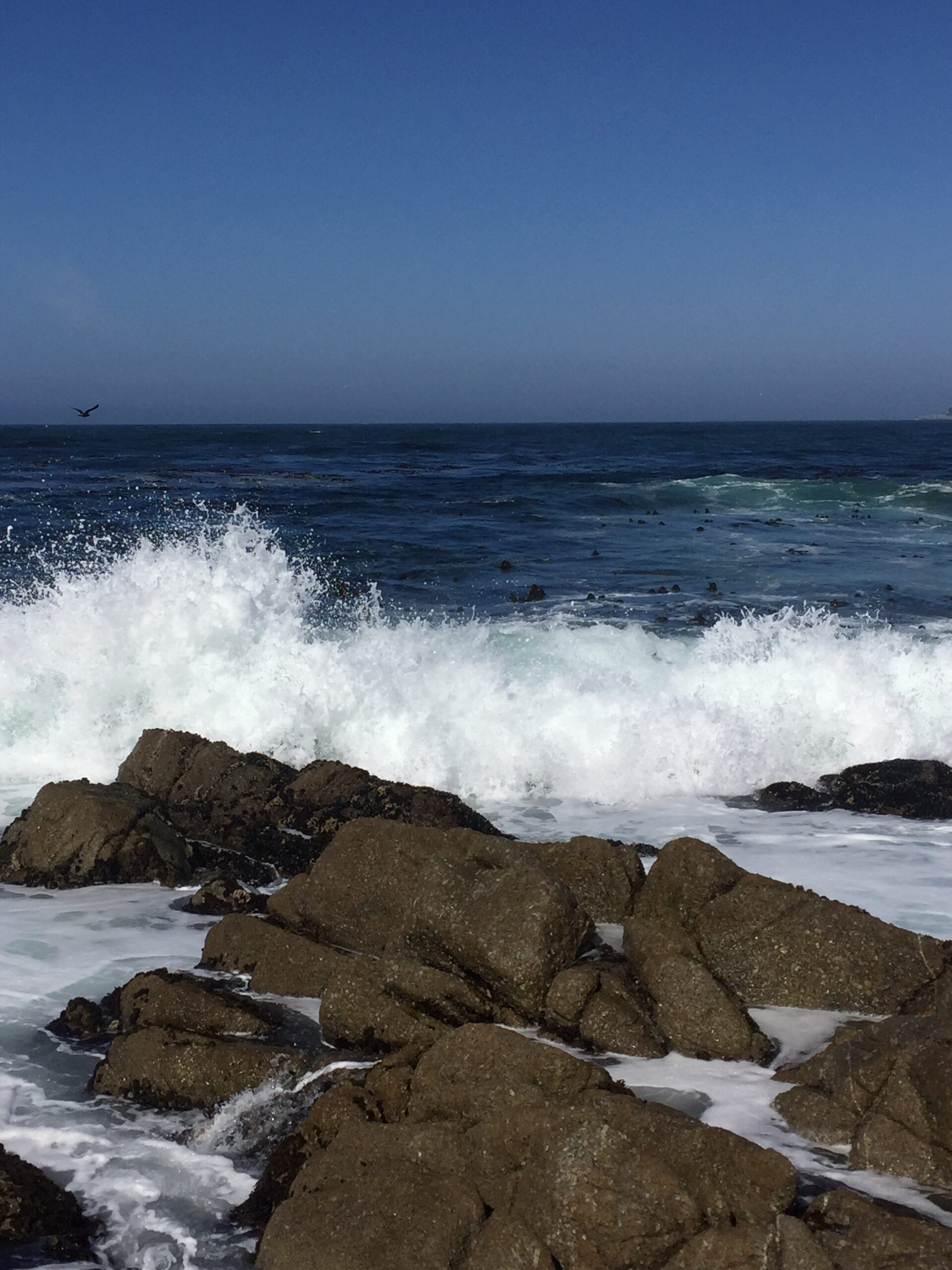
So I am going to assert that Peter recognizes Jesus as Hokmah embodied in that storm and he wants to embody it as well. Of course Jesus is like “go for it!” This is what Jesus wants for all people. To be rewilded, to be restored to the family of creation. To listen to the trees, to recognize the divine in rocks and the water that washes over them.
But after a couple steps Peter doubts himself and begins to sink. Jesus’ rebuke then is not that Peter did not have faith in him – Jesus as savior. No, Jesus is disappointed because Peter didn’t trust his own connectedness to creation, to the creative power of the storm, to the lineage of Hokmah – the wild wind on the water when creation was born.
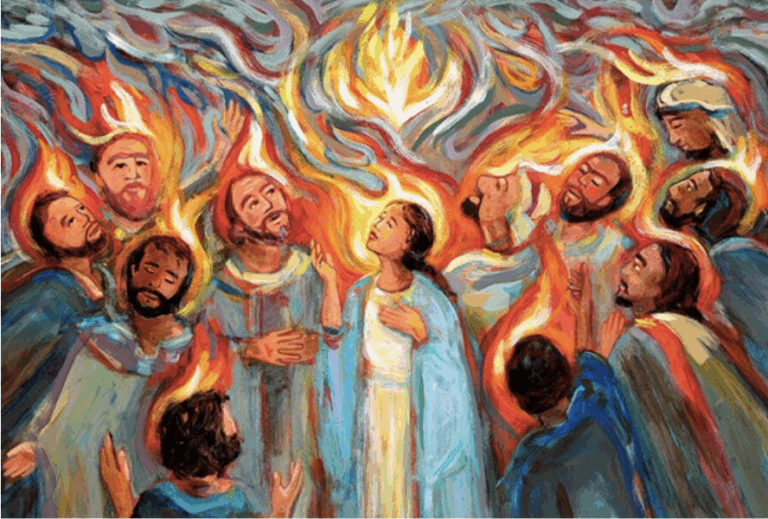
This indeed was an encounter with the other on the water. Jesus as Hokmah in human form. Jesus embodying a way beyond the bounds of empire. Jesus as an elemental force, much like the Holy Spirit coming in the form of fire.
In rewilding this story we see Jesus as part of the ecosystem. He is one with creation and from that oneness, I believe, flows his healing power and his ability to be in the storm rather than overcome by it. This is what he wants for his disciples as well. This is the call to discipleship – to live into this truth of our connectedness to the Creator – to recognize ourselves held in the web of life.
This path of discipleship is an invitation to live in right relationship with our own bodies, and with each other, and with creation. This is a path we walk our whole lives long and we can’t do it without community. It took the Hebrew people no less than 40 years to decolonize themselves in the wilderness, and even then they still struggled to live as a liberated community.
When I think back to my seven year old self, very disappointed standing in the puddle, I know what to say to her now. I would say, keep playing in the puddles. Keep climbing trees and getting to know the worms in the sandbox. God is in the rain and in the trees and in the worms.
God is all around you, just as much as God is in church. Sing praise songs in the forest and feel God’s presence in the wind. God does not need you to walk on water to prove your faith. God wants you to have faith in yourself, as a beloved creature in the web of life.
I invite you to take from this story whatever message you need to encourage your discipleship today. It may be that Jesus takes time to grieve the death of a loved one. It may be that Jesus demonstrates compassion even when exhausted. It may be that Jesus asks the disciples to do hard things. It may be that Jesus goes to the mountain alone to pray. It may be that Jesus is one with the storm. It may be that Jesus reaches out his hand when we forget our connectedness. It may be that we are called to have faith in ourselves, as beloved creatures. It may be that we are made for community – that we are part of the web of life. It may be that we are in this together, for the long haul.
Spirit of the living God, fall afresh on us – that we may know and feel the power of your presence at work within us and in our world, even in the midst of the storm. Amen.