Sermon: Burning hearts on the road to emmaus
Luke 24:13-35
On that same day two disciples were traveling to a village called Emmaus, about seven miles from Jerusalem, and talking with each other about all these things that had happened. While they were talking and discussing, Jesus himself came near and walked with them, but their eyes were kept from recognizing him.
This passage begins with a reference to what came before. “On that same day” it says. Turns out, it was a very significant day. It was the day that Mary Magdalene, Joanna, and Mary the mother of James found the empty tomb. It was the day of resurrection, but these two disciples were walking away from Jerusalem.
It’s probably even more accurate to say they were fleeing Jerusalem, and watching their backs on the road lest they were followed. They were well aware of Rome’s cruelty toward dissident movements, and did not want to suffer the same fate as their teacher.
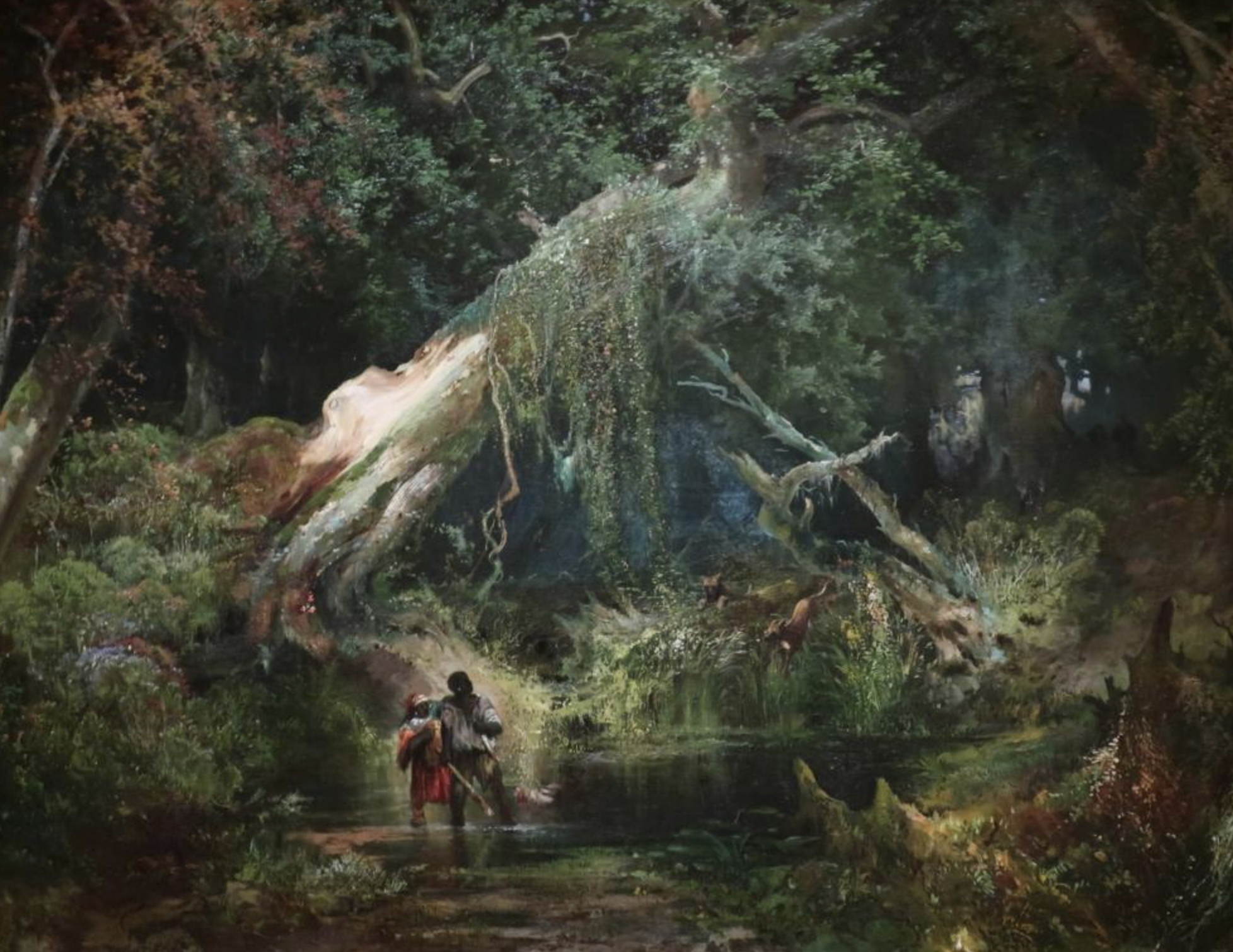
In his book, “Healing Affluenza and Resisting Plutocracy,” Ched Myers likens these disciples to people trying to evade slave catchers in the American South. If you look on the Order of Worship today, you’ll see an artistic rendering of that journey. You see two people wading in the water, as Harriet Tubman’s song instructed them to do, to throw the dogs off their scent. This journey to Emmaus was no leisurely stroll through the countryside, it was an escape.
Ched writes, “These terrified movement members were likely blaming each other for the mess they’d gotten into, wondering what their next move might be, lamenting Roman kangaroo justice, cursing the colonizers—and maybe even cursing Jesus for failing to deliver on the promises of the new social order.”
A contemporary analogy would be the days immediately following the assasination of Martin Luther King Jr. The movement was reeling with grief and questions about how this could have possibly happened, and who might be next on the hit list. These disciples were seeking somewhere safe outside of Jerusalem so they could lie low for a while. They were also incredulous that the person joining them on the road to safety didn’t know what had happened.
Jesus said to them, “What are you discussing with each other while you walk along?” They stood still, looking sad. Then one of them, whose name was Cleopas, answered him, “Are you the only stranger in Jerusalem who does not know the things that have taken place there?” He asked them, “What things?” They replied, “The things about Jesus of Nazareth, who was a prophet mighty in deed and word before God and all the people, and how our leaders handed him over to the Romans to be condemned to death and crucified. But we had hoped that he was the one to set our people free. Yes, and besides all this, it is now the third day since these things took place. Moreover, some women of our group astounded us. They were at the tomb early this morning, and when they did not find his body there they came back and told us that they had indeed seen a vision of angels who said that he was alive. Some of those who were with us went to the tomb and found it just as the women had said, but they did not see him.”
Then Jesus said to them, “Oh, how foolish you are and how slow of heart to believe all that the prophets have declared! Was it not necessary that the Messiah should suffer these things and then enter into glory?” Then beginning with Moses and all the prophets, Jesus interpreted to them the things about himself in the scriptures.
With this response Jesus squarely identified himself within the prophetic lineage. And mind you, these disciples still don’t recognize him. Maybe it’s because he was disfigured from the abuse he endured.
I want to do a little pop quiz. If you were here in the last couple years, you will remember we used the narrative lectionary and preached through the story of the bible, beginning with Genesis. Does anyone remember the original instructions that were given to Abraham and Sarah?
They were to be a blessing to all the families of the earth. And why did the prophets show up in the story? Because the people were not being a blessing to all the families of the earth. How did the prophets feel about the kings? Didn’t like them because they were not following the original instructions. And what did the kings usually do to the prophets? They killed them or got rid of them in whatever ways they could.
The gospel of Luke, over and over again, identifies Jesus within the lineage of the prophets as he confronts people with wealth and power – like Zaccheus, who repents and joins his movement. When Zaccheus repents and divests of his profiteering, Jesus says, “today salvation has come to your house.” This is interesting because Jesus has not yet been resurrected.
“Luke insists,” Ched writes, “that it is only the scriptural vision of justice (Moses and the prophets), not the resurrection that can convince or persuade people to repent.” You may remember from last year, the bible study on the rich man and Lazarus, who was a beggar. This story, which comes earlier in Luke, foreshadows Jesus’ input on the road to Emmaus.
In a nutshell, the rich man dies and goes to hell and then asks Abraham to resurrect Lazarus, who went to heaven, so Lazarus can warn the rich man’s family of their fate if they don’t repent. In response Abraham says, “If they do not listen to Moses and the prophets, neither will they be convinced even if someone rises from the dead.”
Dominant Christianity, in its service to empire, erases this truth at the heart of the gospel – the execution of Jesus at the hands of Rome is the direct result of him building a prophetic movement of liberation. Dominant Christianity makes Jesus’ death and resurrection the reason for his life and salvation a personal choice separated from the material world. If we understand the story of scripture and the prophetic tradition that flows through it, we know that Jesus’ death was not required by God, but it was inevitable given what the State is, as history repeatedly reveals.
This is the same State violence that killed our spiritual ancestors, the Anabaptists. It is the same state violence that demonized women as witches. This is the same State violence that blessed the Christian colonization of these lands and justified the genocide of Indigenous people. It’s the same state violence that killed Martin Luther King Jr. and Fred Hampton. It’s the same state violence that declares the war on Iran a holy war, ushering in armageddon.
Therefore, building biblical literacy in the prophetic tradition is key for discipleship, so that we are not overwhelmed and immobilized by the violence of the State. On the road to Emmaus, Jesus models this approach by taking the time to remind the fearful disciples of the prophetic tradition. And there was so much to cover that he talked until sunset.
As they came near the village to which they were going, he walked ahead as if he were going on. But they urged him strongly, saying, “Stay with us, because it is almost evening and the day is now nearly over.” So he went in to stay with them. When he was at the table with them, he took bread, blessed and broke it, and gave it to them. Then their eyes were opened, and they recognized him, and he vanished from their sight. They said to each other, “Were not our hearts burning within us while he was talking to us on the road, while he was opening the scriptures to us?” That same hour they got up and returned to Jerusalem, and they found the eleven and their companions gathered together. They were saying, “The Lord has risen indeed, and he has appeared to Simon!” Then they told what had happened on the road and how he had been made known to them in the breaking of the bread.
This ending to the story is quite a reversal. These disciples who were fearfully fleeing, turn around – which is another way of talking about repentance. They turn around and courageously head back to Jerusalem to re-join their movement family.
The disciples proclaim that their hearts were burning as Jesus opened the stories in scripture to them. Ched writes that this verb for open, is exclusively used in the Gospels to refer to opening deaf ears, unseeing eyes, and a hardened heart. This story powerfully communicates that even in the midst of traumatic events (which are inevitable for prophets), that God’s presence breaks through fear, and liberates our minds and hearts to carry on the prophetic work. These stories of the prophets enlivened and encouraged the disciples – reminding them of the great cloud of witnesses surrounding them.
In her Easter sermon Sheri held space for the weight of grief, while exhorting us to notice new life within and all around us. These disciples on the road were so grief-laden that they couldn’t possibly believe that Jesus was alive, and that the movement would continue. The violence of the state had succeeded in shutting them down.
So Jesus met them in their grief and fear and told them stories of faithful witness in the face of death. He told them stories of steadfast resistance and joyful hope. He opened their hearts to the truth that the prophetic tradition lived on through them.
Along with the stories of scripture, what are the stories of steadfast resistance and joyful hope that ground us? What are the stories of courage that inspire our witness? Who are the ancestors, biological and spiritual, that make up our great cloud of witnesses?
In closing I offer you this story. When I was in Minneapolis for the week of action at the end of February I participated in some conference sessions. During one session we had small group conversations and I mentioned I was a Mennonite pastor when I introduced myself. Following the session, the woman sitting beside me asked if I had been in Washington DC for action in January of 2024 when a bunch of Mennonites got arrested calling for ceasefire.
I said I hadn’t been there, but someone from my congregation was – Seth, who was an MVSer at the time. This woman went on to tell me that when she first saw the video of that action on Instagram she burst into tears. She said it was so moving to hear the beautiful singing and see Christians taking action for Palestine. She wasn’t otherwise familiar with Mennonites, but she saved that video and would watch it whenever she needed encouragement. She told me that every time she watched it she was brought to tears by the power of our witness as Mennonites.
Let us tell these stories to each other when fear tries to gain a foothold. Let us honor the ancestors who have shown us the way. Let us recognize ourselves as a part of this prophetic lineage. Even the shadow of death, new life is springing forth! Amen.