
Sermon: The Automatic Earth
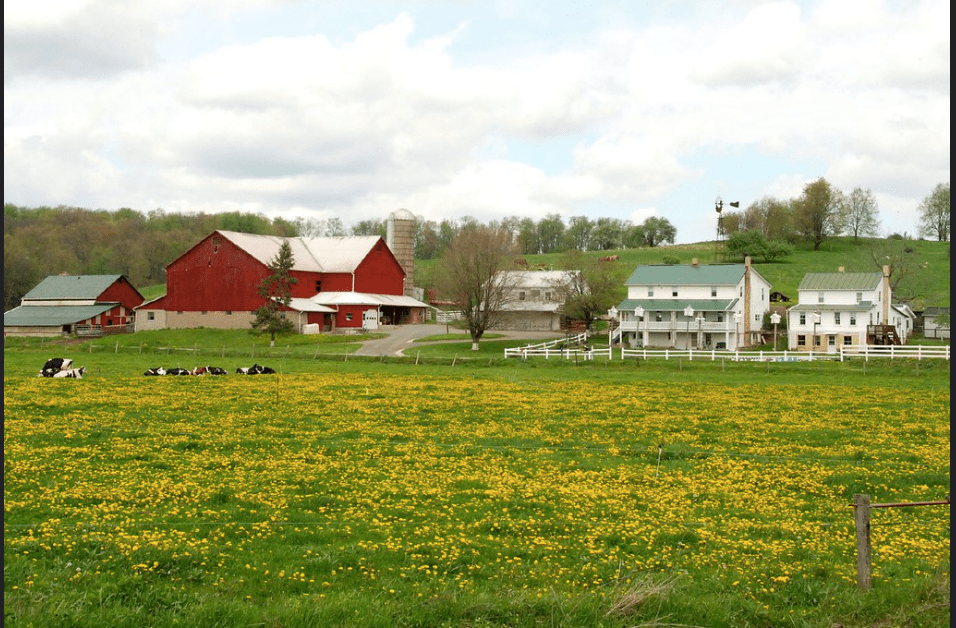
The photos above is of an Amish farm near Sheri’s home in Ohio. This sermon is based on Mark 4:26-34.
I loved reading Frog and Toad stories to Patrick when he was young. And my favorite Frog and Toad story was the one we just heard. If I were to psychoanalyze myself, I would say that the overfunctioner in me — especially the overfunctioning parent in me — recognized myself in Toad. My Inner Toad believes that it is not enough to plant a seed (or birth a child) and sit back and let the organic mystery of growth happen. My Inner Toad believes that I have to do things — many things — to make this mystery happen. I have to hover over my seed and anxiously watch it. Is it growing yet? Why not? If I yell louder, will that result in growth? Oh no! Why is my seed delayed in growing, according to the unrealistic timeline I have set for it? Something is wrong and certainly requires my intervention. Let’s read a book or go online or consult an expert. Just like Toad convinces himself that his seed is afraid to grow, I’ll come up with some story about why my seed isn’t growing and then focus all my efforts around that story. All this work and worry will exhaust me. It is such hard work.
Simply put, my Inner Toad does not trust in what she cannot control. My Inner Toad wants to be in control and assumes that if I am not in control, nothing else is. My Inner Toad thinks it’s all up to me.
So how many of us have an Inner Toad?
Thank God, Toad gets tired, exhausted by his exertions. Thank God, Toad falls asleep, and while he is sleeping, the mystery of the seed unfolds. Of course, when he wakes up and witnesses this mystery, Toad still thinks it happened because of his useless worry and work.
What a contrast to the gardener in our first parable for today. (And, by the way, I’m only going to be focusing on this first parable in this sermon and then preach on the second one about the mustard seed next Sunday.) This gardener in this parable is held up as a kind of role model of how to “produce results” in the kingdom of God. Our kingdom gardener doesn’t carefully choose the site where she will plant each and every seed; she scatters them on the ground! She doesn’t analyze the soil or consult an agronomist or anxiously wonder if this is absolutely the best site for planting. She flings her seeds with abandon. Something will sprout, or it won’t. It is not under her control. The earth produces of itself, our parable says, first the stalk, then the head, then the full grain in the head. The whole process of bearing fruit is not under the gardener’s control. In fact, the Greek word that is used for the phrase “produces of itself,” could be translated as automated. It’s the root of our word automatic. So, it’s the automated earth or the automatic earth. It’s a word that emphasizes the gardener’s “complete lack of engineering or even participation in this fruit-bearing.” (Quote from here.) Because of this letting go of control, because of this trust, the gardener can rest. She’s done her part! She’s scattered the seeds. Now, she can fall asleep and let the mystery unfold. What a contrast to my Inner Toad, who often wakes me up at 3 a.m. to worry about things, things usually beyond my control.
I was reminded of what it means to be a kingdom gardener when I was in Ohio recently. Years ago, I became friends with the Amish farmer, bishop, naturalist and author David Kline, who has been called a modern-day Henry Thoreau. David and his family have a 120-acre organic farm not far from where I grew up, and when I have visited him there, I have often thought that I am in the kindom of God. Nature is so alive there. (Angie and Tree’s backyard.) David knows the land and its creatures and respects natural processes so much. He has such a humble approach to his farming. There’s a German concept that is very important to the Amish, gelassenheit, and it means to be yielded to the will of God, to give up control, to surrender to something bigger than oneself. I would say that David practices gelassneheit in his farming. He doesn’t think he knows better than nature. He cooperates with natural processes, and what results is abundance — for him and his family, for the animals with whom he farms, for the insects that are not wiped out by pesticides, for the plentiful species of birds that live on this farm and eat the insects. I think you can hear a bit of this humble stance in this clip from a podcast, in which he was interviewed by his son, Mike (1:01:49-1:02:32).
The older I have gotten, the easier it has become for me to give up control — thank God! — or at least see it as an illusion. Maybe that’s because as I reflect back on my life, I see that the big things that have really determined the course of my life — like meeting my husband, like finding my vocation as a pastor, like meeting Sarah and starting the Coalition — these things didn’t happen as a result of my planning and strategizing. They happened to me. I couldn’t have engineered how my life unfolded! Knowing this helps me appreciate this parable even more. As one author commenting on this parable said: “The kingdom of God happens. It is organic. Although we can cooperate with the processes of God, we should never think we can control them. Thank God. Mystery will always triumph over our manipulation.” (Sadly, I can not find this reference!)
I love this. The overfunctioner in me breathes a sigh of relief. It is not all up to me. I am a part of a larger mystery beyond my control or comprehension. I’m only called to scatter the seeds and let the rest go. I’m called to trust that the Spirit is at work even when I can’t see it happening. The Spirit is alive in my son’s life, and I may never know — or may not know for years — how that Spirit was working. The Spirit is alive and at work in the world, and I may never know how the Spirit was working through the small things I do to help bring about the realm of God on earth. My obedience is to scatter the seeds. And while I am sleeping, while I am resting, the seeds sprout and grow. And while you are sleeping, while you are resting, the seeds sprout and grow. This is the kindom of God, according to Jesus. Thanks be to God.