
Sermon: Epiphany and the Holy Innocents
Matthew 2:1-18
Happy new year friends and have I got a story for you! I imagine many of you are familiar with the tale of the three kings or the magi. Thank you Kate for the lovely children’s rendition this morning. I’ve also preached on the magi and epiphany a few times, so I wasn’t initially sure what my angle would be this year.
Then I came across Richard Horsley’s book “The Liberation of Christmas: The Infancy Narratives in Social Context” and it totally blew my mind. In other words, I experienced an epiphany reading his account of the magi’s visit, and all the context surrounding it.
Richard Horsley is a biblical scholar who started publishing in the 1970s and his thinking has been very important to mentors of mine, such as Ched Myers. He wrote some of the first socio-political commentaries on the gospel narratives.
He argues that the story in Matthew 2 is much more than a cross-cultural religious encounter illuminating that the baby Jesus would be a saving presence for Jewish and Gentile people alike. The magi’s visit, he asserts, was at its core a politically subversive action, not just undercutting King Herod, but the entirety of Western imperialism.
So let’s begin with some context that the Christmas pageant version of the story leaves out. King Herod ran a brutal, paranoid, extractive surveillance state. This story comes near the end of his reign. The beginning was marked by his violent subjugation of Judea using Roman military forces. Having conquered the region he levied taxes on top of the double taxation the people were already paying to the Temple and to Rome. He used these taxes to construct cities, monuments, and buildings glorifying the power of Caesar and Rome.
For example, the city of Caesarea. You may have heard it mentioned in bible stories before. Caesarea was built during his reign in honor of Caesar. It had a large seaport, palaces, a theater, an amphitheater, and a colossal statue of the emperor, among other expensive architecture paid for by the taxation of Jewish peasants.
Herod also restored and enlarged the temple in Jerusalem, but this was far from an act of religious piety. Horsley notes that Herod claimed he rebuilt the Temple to thank God for giving him the kingdom to rule over and he also made messianic claims about himself. He used the temple as an instrument of his royal and imperial ideology which was anathema to Jewish religious practice. For example, he installed a giant golden eagle over the great gate of the Temple, which was doubly objectionable as a symbol of Roman domination as well as a violation of the commandment against images.
When a few revered Torah scholars and their students conspired to cut down the golden eagle Herod had them burned alive. All those who supported the conspirators were handed over to his executioners as well. He was ruthless, even killing loyal soldiers and their families for questioning his decisions. He murdered a couple of his own sons, fearing they had turned against him. Just before his death he also decreed that distinguished men from every village of the countryside be locked up and killed when he died so that quote: “all of Judea and every household will weep for me, whether they will or not.”
He executed high priests who were not loyal to him (or that he suspected of not being loyal to him) and installed those who would do his bidding.
Horsley reflects, “Herod the self-proclaimed ‘king of the Jews’ thus must have seemed to be the very paradigm of tyranny to his Jewish subjects… The story in Matthew 2 comes to life vividly against the background of Herodian exploitation. After suffering military conquest, economic impoverishment, violation of their traditional religious practices, and strictly repressive control of their lives under the utterly illegitimate king appointed by Rome, the people must have longed intensely for liberation.”
With all of this in mind, when the magi show up in Jerusalem, whether they went to Herod or not (the text isn’t clear along these lines) Herod would have found out about their presence rather immediately. The text says he was “troubled and all of Jerusalem with him.” Given the preceding context it’s clear that “all Jerusalem” is referring to the ruling class – installed by Herod himself.
Horsley notes, “As the traditional ruling class, now dependent on Roman power and Herod’s favor, the high priests and the scribes who worked in the Temple-state apparatus would have been “troubled,” to say the least, at news of any nascent challenge to Herod’s kingship.”
And it’s also important here to point out the anti-semetic trope that Christians have perpetuated through the centuries: that the Jewish people were rejecting baby Jesus due to being troubled by the magi’s search for the newborn king of the Jews. Quite the contrary. The majority of the Jewish population was longing for a messianic leader to help them break free from Rome’s tyranny that at that time was upheld by King Herod.
His priests and scribes, with fear and trembling I’m sure, advised Herod that the baby king was prophesied to be born in Bethlehem of Judea. Herod then secretly invited the magi to meet with him and instructed them to find the baby and report back so he could also honor the baby. Since of course that’s how Herod treated all those who threatened his power.
It’s hard to believe that the magi didn’t know about Herod’s paranoid brutality, especially since he had been in power for decades and since they had to travel through the countryside to get to Jerusalem.
I personally find it curious that Herod didn’t threaten the magi, afterall they most likely were coming from the Persian empire that was in active conflict with the Roman empire. They were from an enemy state and they were coming to honor a king that undercut Herod’s authority. Perhaps Herod believed at some level that their class position would win out and they would continue to feel more aligned with him as royalty than with a poor baby. At some level I imagine, the magi had to be aware of how disconcerting their presence would be to Herod. Perhaps their choice to come to Judea was an act of courage, knowing they could face resistance or worse.
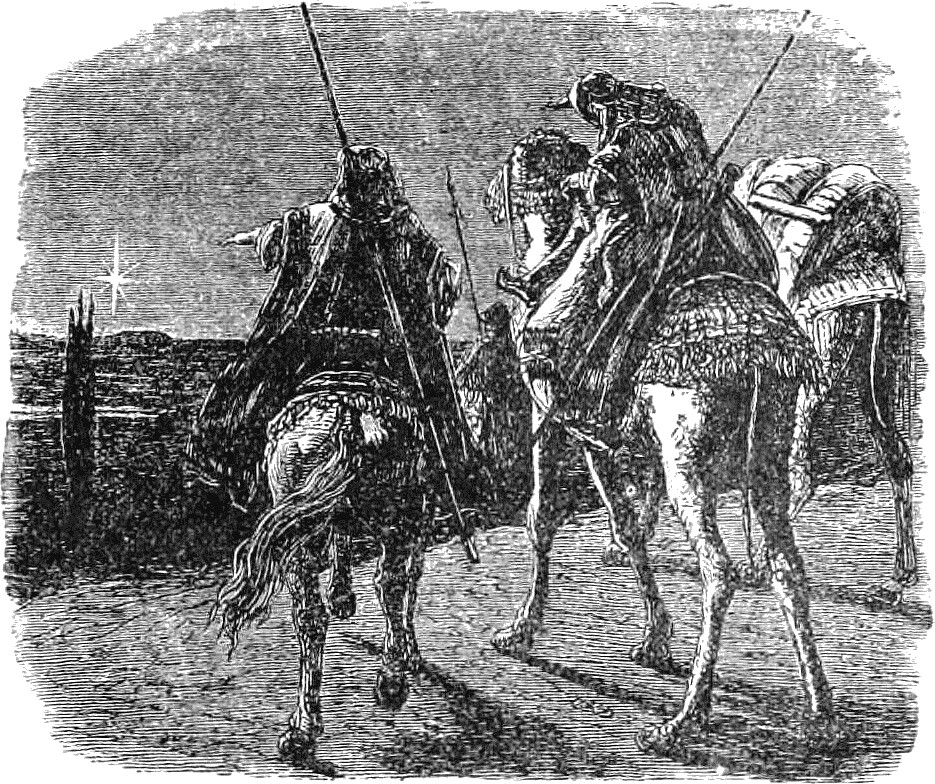
As the story continues the magi arrive in Bethlehem and fall to their knees in homage to the baby king. They give gifts fit for royalty, indicating the legitimacy of Jesus’ kingship which also starkly highlights Herod’s illegitimacy as ruler. Then they are warned to not return to Herod in a dream and head home without a second visit to Jerusalem.
Horsley further illuminates the significance of their homage to this poor child born in a stable. “At the very least,” he writes, “here are royal priests known far and wide as the most important advisers to the Persian King of Kings now seeking and bowing to the newborn king of a small and insignificant people subject to Rome. But they (the magi) surely represent the longing among eastern peoples generally, not just the Jews, for a restoration of their own native rule over against the alien western imperial rule that was so oppressive… when the Magi bow to the child, it is an act of highest respect for, homage to, and submission to a king, a political ruler, not an act of worship.” What the magi are expressing has worldwide political significance.
This humble, vulnerable baby represents not only the hope for liberation of occupied and dispossessed people, but also the resistance to Western imperialism by ancient near eastern societies.
With this interpretation of the text, Horsley is arguing that Jesus’ birth was about much more than spiritual notions of salvation for all people. I mean, wouldn’t the Roman empire want us to leave it at that? Of course. No, the birth of Jesus was about political revolution toppling paranoid power-hungry tyrants and the empire propping them up. This definitely sounds like good tidings of great joy to me.
The magi’s pilgrimage to Bethlehem (now located in occupied Palestine) is a tale of revolutionary hope in the midst of the cruelest of times. And then, as now, we grieve the displacement of vulnerable people and the innocent lives snuffed out by power hungry and ruthless rulers.
Upon the magi’s departure, Jesus and his family are forced to become refugees, fleeing the wrath of Herod. But according to the story, other babies are not so lucky. Herod is incensed that the magi would betray him and orders that all the children under the age of two in Bethlehem and the surrounding area are killed.
Whereas much of Herod’s violence is historically chronicled (and it’s ghastly), the genocide of Judean babies is contested among scholars. However, given what we know of Herod it is entirely plausible that he carried out such a slaughter. Within the liturgical year, this terrible loss of life is commemorated at the end of December with the Feast of the Massacre of the Holy Innocents.
In our own time, we live within the heartwrenching juxtaposition of revolutionary hope and crushing grief. We live on lands where our government and European settlers carried out genocide and ecocide. The commemoration of the Massacre of Holy Innocents falls on the day in December when 300 Lakota people were killed by the US Army at Wounded Knee in 1890. Holy Innocents. Over the past two years our tax dollars have funded the genocide of Palestinian people in Gaza. In March of 2025, almost a year ago now, 2,200 entire families were recorded as being entirely wiped out in Gaza. 2,200 entire families. Holy Innocents. Recent immigrant families in this country have been torn apart and loved ones have been disappeared by ICE across many borders. Holy Innocents. In 2025 alone our president bombed seven countries – Venezuela, Syria, Iraq, Iran, Nigeria, Yemen, and Somalia.
Countless holy innocents targeted by a power-hungry tyrant representing the most powerful empire on earth.
We grieve and we rage and we hold to Mary’s revolutionary hope of tyrants being brought down from their thrones and the dispossessed being lifted up. We journey with the magi to unexpected places where the power of God births liberation. We trust the guidance of the Spirit to protect and strengthen us.
Our scripture stories come from times just as violent and chaotic as what we’re experiencing. Yes, the world is scary right now, but revolutionary love and liberation are always being birthed among us. May we have the courage to follow the Spirit’s leading, whether she comes to us in dreams, through the night sky, or in the stories of those who have gone before us.
We are not alone. We are held not only by Divine love, but by the love of generations of ancestors who have defied tyrants and sang songs of liberation, even in prison cells. May we hold fast to each other in our grief and in our revolutionary hope. Amen.