
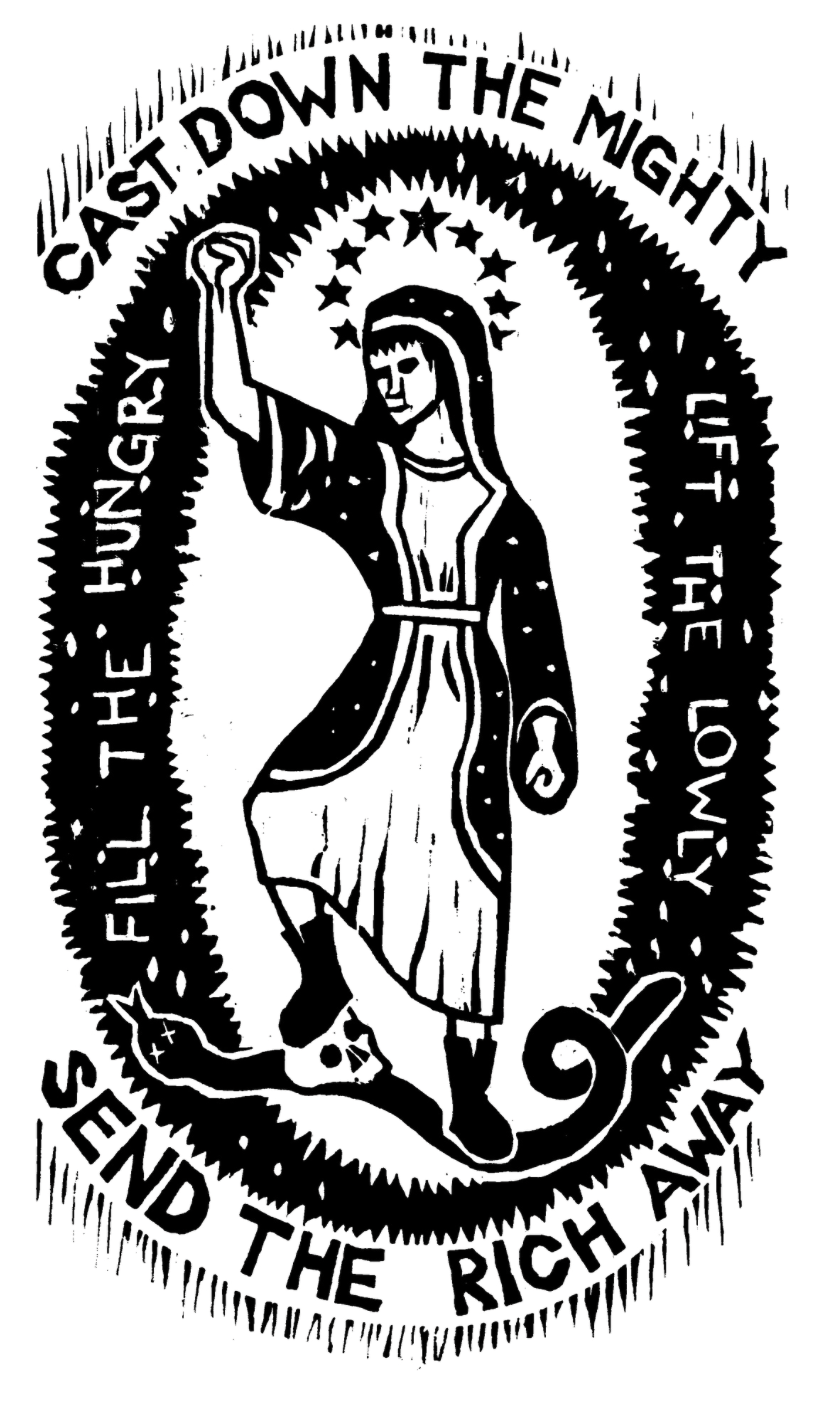
Advent Sermon: Revolutionary Mary
Luke 1:46-55
Thank you Nora for sharing that revolutionary scripture with us in Spanish today. This text is known as Mary’s song, or the Magnificat. It is the first instance in the gospel of Luke that we hear the divine intention to turn the world upside down. And the fact that it’s articulated by a young woman makes it even more subversive. Among the gospel writers, Luke centers women’s voices and stories the most, and is relentless in his condemnation of those who hoard wealth. According to biblical scholar Ched Myers, the stories in Luke articulate that history is transformed by poor folk and not the powerful.
It feels especially potent to hear the Magnificat in Spanish because this text was a rallying cry of movements for justice in Central and South America in the 1980s during the US backed wars. In Guatemala the government found its message of God siding with the poor to be too revolutionary and banned any public recitation of this text.
Similarly, after the Mothers of the Plaza de Mayo – whose children were disappeared during Argentina’s Dirty War – placed the Magnificat’s words on posters throughout the capital plaza, the Argentine military outlawed any public display of Mary’s Song.
A little earlier in history, during the British rule of India, the Magnificat was prohibited from being sung in church.
I actually wouldn’t be surprised if it got banned in this country sometime soon too as it celebrates bringing down the powerful and sending the rich with nothing while lifting up the lowly and filling the hungry with good things. Sounds like socialism if you ask me!
Mary proclaiming this radical reversal was just as subversive in her context as it was in Guatemala, Argentina, India, and here too.
So who was she, this young person speaking and singing words that make authoritarians quiver?
To start with, Mary was a teenager. She was poor. She was a non-citizen living under a constant threat of violence from the most powerful empire on earth at the time – the Roman Empire. She was recently engaged to be married. In her context this wasn’t romantic, of course. Rather marriage was the only source of protection for women, and especially poor women.
When the angel came to her, inviting her to be the mother of Jesus, the smart response would have been to say “wow thank you but definitely not.” Saying yes almost surely meant she would be killed. Stoning was the punishment for pregnancy before marriage in first century Palestine.
What this story communicates about Mary is that she was a young person of incredible courage. She was alert to what God was doing in the world. She understood herself to be connected to a lineage of prophetic women, and she said yes. We sang about a few of them in our first hymn today: Miriam a leader during the Exodus, Anna a prophet, Rizpah who defied a king, and the Hebrew midwives in Egypt who broke the law to save baby boys from being killed.
This Advent I’m taking a class with two amazing queer prophetic Christian women – Lynice Pinkard and Nichola Torbett. It’s called “An Unexpected Birth: Advent in the Fascist Apocalypse.” I mean, how could I NOT sign up with that title? During our first class they described Mary as aligning herself with divine disruption. She was expecting God to break into her reality. Luke’s story, they said, is all about a collision between imperial power and God’s power.
So Mary’s yes was costly and public, as I’ve mentioned, and it was also political.
The Magnificat is not only affirming that God is with the poor and the crushed. Mary is proclaiming that God will change the world through her. “…my spirit rejoices in God my Savior, for you have looked with favor on your lowly servant. Surely from now on all generations will call me blessed, for the Mighty One has done great things through me, and holy is your name…”
Having reflected a bit on Mary, let us now reflect on what this text communicates about God.
Lynice put it this way: God chooses a body that is colonized. God arrives in a community that is being crushed by empire. God comes into the world as a displaced, non-citizen baby who is utterly dependent on human care. God chooses vulnerability.
I want to pause here for a moment because I think this description of God is just as revolutionary as the notion that God is turning the world upside down: God chooses to enter the world in vulnerabiity.
If you are feeling vulnerable, God knows that reality. If you are feeling crushed by the weight of cruelty in our world, God knows that reality. If you have been separated from those you love, the God of our sacred texts knows that reality. God is with us in the suffering of this present time.
The vulnerability of grief and suffering is what allows God to move through us. The broken-openness is what makes us sensitive to the Spirit’s leading. Faith is trusting God in the ruins, Lynice said, and hope is expecting God to show up in the ruins.
Mary sang her song in the clutches of a violent empire, not knowing exactly how God would turn the world upside down, but trusting that just as God had shown up for her ancestors, God would continue to act in history and she would be a part of it.
In the crumbling empire that surrounds us, we are also singing revolutionary songs. We are accompanying each other in our vulnerability. We are protecting each other from violence. We are acting with courage (even if our knees shake at times). We are telling the stories of our ancestors to strengthen our resolve. We are celebrating God’s faithfulness to this beloved community.
Let us sing in faith and hope with Mary, that our vulnerable God will meet us in the ruins. Let us sing in faith and hope with Mary, that Divine presence and power is breaking into our world. Let us sing in faith and hope with Mary, as tyrants are brought down and the people are rising up together filled with good things. Let us sing in faith and hope like Mary that even here and even now we are a part of God’s revolutionary movement throughout history! Amen.