
Reflections on my Time in the Holy land
Jerusalem
My first day in Israel/Palestine, I understand why the psalms speak of going up to Jerusalem—why the psalm we just heard for or call to worship is called a Psalm of Ascent. It isn’t metaphorical language. It’s geography. From Tel Aviv, where we land at sea level, to Jerusalem is a climb of about 2,500 feet—like traveling from San Francisco to Grass Valley in about forty miles. The ascent is steep. You can feel it in your ears and hear it in the downshifting of the engine.
We get dropped off outside of one of the seven gates leading into the Old City of Jerusalem. Just the word “gates” evokes scripture for me, like Psalm 100 — “Enter into God’s gates with thanksgiving and into God’s courts with praise” — one of the first psalms I memorized as a child. From Lion’s Gate, we climb still higher, pulling our roller bags over ancient cobblestones, weaving through worshipers leaving evening prayers at the mosque and shoppers heading home from the markets.
That night—my first night in Jerusalem—I manage almost six hours of sleep. At 4:50 a.m., the call to prayer rises from the minaret beside the convent where I’m staying. I’m in Jerusalem, I whisper to myself.
I step onto one of the terraces of the convent where we are staying. Directly before me is Haram al-Sharif/the Dome of the Rock shimmering in the early light, one of Islam’s holiest sites. It is exquisite. It stands on ground sacred to three faiths: for Muslims, the place from which the Prophet Muhammad is believed to have ascended to heaven; for Jews, the site of the ancient Temple, the meeting place of heaven and earth; for Christians, a landscape woven through the final days of Jesus’ life. It is holy ground. It is contested ground. It is ground marked, again and again, by violence.
This layering of beauty and suffering, history and hope, violence and devotion will become the texture of my days here.
For now, though, I’m simply trying to orient myself in a place that has lived inside me all my life though the stories and scriptures that shaped my faith, my imagination, and my people for generations upon generations. I notice another sleepless pilgrim, Alison, standing nearby. She’s been in Jerusalem before, and she begins to point things out to me.
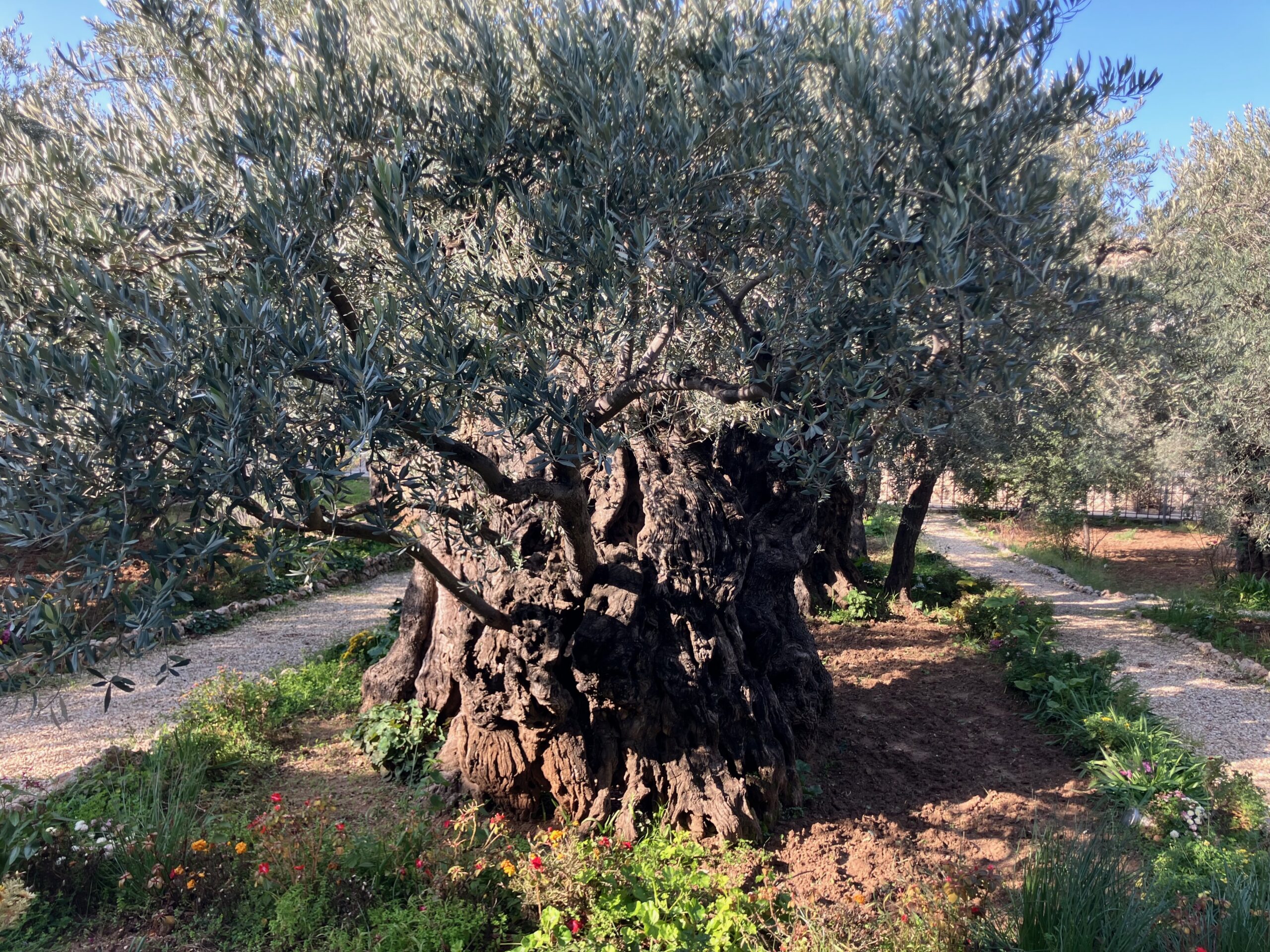
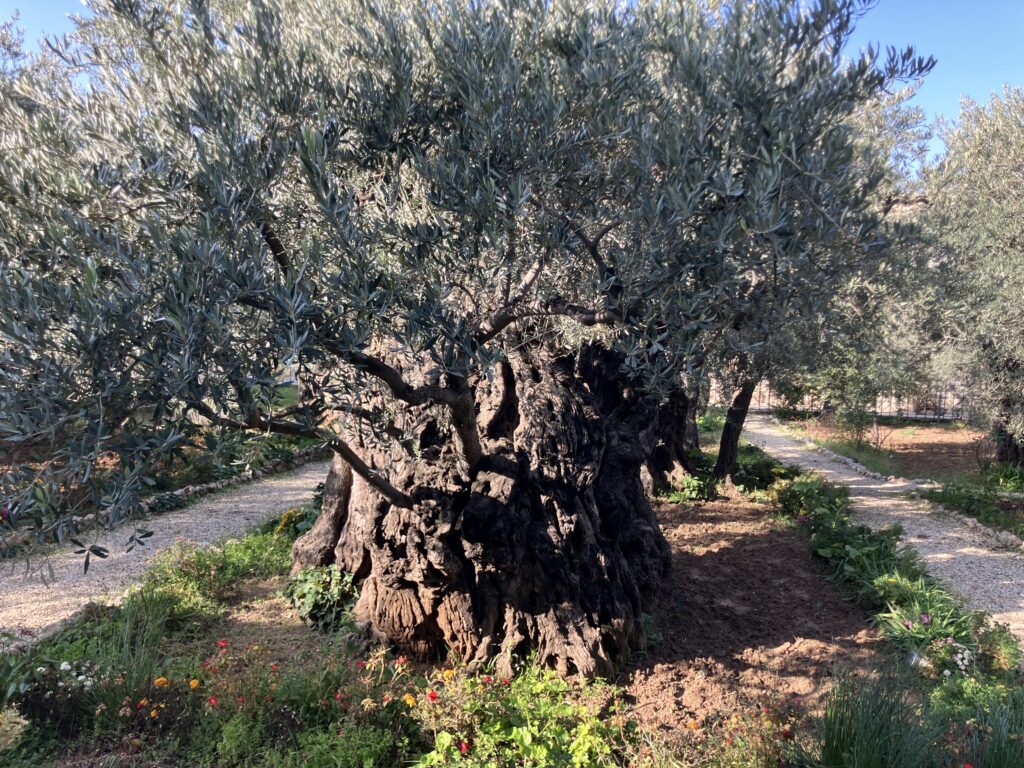
“There,” she says, gesturing to the left, where the sun is just beginning to rise. “The Mount of Olives.” The Mount of Olives, I repeat silently.
“From there,” she continues, “Jesus would have walked down through the Kidron Valley…” I grew up twenty minutes from Kidron, Ohio—but this is the real thing.
“…and he would have walked along the Via Dolorosa—the way of the cross.” She points almost directly beneath us. The convent stands along that path, the one Jesus walked to Golgotha. Her hand points to the right, toward the twin domes of the Church of the Holy Sepulcher that marks the site of Jesus’ crucifixion, burial and resurrection.
I take this in, tracing in one sweeping glance the story that forms the core of my faith, mapped now onto actual hills and stones. I can’t believe I’m in Jerusalem.
Over the next days, I will continue to explore the map of my faith, and I will also listen to the people of this land speak. I heard so many stories—far more than can fit into a 15-minute sermon. To try would be a disservice; plus, we have Education Hour. So I’ll tell this one, which I heard on my first full day in Jerusalem.
Ahmad (name changed) is a jeweler with a small shop along the Via Dolorosa. Like many Palestinians we meet, once he realizes we genuinely want to hear what life is like for him, the words pour out. “We love life,” he tells us, “but we have no hope. There’s nothing we can do. It’s all in the Israeli government’s hands.” He says that if the signage in his shop mentions Palestine—even something as small as saying that the stone eilat is the national stone of Palestine and Israel—the soldiers who come to inspect his shop about once a month could shut his business down for six months. “We never know what they won’t like,” he says. “It changes all the time. And if we do something they don’t like, we get taken to the other side of the moon.”
His daughter, he tells us, was taken into custody after she visited a friend who had been released during a recent prisoner exchange. He spent 3,000 shekels on a lawyer to secure her release from administrative detention—a detention that can last up to six months without charges and be renewed indefinitely. He says to us: “We don’t say, ‘See you tomorrow’ anymore.” “We just say, ‘See you.’”
On our second day in Jerusalem, we visit the Church of the Holy Sepulcher. It is not at all what I expect. I imagine that the church built over the holiest site in Christianity will be grand, moving. Instead, it is a jumbled, messy maze. Six different Christian groups, famously at odds with one another, share custody of it. Nothing about the building is easy to read. You are looking at very holy things and often don’t know what they are. Chapels belonging to different traditions appear everywhere, each with its own aesthetic, its own icons. One whole section is inaccessible unless you are Greek Orthodox.
Nothing about the place lends itself to quiet contemplation. Construction materials lie stacked all over the place, and loud hammering echoes throughout. In the chapel commemorating the site of Jesus’ crucifixion, a woman prostrates herself in prayer while a man walks past her, livestreaming on a selfie stick. If you linger more than a few seconds at the stone said to mark the place of crucifixion, a priest will pull you out by the back of your shirt in order to keep the line of pilgrims moving.
I’m not alone in our group in feeling disappointed, even strangely unmoved by this Church. But as I sat with this experience, something in me begins to shift. Unlike cathedrals that lift your eyes upward, the Church of the Holy Sepulcher pulls you downward—toward stone, toward cramped and crowded spaces, into the messiness and heartache of the human condition. It reflects the truth it claims to hold: God entering into our violence, division, and frailty rather than bypassing them. It bears witness to a hope, a victory, that is anything but obvious.
Mount of Olives
As Jesus came near the place where the road goes down the Mount of Olives, the whole multitude of the disciples began to praise God joyfully with a loud voice for all the deeds of power that they had seen, saying,
“Blessed is the One who comes in the name of the Lord! Peace in heaven, and glory in the highest heaven!”
As Jesus came near and saw the city, he wept over it, saying, “If you, even you, had only recognized on this day the things that make for peace. But now they are hidden from your eyes.” Luke 19:37–38, 41-42
On my fifth day in Jerusalem, Alison suggests we hike to the top of the Mount of Olives at sunrise. I say yes immediately.
As I continue listening to the stories of people who live here—mostly Palestinians, but also some Orthodox Jewish women—their words begin to settle into me with a palpable weight. The strain, the grief, the daily pressures and humiliations of life under occupation press down on my spirit. I know what I am feeling is only a fraction of what people here bear every day. And I find myself wrestling with something else as well: how religion, which at its best is meant to open hearts, can be wielded to close them—to sanctify dispossession, to justify oppression, to bless division.
I think of one Orthodox Jewish woman we spoke with, who told us that what she learned from October 7 is that peace with Palestinians is impossible, that her generation should have fought harder for the land God gave them 2,600 years ago so her son would not have to fight for it now. I think, too, of the nearly 2,000-year history of Christian anti-Semitism – the centuries of pogroms against Jewish people, which culminated in the nightmare of the Holocaust – that led us to this bitter reality where Jews live in fear and Palestinians live under occupation. I think of my own family, who settled on land belonging to Indigenous people 300 years ago, a dispossession justified by Christian doctrine. For the first time in many years, I feel a reluctance to call myself a religious person at all.
Carrying all of this with me, Alison and I reach the top of the Mount of Olives just as the city receives the first light of morning. Jerusalem stretches below us, its stone walls glowing gold. To my left, a different line cuts across the hills—the separation wall, one of many such barriers in this land. Suddenly, I think of Jesus standing somewhere on this slope, looking out at this same city. The same ridgelines. The same valleys. And the gospel tells us that when he saw it, he wept: “If you had only recognized on this day the things that make for peace.” I feel a deep kinship with him there I have never felt before. If we would only recognize on this day the things that make for peace.
Alison and I invite the rest of our group to join us the next morning in our walk to the top of the Mount of Olives, and several do. Soon it becomes a rhythm. We begin the climb with a simple prayer, then walk in silence until we reach the summit. The Mount of Olives becomes a touchstone for me—a place I return to, not just physically, but inwardly.
Because it is there that I encounter the Jesus of my Anabaptist faith, the one my ancestors taught me to trust: the Jewish Jesus who sees clearly and loves without illusion. The poor Jesus who lived under occupation, who knows the things that make for peace. Who embodies nonviolence not as passivity but as fierce, grounded courage. Who says no to injustice with his whole being while still extending a hand to his enemies.
Standing on that hillside, I realize with a clarity that feels less like insight and more like summons that this way—the way of Rabbi Jesus—is not one option among many; it is the narrow path that we will keep rejecting until we learn that it is the only way that leads to peace.
Galilee
After the sabbath, as the first day of the week was dawning, Mary Magdalene and the other Mary went to see the tomb.
And suddenly there was a great earthquake; for an angel of the Lord, descending from heaven, came and rolled back the stone and sat on it.
The angel said to the women, “Do not be afraid; I know that you are looking for Jesus who was crucified. He is not here, for he has been raised, as he said. Then go quickly and tell his disciples, ‘He has been raised from the dead, and indeed he is going ahead of you to Galilee; there you will see him.’ Suddenly Jesus met them and said,“Do not be afraid; go and tell my brothers and sisters to go to Galilee; there they will see me.” Matthew 28:1-2, 5-7, 9–10
If the Mount of Olives is where I saw clearly the importance of the way of Jesus, Galilee is where I saw how it is lived out.
The angel and Jesus’ message at the tomb is quite specific: I’m going ahead of you to Galilee. There you will see me. Not in Jerusalem, in the center of power, but back where it all began. Back to fishing nets and dusty roads and shared meals.
And it was in that spirit—in that geography of the ordinary—that I start to meet people who show me what the way of Jesus looks like when it is mapped onto real ground. One of them is Zoughbi Zoughbi, a Palestinian Christian. He leads Wi’am, which is devoted to conflict transformation, peace building and training in nonviolent resistance. He has been imprisoned. The Israeli government will not allow his wife—a U.S. citizen—to live there with him; she can only visit for three months at a time. Wi’am itself sits beside the massive 30-foot-high separation wall built during the Second Intifada in 2002. He tells us their location is one of the most dangerous places in Bethlehem. “We cannot vigil or pray or challenge them,” he said. “If we do anything, they will shoot to kill us.”
In a land where despair would be understandable and hatred would be easy, he has committed his life to the nonviolent path of Rabbi Jesus.
I will talk more about him, and about others I met — Jewish, Christian and Muslim — who are actively building peace and nonviolently resisting injustice during Education Hour. These are people courageously, sacrificially living the things that make for a just peace. They and their organizations and movements are only a small part of the landscape in Palestine and Israel. Their path is steep, and not many seem to be walking it. Those that do bear witness to a hope, to a victory, that is anything but obvious—until the day it will be. May that day come soon.