
Reflection: For Nothing Is Hidden From God or “Come Out, Come Out, Wherever You Are”
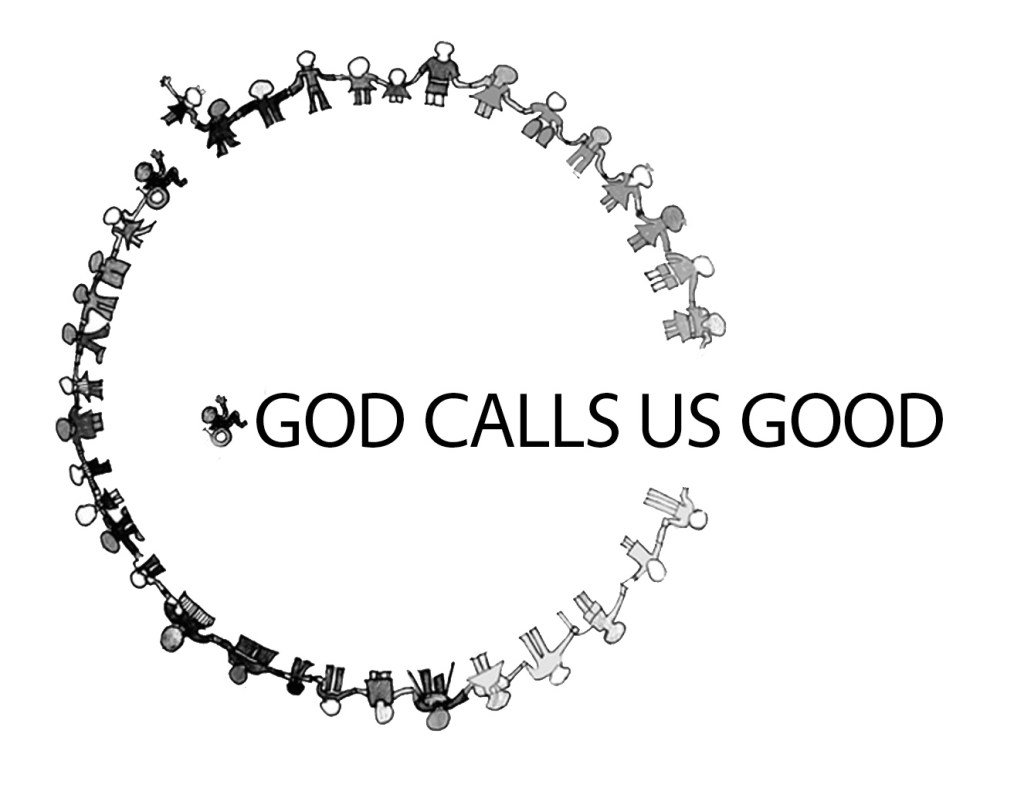
This reflection by Janet Kroeker is from the second Sunday of our Back to the Basics Series: A Theology of Disability: God Calls Us Good. You can find audio and video recordings of both her reflection and that of our other speaker, Peter Kangas, here.
I Corinthians 12:4-13
I imagine most of you thought I’d be sharing how my life has changed since losing much of my mobility a few years ago. Me too! And, it has been a huge adjustment, and I’m not close to knowing how to function with these limitations. Also, “disability” is a word I don’t really like. It seems to me to buy into our binary world, and this right and wrong, black and white mentality. I’m also a rebel and especially when anyone kinda dictates the language I should use . . . that is unless my language use is offensive, or causing pain or distress to others. All that said, for today I AM going to use it as a descriptor for myself.
I.am.disabled.
The passage Amy just read, is integrally connected to the letter to the Romans that Joanna explored with us last month. (I strongly encourage you to read it on the blog if you didn’t hear it) This “each of us gifted for a specific purpose” seems like an important concept, and for centuries the church has tried to figure out what it all means. Perhaps we’ll get a little closer today?
My transition from mobility to crippled coinciding with the Covid pandemic, softened the blow. My body could no longer sustain the stress I was putting on it. Since we were meeting on zoom we mostly saw each other from the neck up. And, even though this is NOT what I want to share about today, it has provided a platform, or a space, to tell you about the “invisible” disability I have. This invisible disability, combined with severe childhood trauma, held me captive for more than half of my life.
The summer before I turned five, we moved from my birthplace in North Dakota, to a farm in the central valley of California. This place was everything a child could ever dream of. Fifteen cats, (not allowed in the house) six ducks, three geese, some rabbits and laying hens . . . an enormous vegetable garden, two fig trees, four walnut trees, a huge stone fruit orchard, and a parakeet in a cage on the back porch. Bliss. I still dream about this place more than anywhere else. My idea of heaven.
We ended up not living there long, because it was in this place that horrible, heinous things happened to me. I’m not going to talk about this either, only that it triggered the genes lying dormant in me . . . and, it’s part of the reason we moved. With moving I remember feeling like everything in the world was going to be okay, again.
But, it wasn’t. I was different. I knew that something was wrong with me – that I was different from the other kids. I wanted to be like them, and I wanted them to like me – more than anything. Believe it or not I was a quiet, shy child. A benefit of being so quiet is that almost everyone leaves you alone. And although I was no longer being traumatized, the trauma remained. I was no longer the happy child I once was. The difference in me was drastic. I was often “sick”. I didn’t want to go to school. And even though I was put into a “gifted” program at school, I didn’t understand most of what they were trying to teach me. I’d ALMOST get it – but at some point there was a disconnect – always.
When I got to Junior High School, I again thought it would be a fresh start – that I’d have a chance to fit in. And, things were going pretty well until a teacher shamed me in front of my classmates. It was morifying. This is when I began to aggressively mask. It wasn’t a conscious decision – in fact I’ve only recently learned this terminology. In order to survive – I had to fit in.
SIDEBAR: Do you all know what “masking” is? A simple explanation is that the person creates a persona to take on, in order to survive. It’s a compensatory response enabling the person to exist in the world in such a way that no one will detect that something is wrong with them. Basically, it’s really good acting
My semi-aware strategy was that by mimicking those around me, I could pass for “normal.” I created a persona that fit within the norm. My compensatory skills were on point, and in many ways this began the most successful and productive time of my life. (fake it til you make it?) In these years I succeeded in my schooling – all the way through university . . . my early career, into what I consider mid-life. I was even able to buy a home. It was working.
And, life was going well until one day at work, I just lost it. I stopped functioning, I began to cry uncontrollably, and the next thing I recall was being in the hospital. I was experiencing a psychotic break, or what we called it then, a mental breakdown. Those first weeks were spent in acute care, then rehab, then with family until it was decided that I was “stable” enough to go home and be on my own.
All the years of pretending to be normal was actually so fragile that any attempt to piece together what had broken was impossible.
Since then, until now, I’ve been on a long, arduous journey of reclaiming myself – of trying to claw back the essence of who I was before that first trauma. At the same time I’ve been dismantling what remained of that forty year, now broken, structure. Nothing had really changed in those years in regard to trying to live in a world that is conflicted about whether the REAL me, is acceptable, or valid. Major Depressive Disorder – combined with Acute and Complex PTSD was that initial diagnosis. But even the best experts in the world know very little about the interaction between the brain and the mind. So little that the latest thinking is that there is a strong correlation between autism and MDD – and it may even be a form of the same thing. This isn’t something imagined, nor controlled, or managed by our will. We who have this don’t choose to have it anymore than someone chooses to have cancer, or Parkinson’s, or Diabetes . . . . I’m sure you are quite familiar with the term depression, and those who have it. You may even be thinking – oh, lots of people have depression, and this is very true. And just like Autism, or similar conditions – there are differing types, and there is also a spectrum.
A couple of days ago I re-listened to a sermon given by a good friend which included his referencing his “disabled” daughter with trisomy 21, or Down’s Syndrome. At one point he starts listing some of her characteristics such as: kindness, gentleness, a cheerful heart, contentment, love . . . . then he talks about what he values, and what his character is. He goes on to say that his daughter, with Down’s, has all the characteristics that Jesus cares about, and many of the characteristics he lacks.
So what if we saw others in this way – that everyone among us is here because without them we are disabled? Seeing gifts in this way gives us an entirely new perspective. What if we were all to let go of our self perception, and accept merely that we are created in the very image of the great creator of all things.
What if we heard the scripture that Amy read today to be telling us that WHOLENESS happens when we are in community – or “body.” That each visible, and invisible part of who each of us is – is essential, is needed . . . that this wholeness happens when we recognize that EACH of us is DISABLED without the other.
We are ALL given gifts – in order that we, together, might be whole. Each one here is uniquely gifted to meet the needs of others, and I am uniquely gifted to meet YOUR needs. And YOU to meet mine. We have the same spirit. May we continue to learn to see, to hear all around us so that our welcome meets each – as created in the very likeness of God.