
Our Inner Toad and the Kindom Gardener
Matthew 4:26-34
I love these parables we just heard, especially the first one about the gardener who sows her seed and goes to sleep — although the mustard seed is a close second. I love this first one so much that I have preached on it every Sunday that it has come up in our lectionary cycle when I’ve been giving the sermon. Many of you know that we often determine what Scripture we’re going to use in our worship by consulting the Revised Common Lectionary, which is a three-year cycle of Scripture readings. And since I have been here 24 years, and these parables come up every three years, that adds up to a lot of sermons on this one parable.
I think I love this parable, in part, because it comforts and corrects my Inner Toad. The overfunctioner in me recognizes myself in the silly gardener Toad from our children’s story. My overfunctioner especially comes out in me as a parent, although she shows up in other spaces in my life, too — like in my relationship with my husband or in my own personal growth goals and desires. My Inner Toad believes that it is not enough to plant a seed (or lovingly parent a child) and sit back and let the organic mystery of growth happen. My Inner Toad believes that I have to do things — many things — to make this growth happen. I have to hover over my seed and anxiously watch whether it is growing yet. Why is this seed not growing? If I yell louder, will that result in growth? No, that never works! Why is my seed delayed in growing, according to the unrealistic timeline I have set for it? Something is wrong and certainly requires my intervention. Let’s read a book or go online or consult an expert. All this work and worry will be exhausting. It is such hard work.
Simply put, my Inner Toad does not trust in what she cannot control. My Inner Toad assumes that if I am not in control, nothing else is. My Inner Toad thinks that growth will not happen unless I make it happen. My Inner Toad thinks it’s all up to me.
So how many of us have an Inner Toad?
I think our Inner Toad shows up in other ways as well. Many of us are very aware of how much is wrong in this world — systemic racism, inequality, rising authoritarianism, climate change, etc. None of these wrongs have easy solutions. They are rooted in harmful or broken systems that have existed for a long time and that are not easily changed. Anything we do can sometimes feel like throwing stones into an ocean and hoping it eventually forms a dam to hold back the tide. It doesn’t feel like enough.
And so, we can fall into despair or become chronically anxious. Sometimes, in our despair or anxiety, we can convince ourselves that there’s a quick fix that can save us from whatever it is we are worried about. But I think most of us know that deep-seated change is necessary. The kind of change that results from slow multi-generational work, in which we together collaborate to build power and then exercise that power to resist the forces that perpetuate harm — like what many of us are doing in Faith in Action or with the Coalition. The kind of change that results from slow multi-generational work, in which we together collaborate to build alternative systems — what is sometimes called building the new world in the shell of the old — like establishing food systems based in regenerative, not industrial, agriculture. Many of us support CSAs or farmers’ markets, neither of which would exist if it weren’t for some people working for decades to make it happen. None of this work is fast. It’s “slow justice” work. When we are doing slow justice work, we must accept the fact that we may never see major changes in our lifetime. That’s so important to say that I’m going to repeat it: When we are doing slow justice work, we must accept the fact that we may never see major changes in our lifetime.
For people trained in our dominant culture worldview of efficiency, measurable results and short-term thinking, accepting that we need to take action without the gratification of seeing results is hard; it’s countercultural. I often see this worldview bump up against the worldview of the Coalition, which is based in “slow justice” work. A few years ago, a very lovely man with a heart for Indigenous people approached the Coalition. He was interested in giving us quite a bit of money. But first he wanted to see our five-year plan. Sarah and I laughed. For one thing, we don’t have a plan per se. We scatter our seeds, watch where plants start to sprout and then focus our attention there. We’re working with a Maya group in the Yucatan because one of their community members found us on the Internet and came to ask for our assistance. We could never have planned that.A Methodist pastor with whom I worked in Montana used to call this “cooperating with grace.” We see where grace, or the Spirit, is moving and then come alongside it.
And whatever we’re doing can’t possibly be accomplished in five years. That time frame is way too short to dismantle harmful structures that have been in place for hundreds of years. Sarah put it this way in a recent conversation: “We’re planting the seeds for a society that does not yet exist. We are planting a cedar tree from seed that will be the center beam for a lodge 1,000 years from now.” The wonderful Aboriginal wrier and thought leader Tyson Yunkaporta echoes this timeline. We stand, he says, at the beginning of a process that will take a thousand years, because that is how long it will be before old growth forests have returned.
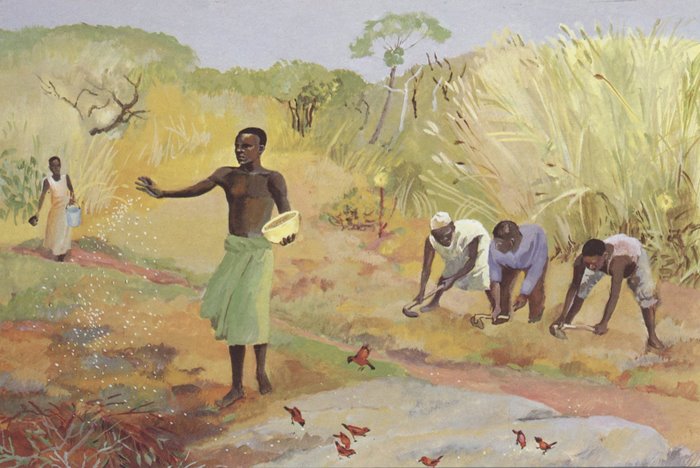
So let us release our Inner Toads and become kindom gardeners. Let us become like the gardener in the parable whom Jesus holds up as a role model for how to “produce results” in the kindom of God. Our kindom gardener doesn’t carefully choose the site where she will plant each and every seed; she scatters them on the ground! She doesn’t analyze the soil or consult an agronomist or anxiously wonder if this is absolutely the best site for planting. She flings her seeds with abandon. Something will sprout, or it won’t. It is not under her control. The earth produces of itself, our parable says, first the stalk, then the head, then the full grain in the head. The Greek word for “of itself” here, is the word “automatos.” So, the kindom farmer trusts the “automatic earth” – the agricultural grace that transforms a small seed into a plant large enough to feed people. Because of this letting go of control, because of this trust, the gardener can rest. She can fall asleep and let some other force take over.
I love this. The overfunctioner in me breathes a sigh of relief. It is not all up to me. I am a part of a larger growth process beyond my control or comprehension. I’m called to scatter the seed and watch where something grows so that I can harvest when the time is ripe. I’m called to trust that the Spirit is at work even when I can’t see it happening — when I am, literally, unconscious. The Spirit is alive in my son’s life, and I may not know for years how that Spirit was working. The Spirit is alive in my relationship with my husband and in me, and the fruit of that work may not be obvious to me in a timeline I like. The Spirit is alive and at work in the world, and we may never know how the Spirit was working through the small things we do to help bring about the kindom of God on earth. Our obedience is to scatter the seeds of grace, rest, and cooperate with grace where we see signs of sprouting. This is the kindom of God, according to Jesus. Thanks be to God.