Sermon: A Spiral-Shaped God
Trinity Sunday
Matthew 28:16-20
Jesus and his disciples were sitting around, and he asked them, as he liked to do: “Whom do people say that I am?”
And his disciples answered, “Some say you are John the Baptist returned from the dead; others say Elijah or other of the old prophets.”
And Jesus said, “But whom do you say that I am?”
Peter answered: “Thou art the Logos, existing in the Father as His rationality and then, by an act of His will, being generated, in consideration of the various functions by which God is related to his creation, but only on the fact that Scripture speaks of a Father, and a Son, and a Holy Spirit, each member of the Trinity being coequal with every other member, and each acting inseparably with and interpenetrating every other member, with only an economic subordination within God, but causing no division which would make the substance no longer simple.”
And Jesus, said, “Huh?”
Today is Trinity Sunday where preachers are supposed to preach about the Father, Son and Holy Spirit or, as some of us think inside our heads every time we hear that, “Father, Son and Holy Spigot.” I’ve avoided preaching on the Trinity for years — probably because, like Jesus in that joke, I find the doctrine of the Trinity not only hard to get my head around but kind of abstract and boring. The theology of the Trinity that I was exposed to in seminary is quite tortured. That joke is only slightly exaggerating how weird it can get.
So then the question is: If it’s weird and tortured and abstract and irrelevant, why bother with it this morning?
Because I’ve come to believe the Trinity gets at something about who or what God is that’s a necessary corrective to how we tend to think about God. As Richard Rohr says: “Sadly, the doctrine of the Trinity hasn’t exercised much influence in the Christian understanding of God. If most Christians—Catholic or Protestant—are questioned about their real image of God, it’s generally an old man sitting on a throne. He’s upset half the time and it’s our job to make this god happy.” For him, the Trinity opens us up to a much more weird (in a good way), relevant, freeing and mystical understanding of the One in whom we live and move and have our being.
So let’s dig in! But we’re not going to approach this as a theological puzzle that needs to be solved — that’s what got us into this tortured mess in the first place. We’re going to approach this as a mystery we’re invited to enter and live inside. Instead of thinking our way in, let’s walk our way in.
Many of you have walked a labyrinth. You know the experience: You enter a single winding path, and it takes you sometimes toward the center, sometimes frustratingly away from it, turning back on itself, doubling around — until suddenly, without your quite knowing how, you are at the center. It is not a maze. There are no dead ends, no wrong turns. There is only the path, and the constant turning, and the presence of the Mystery at the center.
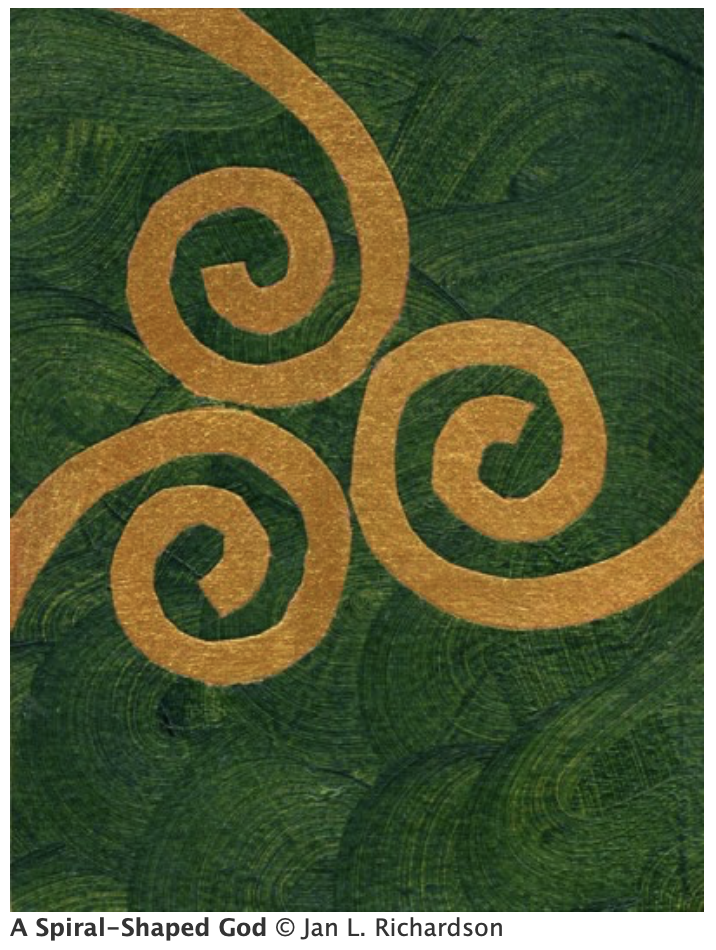
The writer and artist Jan Richardson talks about a similar movement to the labyrinth: the Celtic triple spiral, a symbol that became associated with the Trinity in early Christian Ireland and Scotland. I’ve always loved this symbol. Unlike the triangle or other geometric attempts to diagram God, the triple spiral is not static. It moves. Three spirals, each curling inward, meeting at a common center, each one also opening outward. It’s a shape that evolves, that changes, that flows, that is interconnected and thus complex.
Interestingly, the early church theologians of the fourth century — the Cappadocian Fathers, working in what is now eastern Turkey — gave us a word for the inner life of the Trinity that evokes this shape— perichoresis. Perichoresis means something like “circular rotation.” In fact, the root word choros means dance. What the Cappadocians were reaching for was this image of God as an eternal dance — not a dancer who dances, but the dance itself. God is the dance itself. (Thanks to Richard Rohr, for this insight.)
In this understanding of God, God is not a noun but a verb. Not a static Being who occasionally decides to love, but Love itself in constant motion, constantly dancing — outpouring, receiving, spiraling in, spiraling out. Three spirals that dance together, always giving, always receiving what the other gives, and always inviting everything else into this dance.
As Rohr writes, “The Trinity reveals God more as a verb than a noun, but we rarely speak about God that way… God is three “relations,” which itself is mind-boggling for most (Christians). Yet that clarification opens up an honest notion of God as Mystery who can never be fully comprehended with our rational minds. God is dynamic—a verb rather than a static name. God is Interbeing itself, and never an isolated deity that can be captured by our mind.”
This motion, this Interbeing, is not only what God is. It is the pattern the Creator has written into everything.
Consider what we now know about the physical world. Scientists studying matter at its smallest scales find that energy exists not so much in particles themselves as in the relationships between those particles — in the space between things, in the interactions, in the flow. Physicists call this quantum entanglement: two particles that have interacted remain connected across any distance — and I mean any distance, light years away, even from each other. Einstein famously hated this idea — he called it “spooky action at a distance” — but it’s real, and it means that even at the most fundamental level of matter, nothing is ever truly separate once it has been in relationship. Nothing in the universe exists in isolation. Everything is constituted by its connections.
At the largest scales, the same is true. Stars are born from clouds of gas, burn for billions of years, and then die in explosions that scatter their material outward — carbon, oxygen, iron — seeding the next generation of stars and planets. The calcium in our bones and the iron in our blood were forged inside a star that died before our sun existed. You are, quite literally, made of what was given away: stardust. Matter itself moves in this great cycle of giving and receiving, and nothing in it is ever truly lost.
Come down from the cosmic to the creaturely, and the pattern holds. Beneath the forest floor — beneath the very ground some of you walked on on your way here— mycorrhizal networks are at work. Fungal threads connecting tree to tree, passing water and carbon and nutrients between them, the old trees feeding the young ones, the whole forest in a kind of silent conversation. Biologists have started calling it the Wood Wide Web. It is giving and receiving, all the way down.
Rohr says that if God creates in God’s own image, there must be a family resemblance between the Trinity and everything else. So this constant give and take we see within creation and the cosmos, this constant flow, this constant connectedness, this isn’t a metaphor for God, this is the shape of what is. This is reality.
At our best, we are this flow, this connection, this relationship. The way grief moves through a community: how one person’s loss becomes everyone’s loss, how a meal delivered to someone recovering from surgery is a small act of perichoresis. The way joy does the same: how someone’s good news lifts a room, how we carry each other’s children in our memories and our prayers. The passing of bread and cup, which we did last Sunday. As the hymn says: “Here in this world, dying and living, we re each other’s bread and wine.”
We were made for this. Created in communion, by communion, for communion. And when we live into it, we are not just being kind or Christian. We are participating in the very motion that holds the universe together. We are participating in the Trinity!
We will never intellectually solve the Trinity. I hope we never do. But we can live inside it. We can trust the path, trust the turning, trust that the presence at the center is — as Jesus promises in this passage — with us always, to the end of the age. And we can trust that we are most ourselves, most in touch with reality when we see ourselves not as small isolated beings, existing inside the wall of our own skin sack, but part of a vast, cosmic flow of life that reaches out to the furthest reaches of the universe and down into the ground beneath us— sometimes giving, sometimes receiving, sometimes spiraling inward, sometimes spiraling outward, always inviting more and more of life into the dance.
Amen.