
Sermon: Rebuking the powerful
By Joanna Lawrence Shenk
Luke 7:36-50
With the seemingly relentless stream of bad news, I am pleased to say I have good news to share with you today! First off, our denomination – Mennonite Church USA – is suing the Dept. of Homeland Security. Although the lawsuit represents 27 denominations and religious bodies, including Reformed Judaism of which Congregation Sha’ar Zahav is a part, the case is named Mennonite Church USA vs. the United States Department of Homeland Security. Some of the other groups include the Episcopal Church, Presbyterian Church USA, African Methodist Episcopal Zion Church, The Disciples of Christ, Church of the Brethren, Unitarian Universalists, and United Church of Christ. These groups represent over five million people of faith in the US.
Associate Executive Director of MC USA, Iris de Leon Hartshorn is the point person on the case. While acknowledging that lawsuits are a deviation from typical Mennonite practice, she names our participation as a necessary nonviolent tactic in these times.
If you’re wondering why MC USA is the named plaintiff, given we are probably one of the smallest religious bodies in the lawsuit, it’s for a mundane yet telling reason: We got our information to the lawyers first. What makes this telling is that the MC USA executive board unanimously and immediately approved the invitation to join the lawsuit, put forward by Georgetown University Law Center’s Institute for Constitutional Advocacy and Protection. For Mennonite decision-makers it was a no-brainer, which says a lot about our solidarity with and as immigrants and our understanding of the root causes of migration. This was profound to Iris who expected there to be some amount of pushback among denominational leaders.
On the grounds of religious freedom, the lawsuit specifically challenges the Trump administration’s order to rescind the status of houses of worship as protected spaces from ICE. We, along with the other religious bodies, are making the case that rescinding this protection puts an undue burden on our ability to practice our faith since it keeps people from coming to church and goes against our tenants of faith, including welcoming the stranger.
I am proud of our denomination for taking this stand and doing so without reservation. And Iris is under no illusions. Even if we get an injunction, the Trump admin might not abide by it so we need to continue to support and protect those who are most vulnerable. One opportunity for our congregation specifically along these lines is the invitation from First Mennonite and Primera Iglesia in Reedley to provide overnight housing to Venezuelan asylum seekers who have ICE appointments in SF.
Our participation in this lawsuit is a powerful statement in the face of Christian nationalism that continues to align itself with policies that target the most vulnerable in our country. Five hundred years after our spiritual ancestors, the Anabaptists, dissented from the unholy union of church and state power, our bold witness continues.
The scripture story today undergirds this good news as it confronts the powerful and uplifts the agency of those who have been stereotyped and marginalized in society.
For this bible study I will be pulling heavily from Ched Myers’ latest book titled, “Healing Affluenza and Resisting Plutocracy.” Anyone other than me need a refresher on the definition of plutocracy? It means a society ruled by the wealthy.
We’ll look at the story from Luke in three scenes. Given its drama, Ched suggests acting it out, so I’m glad we had the children’s story to aid us along those lines. I’m going to invite our scripture reader to jump in with the first scene. This translation is adapted from the First Nations Version, an Indigenous translation of the new testament.
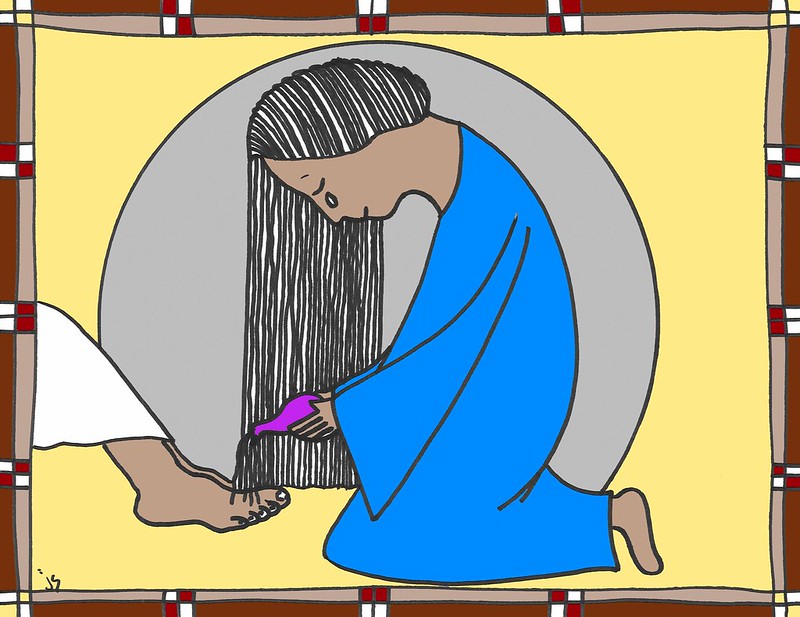
A spiritual leader from the Separated Ones (Pharisees), named Simon, invited Jesus to a meal. So he went to his house and joined the guests at the table. There was a woman in the village, an outcast with broken ways, who heard that Jesus was eating with the spiritual leader. So she went to the house and brought with her a small pottery jar of sweet smelling ointment. She came up behind Jesus and began to weep at his feet. Her tears fell on his feet, and she wiped them with her hair. Then she kissed his feet and rubbed the ointment on them.
Scene One opens with Jesus receiving and accepting an invitation to sit at the table of the powerful. The host, Simon, is someone of means since he has a table at which to recline. He is not only wealthy but also culturally powerful as a spiritual leader. His guests would have been exclusively male, which makes what happens next especially jarring.
A woman enters the room and not just any woman, but one who is judged and marginalized in society because of her poverty and resulting line of work as a prostitute. How did she know Jesus would be there and how did she get in the door? Those questions remain unanswered. She brings with her a multi-sensory experience in the form of sweet smelling ointment and her wailing, a public and dare I say, political display of grief. She was not just quietly sniffling, she was full-throated wailing.
Then as now, women disproportionately bear the brunt of society’s violence that is perpetuated by patriarchal systems. I think of the tremendous grief carried by Palestinian women whose families have been maimed and buried by bombs our tax dollars paid for. I think of the tremendous grief carried by Congolese and Sudanese women, who have been forced to flee their homes and face the threat of sexualized violence. I think of the tremendous grief of poor women in this country who are crushed under the load of poverty, unable to protect themselves and, if they are mothers, their children from violence in many forms. I think of the tremendous grief of trans women who are targeted because of their mere existence.
It’s not a stretch to say that the woman wailing at Jesus’ feet was bearing witness to this grief as an act of political resistance to a system that was blaming and invisibilizing her. Her tears were washing Jesus’ feet which then she dried with her unbound hair, something that was taboo in the presence of men who were not kin. The tension builds even more as she kisses his feet and anoints them with the sweet smelling ointment.
Ched writes, “From the perspective of first century propriety, this is truly a spectacle: a socially outcast, unclean, and uninvited woman with her hair unbound in public engages in the intimate touching of a purported male prophet in the exclusive company of elite males… Nothing about it, however, seems to bother Jesus.”
Which brings us to Scene Two:
When the spiritual leader saw this he thought to himself, [with disgust] “If this man were a true prophet he would know who is touching him. He would see what kind of woman this is – an outcast!” Jesus knew what he was thinking and said to him, “Simon, I have something to say to you.” [annoyed] “Wisdomkeeper,” he answered, “say what you will.” Jesus went on, “Two men were in debt to the same person. One owed him five hundred horses, the other two buffalo hides. Neither of them had enough to pay him back, so he released them from their debt. Which one do you think will love him the most?” Simon replied, “I suppose it would be the one who owed him the most.” Jesus said, “you have answered well.”
I can imagine that Simon was probably fuming by this point. His whole party had been ruined, and potentially his reputation with the presence of this woman who needed to be rebuked for her shameful behavior. It was obvious to Simon that Jesus couldn’t actually be a prophet if he would allow this.
But instead of trying to help Simon save face or rebuking the woman, Jesus offers a story. In the story two people owe debts, one big and one small, which neither are able to pay. It is important to note that “debtors” and “sinners” were both derogatory social labels and Jesus equates them.
Ched writes, “Jesus’ little parable thus functions to illuminate the human backstory behind the “sinner” who has crashed the party: she was probably forced onto the street because of desperate poverty bred by indebtedness.” This again would be due to the patriarchal society that Chris Lotz pointed out in our bible study a couple weeks ago – women were dependent on men for protection so if she had no husband or son she would be extremely vulnerable to exploitation.
In the parable both debtors had their loans forgiven, which we can interpret as an acknowledgement that the system that made them debtors was most likely unjust. It is a story of Jubilee! Much to Simon’s horror, Jesus’ story absolved the woman and actually rebuked him for upholding an unjust status quo.
I imagine Simon and his companions are recoiling as scene three unfolds:
Then Jesus turned to the woman and said to Simon, “Do you see this woman? When I entered your house, you did not offer me water to wash the dust from my feet, but she washed them with her tears and wiped them with her hair. You did not welcome me with a kiss, but this woman is still kissing my feet. You did not put oil on my head, but she has rubbed sweet-smelling ointment on my feet. I tell you, she is forgiven and liberated because of her great love. But small is the love of one who has been forgiven only for small things. Jesus looked at the woman with kindness in his eyes. “You are forgiven!” he said to her. The other guests at the table began to grumble to each other and say, “Who is this man who thinks he can forgive wrongdoings.” Jesus ignored them and said to the woman, “Your faith has healed you, go in peace.”
Jesus’ query, “Do you see this woman?” is profoundly moving to me. It is a direct challenge to a room full of powerful males who are unwilling to look at her, let alone grant her the human dignity she deserves. Jesus’ righteous indignation echoes today: “Do you see this Guatemalan immigrant? Do you see this trans person? Do you see this Palestinian? Do you see this Haitian refugee? This person who you demean and refuse to acknowledge as fully human, they have ministered to me! They have honored me! They have tended to my needs while you have remained aloof and uncaring. This is the true measure of what it means to be a child of God.
Their care and empathy and courage, in the face of dehumanization, has liberated them from the supremacist hierarchies you claim as truth. They are healed and they are free even if you never recognize it.
In a world filled with no end of bad news, this is truly good news. Jesus knew that he and this woman were still in the chokehold of Roman occupation, but that did not stop him from proclaiming liberation and continuing to build his movement with poor and marginalized people who were enacting their freedom.
Do we see ourselves and our neighbors, near and far, as agents of liberation in this time of fear and repression? Are we willing to grieve courageously and publically for all the lives lost and families torn apart by supremacist ideologies? Are we trusting that Jesus, the subversive Rabbi Yeshua, is with us every step of the way?
We are not alone and we are not powerless. May each Sunday morning that we gather for worship be an act of resistance to fear and despair. May each song we sing and each prayer we pray for one another be a reminder of our connection to each other and to the Divine. May our action in the world flow from an inner well of peace, knowing we are seen and held in the love of the Creator and that we are free! Amen and may it be so.