Sermon: Shaped From the Clay
By Joanna Lawrence Shenk, upon return from a six week sabbatical.
I must begin with gratitude – and it’s hard to put into words because I feel like my heart is overflowing. It is such a gift to have you all as a community, affirming the value of sabbaticals and helping to make them happen.
Although I was originally thinking of doing my first sabbatical the summer of 2020 a little thing called covid got in the way. But I can honestly say that having my sabbatical this summer felt right on time. Due to the healing journey I’ve been on over the last couple years, I’m now at the place where I could really appreciate the sabbatical and sink into it, without feeling guilty. Furthermore, rather than being at the edge of burn out and collapsing into the sabbatical, I felt freed to use my energy in creative and connecting ways.
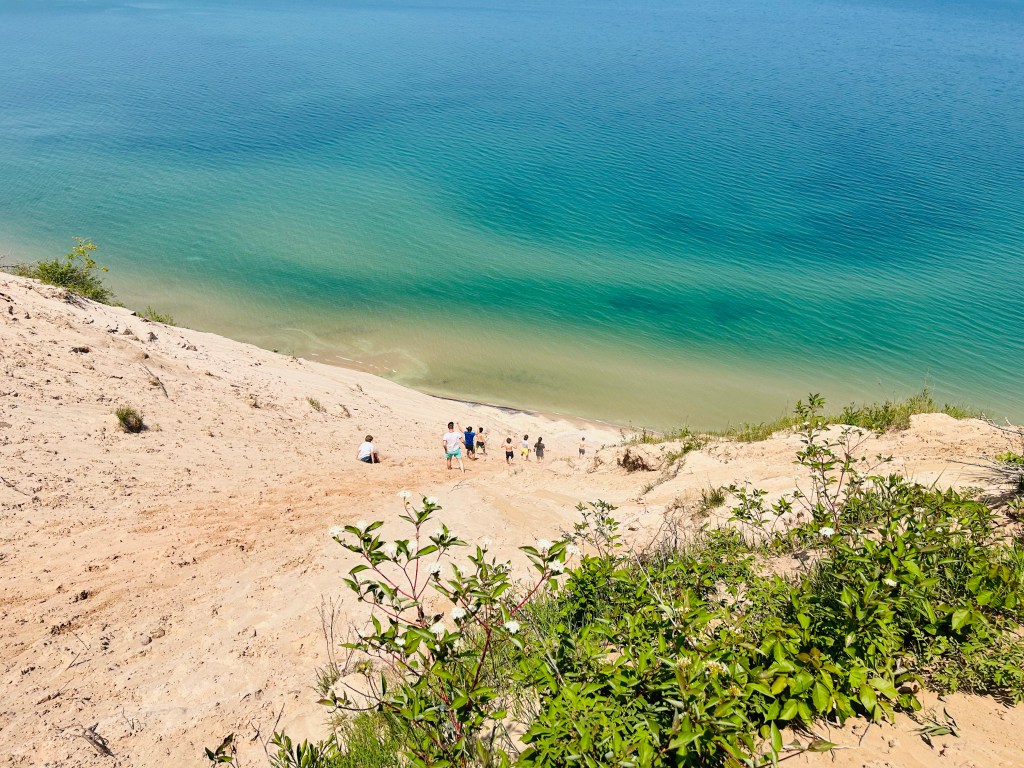
A few highlights include beautiful hikes all around the country – on the beach and dunes of Lake Superior,
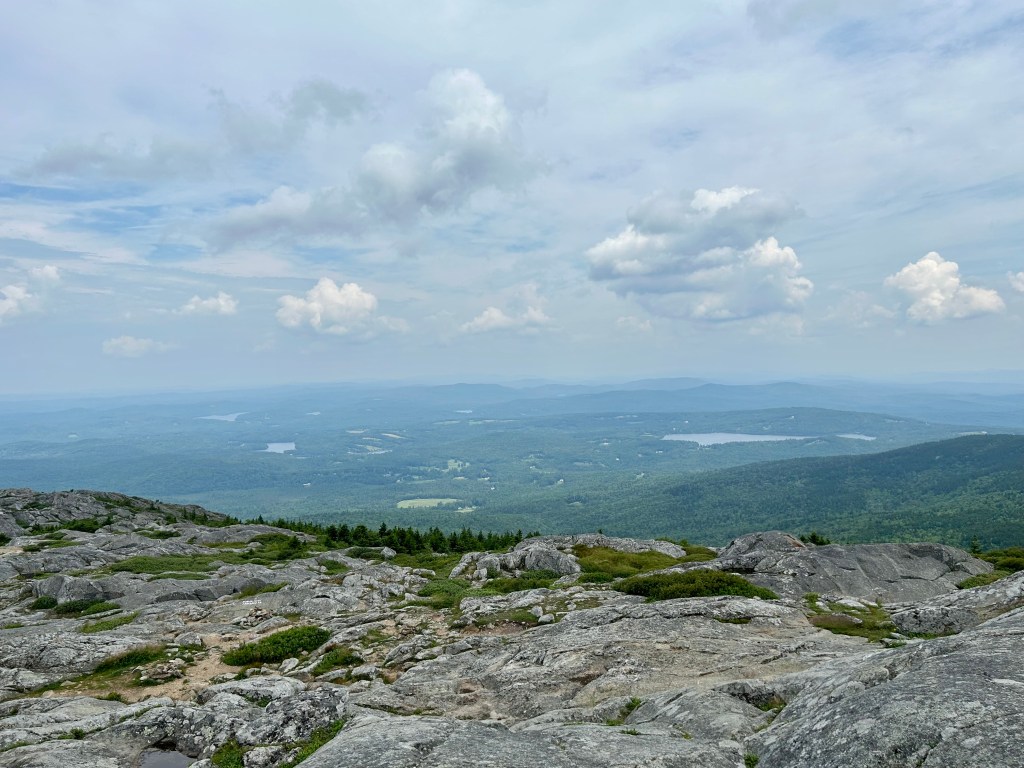
up a granite mountain in New Hampshire,
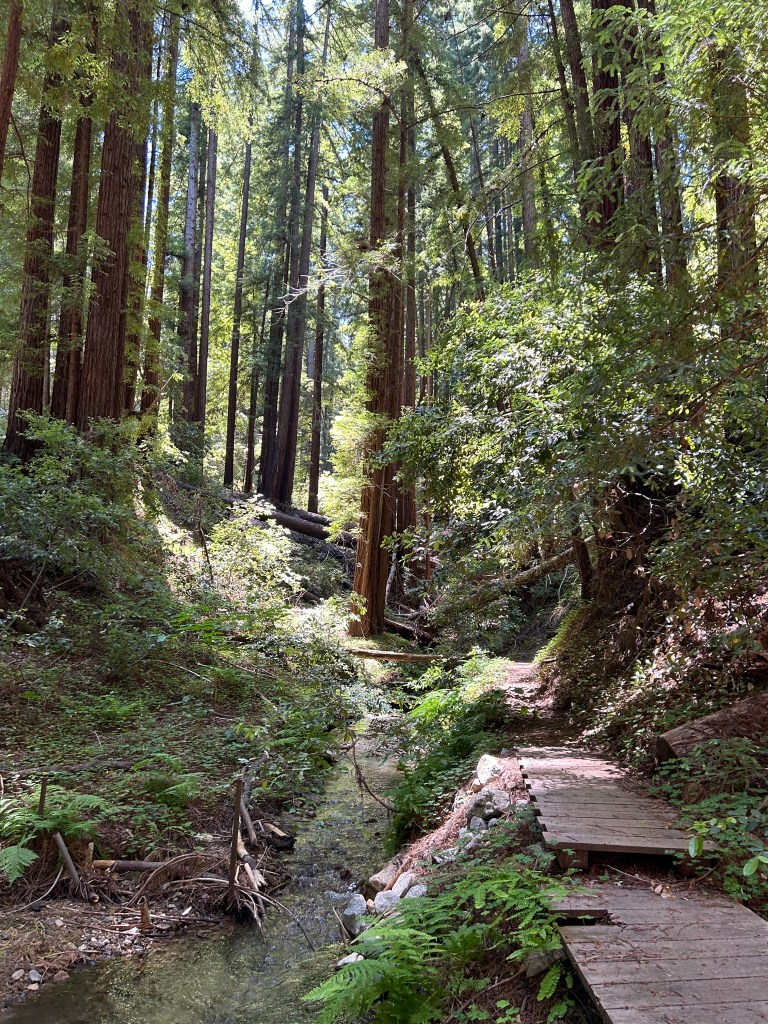
through the redwoods in the Santa Cruz mountains,
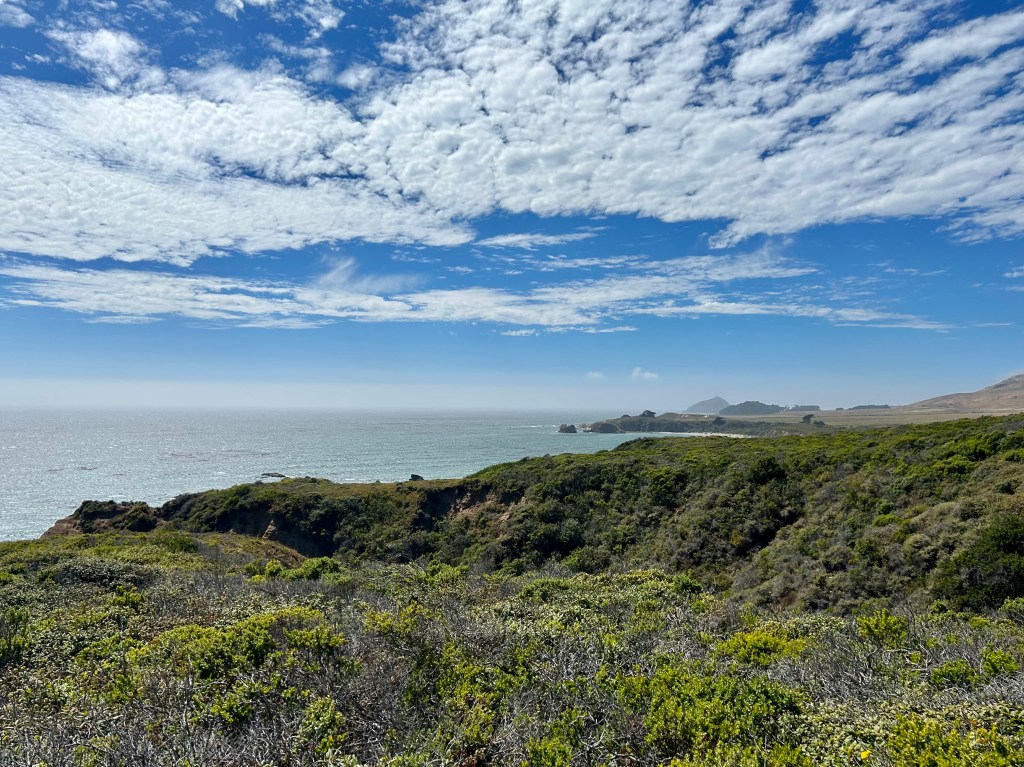
and on the bluffs of Big Sur.
I got to take my first sailing lesson during a lovely and restful visit to see Pat and Steve in New Hampshire. I was able to organize many nooks and crannies of our house that really needed to be cleaned out. During my personal retreat at the Quaker Center in the Santa Cruz mountains I did a lot of reading, rotating between Robin Wall Kimmerer’s Braiding Sweetgrass and We Are the Land: A History of Native California by Damon D. Akins and William J. Bauer Jr. Both books challenged me to reroot myself in relationship with land, ecosystems and history.
I was also honored to be asked by Chude Allen to edit an extensive interview she gave about her participation in the Southern Freedom Movement and as a leader in the women’s liberation movement. Given the spaciousness of my sabbatical time, I was able to say yes to that project which is ongoing. Some of you might remember Chude from her reflection on MLK Sunday four or five years ago.
Eric and I also celebrated our 5th wedding anniversary with a magical getaway just this last week to the Monterey area.
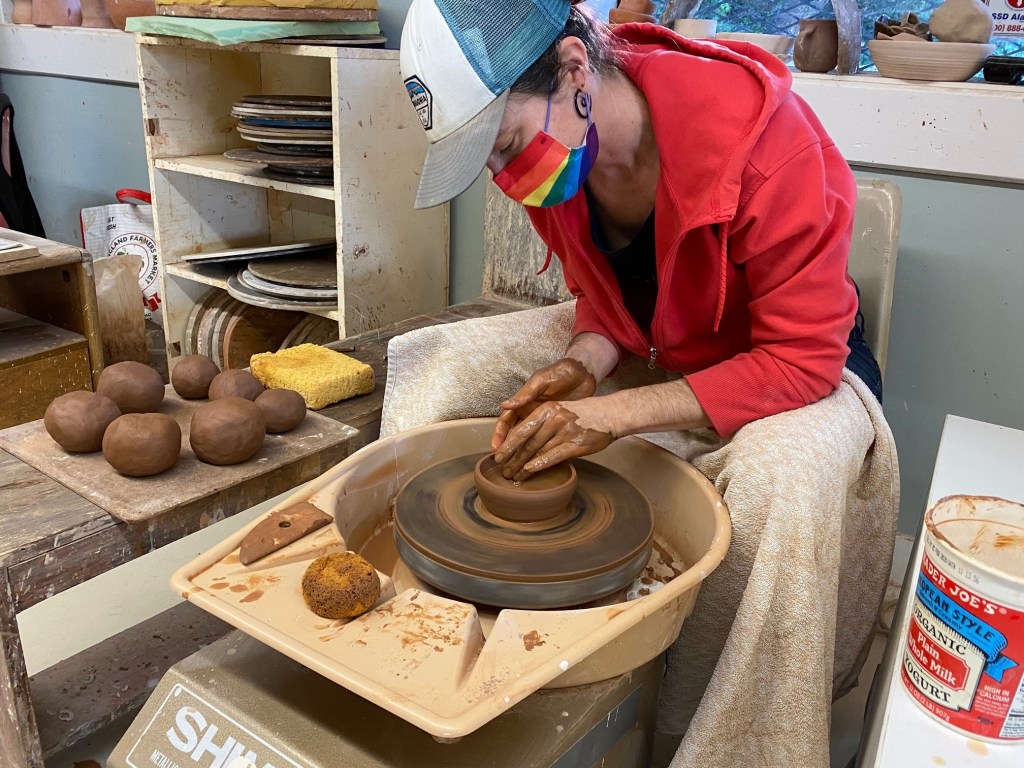
And then there was all the ceramics. I signed up for as many classes as I could between our travels with the expressed goal of improving my skills on the wheel. It was not an easy task and I walked away from a handful of classes wondering if I would ever get the hang of it. I knew that practice, practice, practice (and watching youtube videos) was the name of the game. And still it’s hard to not be good at something.
Here is an example of a potter throwing with ease on the wheel.
In my experience, working with clay requires me to be fully present. That is definitely the case when throwing on the wheel, but it’s also true of handbuilding. I need to be connected with my body so that I can connect with the body of the clay.
When working on the wheel my body has to be centered physically so that I can center the clay. Then I need to be able to trust myself and trust the clay. In just the last week or so I had a breakthrough along those lines. I mean it seems like such a no-brainer, but I realized that I could trust the clay to be responsive to my shaping, because that’s what clay is created to do.
In my timidity I was either treating the clay way too delicately (and making big clunky pieces) or thinking that the clay was out to prove how unskilled I was at throwing. Funny stuff. But without the dedicated time set aside for multiple classes a week, I don’t think I would have been able to move through my insecurities on the wheel. And now I am able to come to the clay in a much more relational way – we are working together to create something beautiful.
This relational approach to the clay informs how I hear the passage from Isaiah:
You are our mother and father, YHWH;
We are the clay and you are the potter,
We are all the work of your hands.
“We are the work of your hands” harkens back to the creation narrative in our scripture, where God shapes humanity from the clay of the earth. We are earth creatures, and I love how this theme connects with Sheri’s sermon last Sunday – we are soil animated by the breath of God.
So yes the potter shapes the clay but the clay is also dynamic and informs the potter of what’s possible. There are all different kinds of clay bodies and ways that clays can be mixed together. The potter must know the clay and work with the clay, even before they start throwing on the wheel. In my case, I am not harvesting the clay that I throw from the earth, but when our scriptures were written that’s how the potters would get the clay.
There are quite a few references in the bible to clay and pottery, sometimes called earthen vessels. Some references are metaphorical like what Helen just read, and others talk about literal potters and their work.
I did some research, especially thanks to the book Women’s Lives in Biblical Times by Jennie Ebeling. As it turns out there was lots of clay in Palestine. During the monarchy, pottery was quite advanced with permanent kilns and wheels. These permanent structures were used by male potters for the mass manufacture of ceramics for the king’s use.
However, before, during and after the monarchy, women made pottery at home for all kinds of domestic uses – food preparation and storage, fermentation, drinking and eating vessels.
Ebeling writes, “We know more about ancient Israelite pottery than we do about any other craft or household technology, although archaeologists have primarily used pottery as a tool for establishing chronology–since pottery forms change gradually over time–rather than a means for investigating women’s technological contributions.”
Pottery was a skill passed down among women in each family line and was a valued asset. It was also a multi-generational effort. Young women helped with finding and cleaning the clay. It had to be dug out of the ground and then all the little stones and other debris were removed. The older women then shaped the clay by hand rather than on a wheel, most likely.
Here’s a clip that shows one hand building technique called coiling… (watch at about 2 min)
Once the vessels dried, then the fire pit was prepared with collected sticks and dried dung. As the fire was tended, the women sang songs to keep the vessels from breaking.
In her book Ebeling notes that there is not much evidence of specific kiln-like structures in ancient Israelite homes. This is probably because pottery was one of many domestic skills woven into everyday life, using already existing bread ovens or cooking pits.
In order to create this pottery the women were engaging in many layers of relationship. They were working together across generations. They were in relationship with the land, knowing where to harvest the clay. They shaped the clay using skills passed down from their foremothers. They fired the vessels using the resources at their disposal – dried branches and dung. They sang together around the fire. I would love to be clay in the hands of these potters.
Perhaps the Divine Creator is a Jewish grandmother, humming as she massages and shapes the clay. She is rolling coils in the shade of her courtyard, instructing the younger women on the technique of water jar construction. The clay is honored to be in her weathered, loving hands.
Each of us, beautiful earth creatures, shaped from the clay. We are made from the stuff of earth and the Divine is always calling us to remember these primal relations. We do not care for the earth as beings set apart, we care for the earth because we are earth, recognizing the abundance with which the earth cares for us.
Even amidst the chaos of our world, may we be recalled to the generosity of the trees who help us breathe and the ground that grows our food and the water that gives us life. May our gratitude for these priceless gifts inspire us to live generously and joyfully. As Robin Wall Kimmerer writes, “I choose joy over despair. Not because I have my head in the sand, but because joy is what the earth gives me daily and I must return the gift.”
May we live as joyful earth creatures, shaped by loving grandmother God. Amen.