
The Gospel of Weakness
2 Corinthians 12:2-10
Last Sunday, I was getting out of my car to unlock the synagogue, when I realized I had left everything I needed back at my house: my computer (which was needed for Zoom hosting), my phone, my notes for worship leading, and the children’s story book. So, I was rattled when I opened the door and put in my code to turn off the synagogue alarm. Rattled enough that I entered my ATM pin code instead of the correct code that I have been entering for almost 20 years.
The alarm started beeping at me, getting louder and more insistent. I knew I had 30 seconds before before the alarm started screeching and before the alarm company contacted the police and synagogue staff. As I stood before the control panel, I could not, for the life of me, remember the code. Sure enough, the alarm began screeching, and all I could think to do was drive to Sharon Heath’s house and, from there, make phone calls.
I have forgotten other key items for Sunday morning in the past but never have I walked out of the house with nothing I needed in my hands. And I have never forgotten the alarm code. I felt shaky driving. How was I going to make this OK and not impact Sunday morning’s worship? How much was this going to inconvenience the staff of the synagogue? I vaguely remembered hearing that every time the police are called for a false alarm, it can cost hundreds of dollars. Were we now going to bear that cost because of my mistake? And, frankly, I was worried about me. What’s the matter with me? Was I losing it? Dementia runs in my family.
Needless to say, I felt foolish. Weak, even. I have long valued my competency, my ability to get a lot done efficiently, to juggle many plates and not drop them, or at least not drop them too often. And I have long valued my intellect, my ability to be pretty aware and on top of things. These strengths have benefitted me, and, I hope, they have benefitted others. So it was especially disconcerting to find that the very qualities that make me feel strong were so absent last Sunday morning.
I don’t like feeling weak. Do you? Most of us believe that weakness is bad and to be avoided as much as possible. We try to hide when we feel weak. We mask. We put on a brave face. We apologize for our weakness. We try to control our lives so we don’t appear weak, or we avoid those situations in which we suspect we may feel weak. Most of us do anything we can to avoid that vulnerability.
It doesn’t help that we live in a society that highly values strength of all kinds. We value physical strength and the athletic skill that often goes with it. We value those people with economic, social or political power. We value people with exceptional skills and talents. We implicitly and explicitly preach the gospel of strength and power.
But Jesus and the earliest Christians proclaimed a different gospel — a gospel of weakness. In the middle of the first century, Paul established a church in Corinth, a large, important and prosperous city in Greece — much like San Francisco. Corinth was a major center of economic trade and a political power broker in the Mediterranean world. Like our society, it valued people who had economic, social and political power. They also valued physical strength and athleticism, as well as skill in oratory and speech. The mystery religions of that time highly valued transcendent spiritual experiences, like out-of-body travel and ecstatic visions, and we know that the church in Corinth also favored the more sensational kinds of spiritual experiences. As one commentator said, “It is not surprising that the cult of power was alive and well among Corinth’s citizenry and even among the Christians who responded to Paul’s preaching.”
This was a problem for Paul because it seems he wasn’t conventionally impressive. A rival group of Christian leaders — Paul sarcastically calls them “super-apostles”— are actively undermining Paul and his teaching because of his perceived weaknesses. The super-apostles claim they are better speakers; they claim to have better supernatural visions and powers. They say of Paul, “His letters are weighty and strong, but his bodily presence is weak and his speech contemptible” (2 Cor. 10:10).
In the face of this, Paul proclaims the paradox of strength in weakness. Paul has had ecstatic spiritual experiences himself, but he was directed by God not to talk about them, even though doing so would have given him status in that society. In addition, he is actually given a thorn — the word could also be translated as splinter, so think of how irritating a perpetual splinter would be — to keep him humble. There’s been much conjecture about what this thorn could be. Many have thought it was a physical affliction like migraines, convulsions, a speech impediment or even leprosy. Whatever the case, God’s direct refusal to heal him keeps Paul “weak.”
Why does God deny his prayer for healing? Here’s what Paul says in the passage you just heard:
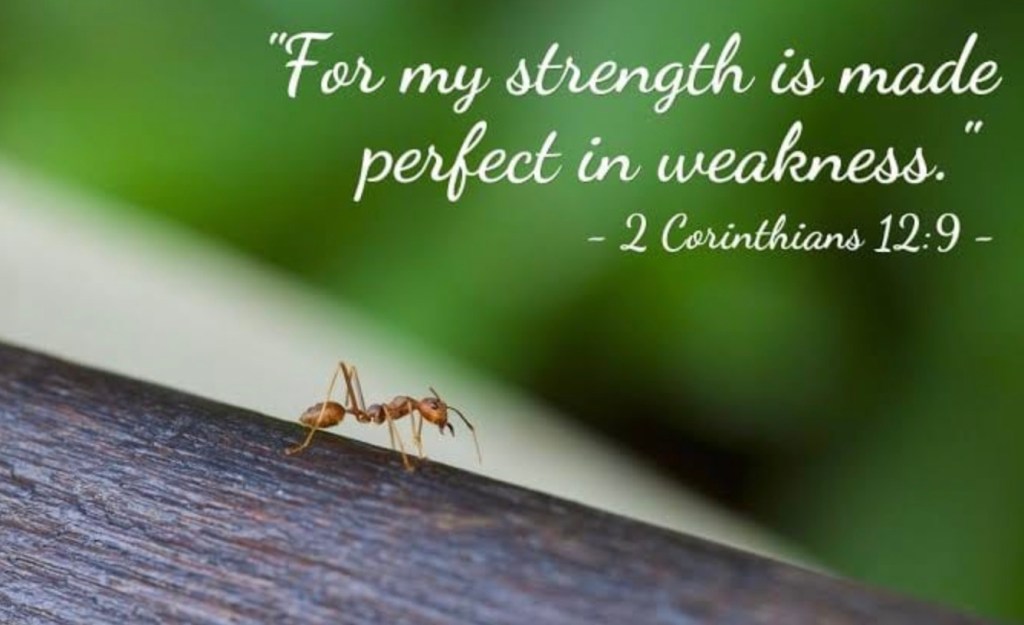
Therefore, to keepme from being too elated, a thorn was given to me in the flesh, a messenger of Satan to torment me, to keep me from being too elated. Three times I appealed to the Lord about this, that it would leave me, but he said to me, ‘My grace is sufficient for you, for power (or my power) is made perfect in weakness.’ So, I will boast all the more gladly of my weaknesses, so that the power of Christ may dwell in me. Therefore I am content with weaknesses, insults, hardships, persecutions, and calamities for the sake of Christ; for whenever I am weak, then I am strong.
God wants Paul to be weak in the eyes of the dominant culture of his day so that Christ’s power, Christ’s strength, can dwell more fully in him. That was as countercultural then as it is now!
Paul writes a lot about the strength in weakness to the folks in Corinth. Maybe he knew their dominant culture so valued strength that he had to actively work against that cultural bias in his guidance to them. Maybe Paul, with his “weak bodily presence and contemptible speech,” was just the kind of apostle the power-obsessed folks in Corinth needed. Maybe this is why Paul so often mentions the paradox of the cross to them. The man they are following was crucified, he reminds them again and again. The cross was shameful to Greeks and Romans — it was a public disgrace. Humiliating. The epitome of shameful weakness. But to those whom God had called, Paul says, the cross is the wisdom of God and the power of God.
I heard this paradoxical power of God in Dorcus’ testimony last Sunday. Dorcus recounted how she was essentially trapped in her father’s home, taking care of children, longing to begin her own life in the world. Not knowing how to make this happen, Dorcus turned to the power of God. She prayed and fasted for two weeks, and — doors opened. She was given a job and a place to live and the wherewithal to leave and begin her life. For whenever I am weak, then I am strong.
Last week in the Substack that Sarah and I write together, she recounted being at a conference and losing the ability to speak because of what’s called a trigeminal nerve flare caused by her MS. She writes: “During a flare, when I try to speak, I experience excruciating pain that immobilizes me. I am frozen, unable to do anything…. It looks like I am having a stroke. I lose the use of my tongue, to speak, eat, or swallow. Those of you who know me know that talking is what I do. In the meeting…I would raise my hand, mumble a few syllables, then freeze. When my mouth gets stuck open, sometimes I even drool. It is humiliating. What surprised me most was how people I have known for years began to treat me like a disabled person. Avoiding eye contact. Speaking loudly and slowly, as though I can’t hear, or else I don’t fully understand English.” She goes on to write about how quickly she became powerless, voice-less, and invisible to folks due to her weakness.
And yet, at the same time, she said: “…during this time of extreme pain, I also experienced joy. Grace, I think. There is no other word for it. I feel such joy to be alive, such love for all the living creatures in this web of life. The bee at my sleeve; the squirrel chittering in the tree. The other humans I can hear breathing through the dorm walls… I am awake to every sensation: the excruciating pain in my face, my exquisite fragility, and also the threads that tie me to my family, my people, my community.” For whenever I am weak, then I am strong.
Last Sunday, I drove to Sharon’s house, and her unflappability calmed me down. She called the synagogue to let them know what happened. I called my husband Jerome, whom I awoke from a deep sleep, but who was nevertheless happy to drive half an hour to bring in the things I had forgotten. I called Pat (who called Joanna) to let them know they might be walking into a screeching building. It turned out that Joanna was only about a minute behind me in getting to the synagogue, so that even as I was driving to Sharon’s house she had already entered the correct code, turned off the alarm, and let the police and synagogue staff know that all was okay. By the time I got back to the synagogue, she had done most of the setup in my absence. All was well.
And, as I recounted my eventful morning to Joanna and her parents, her father quoted me the Scripture you just heard: “God’s grace is sufficient for us, for God’s power is made perfect in our weakness.” This reframed my weakness for me. I thought of all the people who filled in the gaps for me that morning, who helped me out. I thought of how when I am weak in myself, I am strong in community. For whenever I am weak, then I am strong.
The truth is, as spiritual sages have said throughout the centuries, the more vulnerable we are, the more open we are to the presence of God. The more weak we are, the more we experience the strength of community. In our suffering, we often experience the most powerful moments of grace.
And the opposite is true: The more we try to protect ourselves, control our lives, avoid pain and weakness, the more we cut ourselves off from the presence of God, from community, from creation. When we are trying to be strong in ourselves alone, we are cut off from the strength of the web of life in which we live and move and have our being (Acts 17:28). For whenever I am weak, then I am strong. Thanks be to God.