
Sermon: Widows and Children
This sermon is the part of a nine-month series in which we will tell the story of Scripture from Creation to the early Church, using the Narrative Lectionary readings.
I Kings 17:1-16 (17-24)
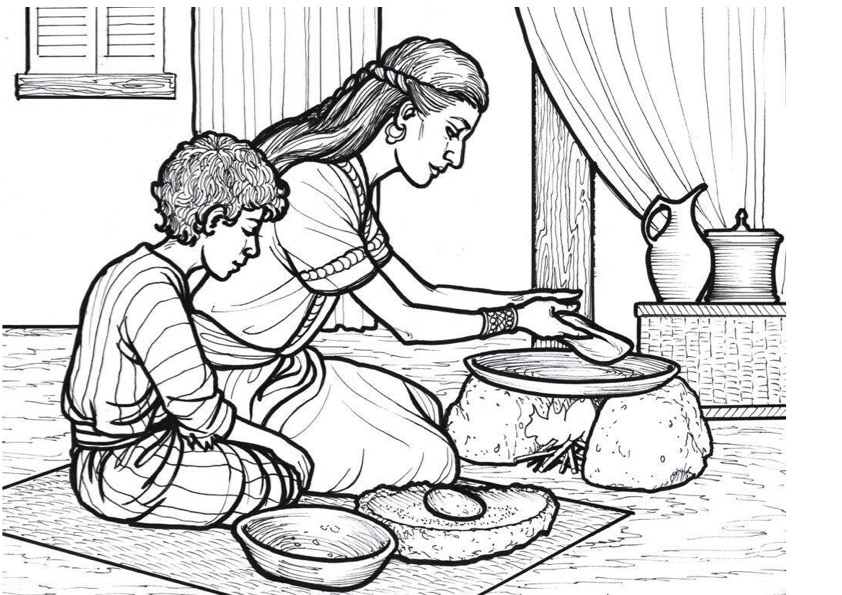
This is a hard story for me. On the surface, it shouldn’t be. On the surface, it is yet another story about how God cares for the most vulnerable in society — similar to the story of the childless Hannah (point) we heard a few Sundays ago or the story of God freeing enslaved people a few Sundays before that. And let’s be clear, the widow in this story is as vulnerable as you can get at that time. Without a husband — and seemingly without family — she has no kin to provide for her or her young son. She would be completely dependent on neighbors or the religious leaders — or perhaps the king would notice her plight?
But in this story, there is a drought. Everyone is struggling to survive. No one can help her. She has scavenged and begged as much as she possibly can. She is reduced to a couple of sticks, a handful of meal, a little oil. Facing reality, she decides – no, she knows — that she and her son will die.
Then the prophet Elijah comes along. A little backstory: Israel is in bad shape at the start of this story. In fact, Israel has been in bad shape ever since it decided to go royal and have a king. Though there have been prophets in Hebrew society ever since Moses and Miriam, prophets come along at a much quicker clip during the period of the monarchy because most of Israel’s kings are unjust kings that disregard God’s operating manual for a just society — the law given at Mt. Sinai. In fact, the monarchy is a system that will always tend toward injustice.
The present king, Ahab, is particularly bad. By kingly standards of that time, he was one of the best. He eliminated his enemies in Israel, consolidating his power. He dominated other nations and people groups. He made Israel great again.
But he was not a good king in the eyes of God. He married a foreign woman, Jezebel, and began worshipping her god, Baal. Soon others in Israel were doing the same. He took the ancestral land of one of his subjects, Naboth, and had him killed to cover it up. Actually, his wife, Jezebel, engineered Naboth’s execution, and the story of how this land was stolen and the cover-up went down is sickening. It was done in a sneaky where they distorted the law and twisted public opinion such that what they were doing seemed okay. Does this sound familiar?
Elijah comes onto the scene at the start of our story to condemn Ahab, which is what prophets do — they challenge unjust leadership, they say again and again how important justice is to God. In this case, Elijah does this not through words but through actions. He initiates a drought. Baal was a storm god, thought to be responsible for bringing the life-giving rains at certain times of the year and thus restoring fertility to the land. By imposing a drought, Elijah is making the point that the God of Israel — not Baal — controls the rain and drought.
And this is where I start to get angry.
I get that King Ahab is a bad leader who deserves to be brought down a notch or two or ten but why do the most vulnerable always have to suffer when the powerful are unjust? I get that Elijah is trying to bring Ahab down a notch or two or ten, but why does he have to prove his point on the backs of the most vulnerable? Who’s going to suffer the most if you punish a king with a three-year drought? Widows and children.
I am so sick of arrogant men making decisions over which women’s children get to live or die. And men, please don’t hear me as targeting you. Women in an unjust system will also govern unjustly. I mean, Jezebel. Margaret Thatcher. Kamala if she wins, is not going to bring about God’s reign on earth. We will still need demand justice, especially for the people of Gaza. But, for most of history for most of the time, it’s been men making decisions that determine which women and children are going to suffer. It’s Netanyahu in Israel whose brutal war has killed more women and children in Gaza over the past year than any other conflict over the past two decades. It’s Biden embracing this man and financing his war. It’s J.D. Vance spreading lies — despicable lies — about Haitian immigrants that have terrorized that community, including school children who can’t go to school because of bomb threats.
For that matter, I’m mad at the God of Israel in this story. It sort of seems like a pissing contest between two storm gods, Yahweh and Baal, both trying to establish their dominance. “No, I’m the most powerful,” “No I’m the most powerful,” “No, I control the rain,” “No I do.” In fact, later in I Kings, they do duke it out. And I’m like, do that somewhere else, in some other realm where innocents won’t have to suffer as you figure out who’s the greatest.
So, remember at the beginning of this series, when I said that we get to argue with these stories? We get to argue with these stories. Okay, let’s step back and take a deep breath.
I get that this story is probably trying to make sense of a very bad drought afflicting this land. And back in this time, people didn’t think, “There’s a low pressure system stuck over the Sinai Desert that’s keeping us from getting precipitation.” They thought, “What is God — or the gods — trying to tell us through this drought? What God — or gods — have we angered and how do we propitiate this God or gods with the right sacrifice or the right actions that will make it stop?” And this story is saying: “Hey, this is the God of Israel’s response to the fact that you, Israel, decided to establish an unjust system that results in unjust rulers like Ahab. This is God trying to get you to return to and embrace Yahweh’s law so you can again be blessed so you can be a blessing to all the families of the earth.”
Also, Elijah, the prophet of God, is not immune from the sanction he calls down upon the land. He’s also hungry and thirsty. He’s also suffering. He gets fed by ravens by a seasonal streambed, a wadi, for awhile, but then he has to keep moving to find food. What’s more, he has to become a recipient of the hospitality of un-kosher people. The widow of Zaraphath is not Jewish. She’s a foreigner living in the epicenter of Baal worship. Elijah is eating “unclean,” un-kosher food that he is accepting from a worshipper of the very god he is condemning In this story, the people of God are not extending hospitality to strangers, they are a guest of those strangers. (Insight from this podcast.)
What’s more, Elijah is such a witness to the presence of God that “foreigners” — the widow and her son — are able to experience God’s grace through him. In fact, later in this chapter, the widow’s son dies, and Elijah resurrects him. He brings him back to life. It’s then that the widow says, “Now I know that you are a man of God and that the word of the Holy One in your mouth is true.” It’s not what Elijah says that causes her to believe in his God, it’s his actions.
Last, the stories about Elijah and the prophet Elisha that follow are considered folk legends — stories that the common people told over and over again, embellishing as they go — as opposed to the official stories coming from the royal priesthood. These folk stories, as Walter Brueggerman says, “are acts of civil disobedience that affirm that much of life — and the power for life — lies beyond royal control in a world where Yahweh’s rule is much more immediate and palpable than royal rationality can allow” (from An Introduction to the Old Testament, page 186). The story subversively claims “that a king who cannot cause rain has none of the powers that properly belong to the office” (186). Okay, I’m warming up to this story.
Friends, we are going into a major election. I know we’re having all the feels about that. And this story is saying how important leadership is. It is saying that the consequences of bad leadership will fall not on the leaders primarily but on the people. God help us as millions of us choose leadership on Tuesday.
And we are also coming into the season of the year where the veil between the worlds thins, as the Celts and many other peoples believed. When our dead are more present to us, when we can more easily communicate with the ancestors, with our beloveds who have died. Even now, the saints of God, who are part of the great cloud of witnesses, are cheering us on we challenge unjust leadership, as we say again and again how important justice is to God not just through our words but through our actions, as we cling to God’s promises to bring life out of death. Amen.