
Sermon: The Soil of our Soul
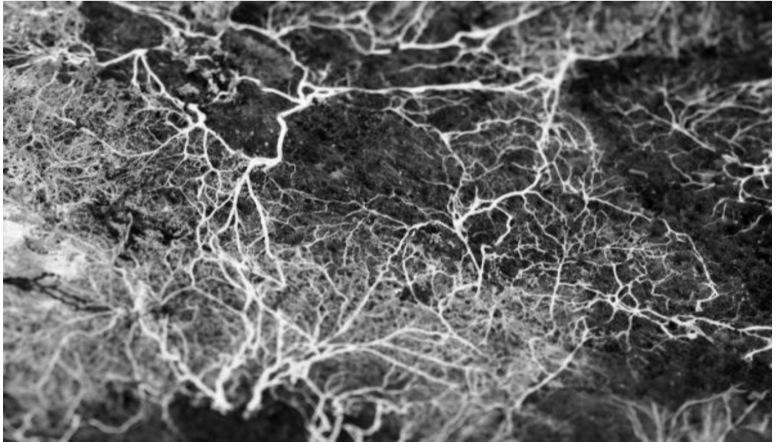
Fungal structures, or mycelium, running through healthy soil.
Matthew 13:1-9, 18-23?
I just listened to a great podcast about what makes for healthy soil. I’m fascinated by dirt in the same way that Sarah Nahar, who preached last Sunday, is fascinated by poop. And if you haven’t heard her brilliant sermon, then you really must!
Jesus also is interested in what makes for good soil in our parable for today. He says first that good soil, the soil in which a seed can grow and flourish, will not be the kind of soil that makes it really easy for birds to eat the seed. And that kind of soil is compacted soil, like on a path that people are walking over all the time. A seed thrown on compact soil isn’t going have any chance to burrow its roots down into the soil. It’s not going to have a chance to germinate before a bird gets to it. It’s just going to sit on top of the soil until a bird comes along and eats it.
Jesus also says that good soil, the soil in which a seed can grow and flourish, is not going to be rocky ground, where there isn’t enough depth of soil for a seed to send down deep roots. So, as soon as a hot day comes along, the plant is going to wither because it doesn’t have access to the life-giving water and nutrients that reside deeper in the soil. We know this right, we know this even if we have houseplants, right? The first two inches of soil can be very dry, but you stick your finger down into where the roots are, and it can be quite moist.
And Jesus also says that good soil, the soil in which a seed can grow and flourish, is not going to have a lot of weeds in it that will compete with the small plant for sunlight and soil and will eventually choke the plant of the things it needs to grow. What an image, right? If we’re choking, we literally can’t get the breath we need to live, and so too weeds will choke the growing plant of what it needs to live — of sunlight, because the weed shades the growing plant, and also because the weed will spread out its roots and outcompete the little plot for soil space.
So we have this hard, compacted soil, where the seed has no chance to send down roots. We’ve got the rocky ground, where the little plant can’t grow deep enough roots. And we’ve got the weedy soil, where thorns or weed outcompete the plant for sunlight and soil.
So, that is all well and true, and there’s more that goes into good soil. Which I now know because I listen to podcasts!
What is soil and how is it different than dirt? Soil is alive in a way that dirt isn’t. Dirt is basically broken down rocks, which are inert minerals. Minerals are super important but they aren’t what make soil alive. Alive soil, which is good for growing plants, is the minerals plus organic matter — decomposing leaves and twigs and tree bark — and then it’s also all the microorganisms and small insects that feed on that decomposing stuff and then it’s also the fungi that do all sorts of amazing things. It’s really a whole complex ecosystem under our feet. It’s like a whole community down there. In fact, soil scientists David Montgomery and Ann Bikle call is the hidden half of nature. It’s hidden because we don’t see it but it’s also hidden because soil is so complex we barely understand it.
You get a feel for this amazing complexity when listening to Ann Bikle talk about healthy soil. So, I’m going to play a little bit of the interview with her from the podcast I listened to, and here’s she’s answering the question of how do you get the minerals in the soil like zinc or iron or magnesium or potassium to the plant?
20:33-22:50 from this podcast episode
Well there’s some very helpful fungi that participate in this process. The large group, there’s different groups of fungi. Those that are the transporters, David and I call them the truckers and the miners of this mineral world in the soil. They are our microrisal fungi. So these are not the kind of fungi that are breaking down organic matter. They have these long thread like structures that are a part of… They’re fungal bodies that run all throughout the soil, in a healthy soil, I should say. And it is through those fungal hyphy that iron, zinc, phosphorus, even other kinds of compounds for which we don’t have a full and complete list, they’re running from some distant location in the soil through these hyphy all the way to the roots of the plant. So you can think once these mycorrhizal fungi enter the root zone of a plant, it’s sort of like the doorstep.
They’ve kind of knocked on the door and let the plant know, “Hey, I got that stuff.” And there’s symbiotic relationships. So these are relationships that benefit plant and microbe alike, because fungi aren’t doing this for free. They are getting nutrition that their bodies need from the plant when they drop the goods off at the doorstep. So zinc, iron, phosphorus, other compounds get dropped off. The plant has been manufacturing an array of sugars, proteins, fats, and that picnic basket of goods is left at the doorstep for the mycorrhizal fungi to take up. So this exchange is going on just ceaselessly and endlessly in the soil. And so that’s how at least the microbial world is interacting with our crops to suffuse them with nutrients.
Cool, huh? There’s all this communication going on between plants and fungi and they’re feeding each other what they need. The problem is that many of our agricultural practices disrupt these relationships. Anytime we dig into the soil with a plow or even a hoe, we’re cutting up those fungal lines of communication, those fungal threads in the soil that are delivering nutrients to the plant. And the chemicals we pour onto the ground— the synthetic fertilizers and pesticides — also scramble this underground communication.
And so our industrial agricultural practices basically turn healthy soil into dirt — a kind of inert, sterile medium that’s not alive, that doesn’t have this robust community of fungi and microorganisms and little insects. In order for a plant to grow in this dirt, you have to dump synthetic nitrogen, phosphorus and potassium into it. These are like the big three food groups or minerals for plants, they’re macronutrients, in much the same way that protein, fats and carbs are for us. The problem is, we and plants need micronutrients to thrive. The big three will keep us alive but we won’t be thriving and we’ll be much more susceptible to disease. In alive soil, as opposed to dirt, there’s not only nitrogen, phosphorus, and potassium coming, there is a vast array of other compounds and molecules that are also made available to the plant — some of which we don’t even know what they are. So while a plant might be getting the big three food groups, it’s actually missing what it needs to thrive. And it’s producing fruit, but the fruit is actually not as nutrient dense as what it should be.
And so when we eat fruit or vegetables or grains that come from inert dirt, we end up without many of the micronutrients that we need in our bodies because we’re not getting them from our food, like we used to. Scientists think these micronutrients have many antioxidants and anti-inflammatory compounds in them, and these things are really important in ways we’re still just discovering.
This has a lot to do with how we grow our food and what we eat. But what does this have to do with our spiritual lives, our relationship to God, to Spirit? Soil is a wonderful metaphor for us. Actually, soil R us. We are, after all, formed from the dust of the ground, according to the Jewish creation story. Made from adamah, dirt. The name for the first human – adam — isn’t really a proper name, but rather a description of that from which they come. We, humans, are adam. Groundlings. In fact, the word “human” comes from the root, humus, or soil, earth. And we are, literally, what we eat from the ground. All those minerals from rocks and nutrients created by microorganisms decomposing twigs — all these things that the plant needs to grow and that the fungi bring them to them — becomes a part of our cells when we eat plants or animals that eat plants. We are, in a very real sense, soil animated by the breath of God. As our creation story says, “And God breathed the breath of life into adam and adam became a living soul.” We are soil with a soul. One writer said “there is a sense in which humans are very complicated, self-aware rocks.”
So given that we are soil with a soul, this parable invites us to ask ourselves: What is the state of the soil of our soul? How’s it doing? Is it healthy soil, in which seeds can grow? Is it good soil, capable of not just bringing forth life but bringing forth abundant life, plants that yield thirty, six, a hundredfold? Jesus is telling us, with this parable, that that is possible for us. Is it possible to be that healthy, that alive, that abundant. So how goes it with the soil of your soul?
I used to begin my morning “soul time — my soil time” with that question. I’d close my eyes and just touch in. Sometimes, I’d journal. And so I invite us to close this time together by doing that. I’ll lead us on a short guided meditation. If you have something to write with and want to do that, please do so. I invite you to close your eyes, if you wish, or not. Whatever helps you connect with yourself.
Is your soil compacted, hard? Ground under? If so, just notice. No judgement. But if you notice that, you may wish to ask: What is compacting the soil of my soul? And you may wish to ask the Good Gardener to loosen the soul of your soil. To fluff it up, to aerate it.
What is your depth of soil? Is there very little there or does it go deep? Are there rocks taking up the spaces where soil could be? Just notice. No judgement. But if you notice this is the case, you may wish to ask: What are the rocks taking up space in the soil of my soul? Or, why is my soil not deeper? And you may wish to ask the Good Gardener to to remove rocks if need be, to add depth to your soil.
Are their weeds in the soil of your soul? In Jesus’ interpretation of the parable, he identifies these weeds as the “cares of the world and the lure of wealth.” Does any of that ring true for you? Or do there seem to be other weeds that are choking what wishes to grow in the soul of your soil? Just notice. No judgement. You may wish to ask the Good Gardener to begin weeding the soil of your soul.
Last, is your soil of your soul healthy, is it chock full of the macro and micronutrients it needs, does it have the organic material and microorganisms and fungi it needs? Is there abundant life going on in the soil of your soul? Just notice. No judgement. If not, you may wish to ask: Why? Or, what does the soil of my soul need to be healthy and alive? And you may wish to ask the Good Gardener to bring abundant life to your soil.
Let’s pray together (a prayer from the early Anabaptist Pilgram Marpeck):
Gardener God, you have planted and protect us by your faithful hand.
Send us the sap of your grace from Christ, the True Vine,
and make us blossom and bear the fruit of love as a sign of your life in us.
Let the sweet fragrance of the shoots you have planted
give you praise forever. Amen.