
Sermon: The Miracle of Enough
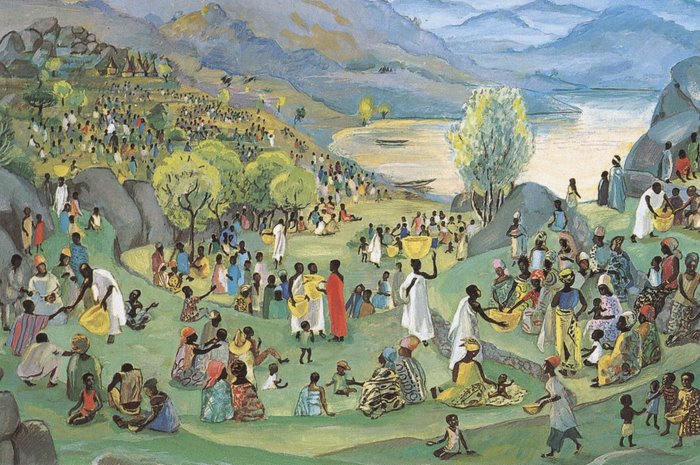
“Jesus multiples the loaves and fishes” from JESUS MAFA, a iChristian community in Cameroon, Africa.
Matthew 14:13-21
We worked with this passage at our lectio group on Tuesday, and something that Sarah Rezny (who has given me permission to share this) really struck me. She said: “This is one of our big stories,” which I initially heard as her saying “This is one of our big stories.” What she was actually saying was, “This is one of our big storeis,” in the sense that that (and here I’m reading from a text she wrote): “I felt myself in the lineage that fed from this story — I got myself a little bite of L&F to chew on.”
Either way you emphasize it, this story really is one of our big stories. It’s the only story that is found in all four of the Gospels, and it’s found twice in Mark and twice in Matthew. So, just a chapter later in Matthew, after this feeding of the five thousand story we just heard, we get the feeding of the four thousand story.
Why is this such a big story? I think we often think it’s a big story because it’s saying something like, “Hey, Jesus can do miracles — he can multiply food. Better believe in this guy because he’s the real deal. He’s the son of God.” And then we moderns don’t know what to do with a story that asks us to believe in miracles we may not be able to believe in.
But I don’t think that’s the reason this story was included six times in the four Gospels. The Galilean hills were crawling with healers and wonder workers at that time who were regarded as doing miraculous things. Doing miraculous things didn’t set Jesus apart from others. I think Jesus’ followers repeated this story over and over again not because it was saying “Jesus is the Son of God and believe in him” but because it was saying something essential about what God’s dream is for the world — what Jesus called the kindom of God. It was saying something about what the kindom of God is like. And that, of course, was Jesus’ big message. He came to announce and enact the kindom of God.
So what does this big story tell us about the kindom of God? In every one of these stories, you have lot of people gathered together. If we are to believe our story for today, the crowd could have numbered fifteen to 20,000 people. That’s big even for our time, and even if the story is exaggerating, it’s trying to convey that it’s a lot of people. And it’s a lot of people getting really hungry. In the story of the 4,000 that follows this one, it says that people had been with Jesus for three days with nothing to eat and Jesus is afraid they’re going to faint on their way home. So, maybe this crowd is not just getting hungry; they might be famished. The disciples’ solution to this problem is to send the people away so that they can go fend for themselves by buying food in the surrounding villages.
This market-based “solution” is unrealistic and will only result in hunger. It’s very likely many of these folks didn’t even have the money to buy food. They were poor and sick, possibly homeless. Homelessness and extreme poverty were at crisis levels at that time. As one Bible scholar and economist said, “The transfers of wealth out of the poor regions and into the wealthy ones had decimated the rural areas where Jesus did most of his ministry.” Basically, the elites in the cities were finding a variety of ways to take land peasants used to use for subsistence agriculture — for growing food to feed their families and communities — and converting that land into export farms that grew food for the people in the cities. This latter use of the land brought a lot of profit to the landowners, but it emiserated the peasants. It created an artificial scarcity. They no longer had the ability to grow food for themselves, and instead had to buy it using money they didn’t really have.
This is an old, old story. I actually go over this story in the book Sarah and I wrote that is coming out in October. Elites have been finding ways to take land that people use to self-provision themselves and turning them into desperately poor, easily exploitable people for a very long time. I was just reading a blog post about how the Irish famine of the 1840s — a famine which brought my husband’s father’s family to this country — wasn’t caused because of the potato blight. Did you know that? I mean, it was. The potato blight did decimate potato harvests for several years. But the real cause of the famine in Ireland was the same reason people in Jesus’ day were hungry — the British colonizers were enclosing (that is fencing in) the best farmland, taking it out of local food production and using it to grow food to export to Britain. This brought great profits to the landowners. At the same time, they raised rents on the land and housing so that, as Eliza Daley said, the Irish people could barely afford either food or shelter but not both. And during this same time, the former wide variety of potato cultivars was reduced to just one or two strains that shipped well, which made crop failure much more likely because pests or disease-causing microbes could decimate an entire harvest now, as opposed to just part of the crop. The famine was not caused by the potato blight. It was caused by theft of the land. This didn’t just happen in Jesus’ time or in the 1840s in Ireland. This is happening to Indigenous and other vulnerable people all over the world today. It’s an ongoing story.
Jesus, of course, is not going to accept his disciples market-based solution because it’s compassion that’s brought him to these people in the first place. At the beginning of our story, he was grieving the murder of his first cousin, John. That’s why he withdraws in a boat to a deserted place. He is just trying to absorb the shock and loss of John’s being beheaded by King Herod. But then he sees the crowds that are following him on foot, and he has compassion for them. Now, compassion is not pity. Pity isn’t wrong, but there’s a distance in it, right? You see someone who’s so much worse off than you and you feel bad for their plight. But the Greek word used here for compassion is a body-related term that refers to the internal organs. Someone said “gut wrenching” is the best English equivalent for the bodily feeling that’s being described here. It’s a whole body, visceral response to suffering.
So, Jesus, whose guts are wrenched by the suffering of these people, says to his disciples, “They have no need to go away.” They don’t have to leave and spend money they don’t have because there’s enough for everyone right here. Right now.
The disciples don’t believe this. They only have the basic peasants’ lunch they had packed earlier — a few loaves of bread and some fish. Clearly not enough. Jesus says: “Bring this little you have to me.” Jesus blesses the bread and breaks it and passes it around. And the miracle of enough happens: “And all ate and were filled; and they took up what was left over of the broken pieces, twelve baskets full.”
I personally believe that in a time of food insecurity, the real miracle here is hungry people sharing the little they already have with each other. Practicing mutual aid. Letting go of that hunk of bread and trusting that they will receive enough in return. The miracle also occurs when folks who have adequate food let go of their several loaves of bread and baskets of fish, trusting that they will receive enough in return — and that everyone having full bellies makes everyone more secure.
That is more of a miracle, in my mind, than Jesus multiplying food. And it’s more consistent with the kindom of God that Jesus came to announce and enact. I don’t think this story is telling us that the kindom of God occurs when a wonder worker somehow defies the laws of nature. The kindom of God happens when we trust the economics of enough more than the economics of artificial scarcity. The kindom of God happens when we devise just, equitable, compassionate economic systems that don’t leave some having it all while others have almost nothing. If the land and its wealth are held captive by a profit-seeking few — making some overly full while others starve — then none of us are ever secure. But if the land and its fruit are equitably shared, there is enough for all.
Given the incredible inequities and injustices of our global economic system, such an economy actually does feel like a miracle. But what if Christians all over the world heard this story this Sunday and — instead of believing in miracles or instead of just believing gin miracles — decided to work together to refashion our economic systems until they more closely resembled the kindom of God? Now, that would be a big story. May it be so. Amen.