
Sermon – Penn’s Holy Experiment: Quaker and Mennonite dealings with Native peoples in colonial Pennsylvania
This sermon was given by Lisa Hubbell and Sheri Hostetler. Many of us aware of the myth of the first Thanksgiving and the harmful and false story it tells of Pilgrim-Indian relations. Lisa and Sheri reflect on our Peace Church myths around Quaker and Mennonite relationships with Indian people. In particular, we tell stories of how how our Quaker and Amish/Mennonite ancestors tried to live out their idealism after coming to this country and the way that idealism was compromised by the reality of settler colonialism.
LISA: Picture this: It’s the mid-1600s in Europe. Lots of religious sects are worshipping in new ways, and governments are persecuting them. Some of these sects have established colonies in the so-called New World, on land grants from rulers claiming rights to those places through the Doctrine of Discovery.
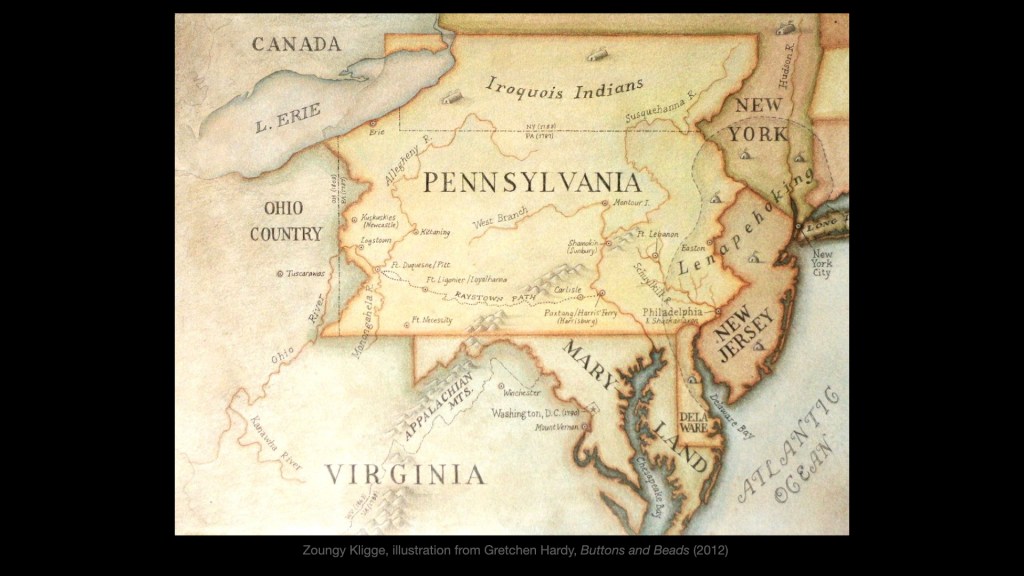
The Quaker William Penn received such a land grant from Charles II of England, in repayment of a loan made by his father, who had been a Navy admiral, an Anglican, and a member of Parliament.
The land granted to the younger Penn, 45,000 square miles between the colonies of Maryland and New York, was as big as England itself. Penn wanted to try what he called a “holy experiment.”
As Colin Woodard writes in American Nations: “Penn envisioned a country where people of different creeds and ethnic backgrounds could live together in harmony. Since his faith led him to believe in the inherent goodness of humans, his colony would have no armed forces and would exist in peace with local Indians, paying them for their land and respecting their interests.”
In 1682, twenty-three ships brought 2,000 Europeans to Pennsylvania. These emigrants included some of my Quaker ancestors, part of an English and Welsh group who hoped that bringing up children in Pennsylvania would provide land for them to inherit and surround them with people whose behavior modeled “holy conversation.”
Ten generations of my mother’s family lived in Chester County, just west of Philadelphia. My Hickman ancestors lived in a cave until they could build a home, which was not uncommon. William Penn and many of the richer Quaker settlers, including my Baker and Smedley ancestors, were slaveholders.

In 1683, Penn had a tract distributed widely in Europe to promote settling in Pennsylvania. About a third of it recommended the natural setting and the abundance of what grew there. Half described the native peoples, their customs and governance. And a few paragraphs mentioned the Europeans already settled and farming there: Dutch, Swedes, and Finns. Groups of families could purchase land near each other, to establish townships and houses of worship that were often named after the places they had come from.
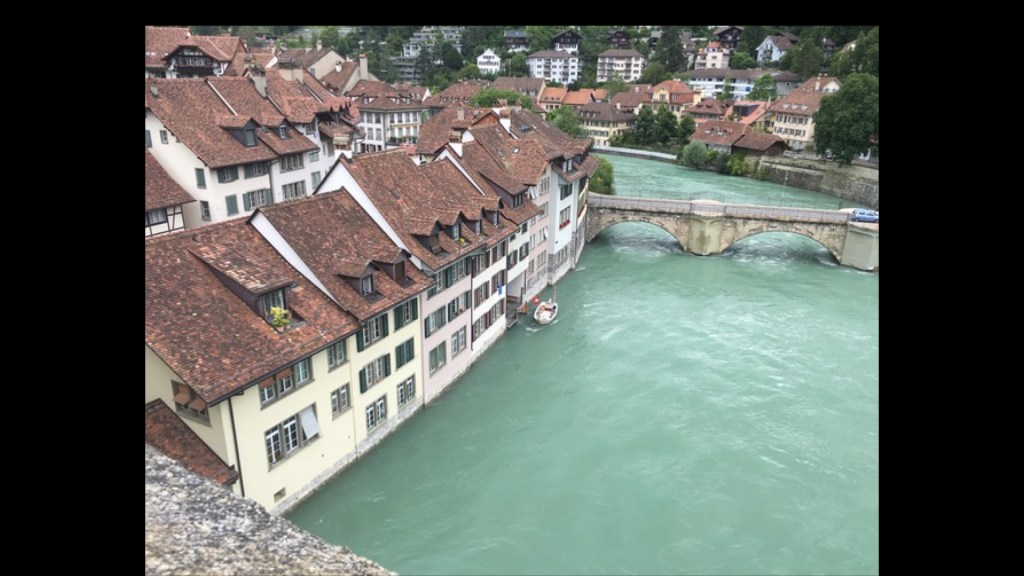
SHERI: My family was among those wooed to Pennsylvania by Penn’s promise of religious freedom and land. My homeland of Switzerland was one of the birthplaces of the Anabaptist movement in the early 1500s but it was also the place of the heaviest persecution of Anabaptists, who were considered both heretical and a threat to the state. Persecution included jailing adults, placing children in foster care, confiscating possessions, and forbidding Anabaptists from owning land. In 1670, the canton of Berne upped the ante when they began deporting Anabaptists to serve on Venetian galley ships. This was considered a fate worse than death to many.
Because of the severity of the persecution, many Swiss Anabaptists escaped to Alsace, a region north of Switzerland that has been fought over by both France and Germany over the centuries. My grandfather seven times over, Jacob Hochstetler, ran an “underground Anabaptist railroad” to help smuggle people out of Switzerland and into the Alsace.
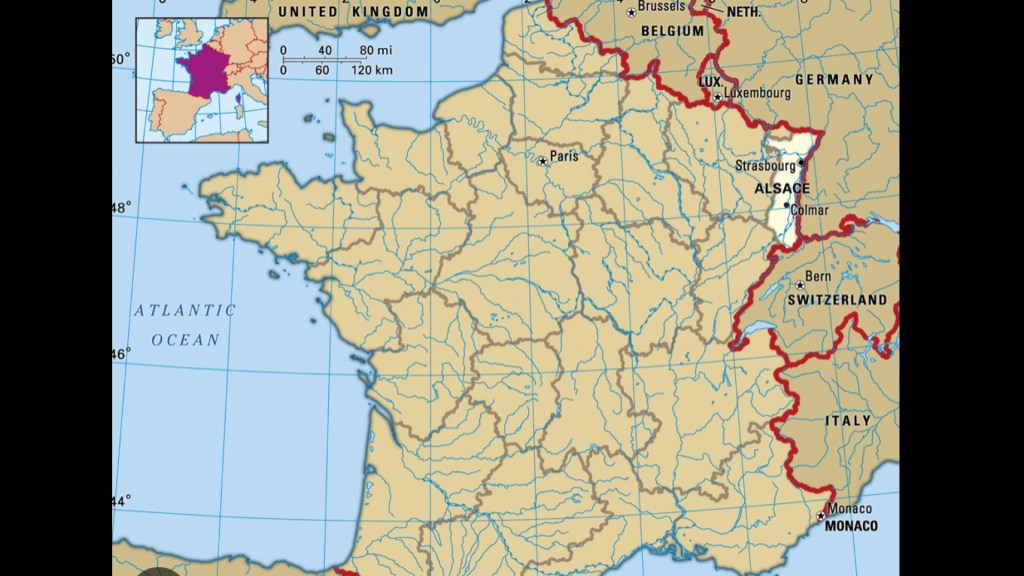
The Alsace had been devastated by the Thirty Years War earlier in the 17th century. After the war ended, the royal authorities who governed that region were desperate to encourage immigration so people could farm the lands that had been deserted. The Anabaptists, long known for being good farmers and eager to settle where no one else wanted to go, moved there, including my Amish family.
As often happened, the whims of the kings and princes shifted and intolerant authorities took the place of those who had once shown tolerance to the Anabaptists. The intolerance must have been quite severe, and William Penn’s salesmanship so good, that many Amish chose to take the long, hard and treacherous journey from their homeland to this new land called America.
On Nov. 9, 1738, my grandfather six times over, Jacob, his unnamed wife and two small children walked down the gangplank of the ship Charming Nancy in Philadelphia and settled in the Northkill area of what is now Berks County, Pennsylvania, along with other Amish families. This was the historic land of the Lenni Lenape.

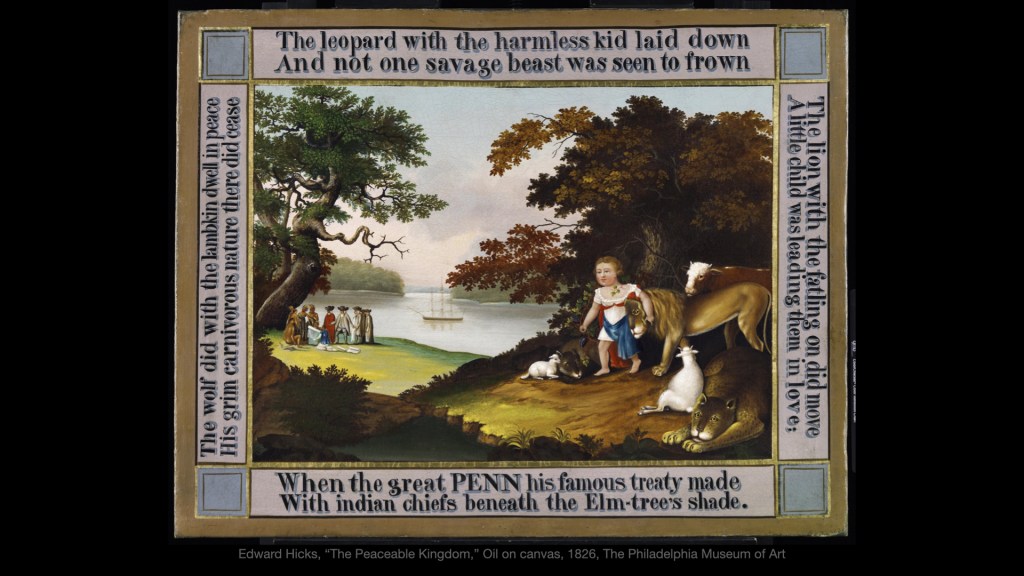
LISA: Edward Hicks was a Quaker sign painter in Pennsylvania, who lived from 1780-1849. He is known for painting dozens of versions of The Peaceable Kingdom. As you can see in this one, the animals on the right represent the scripture we heard earlier, adapted into a poem around the left, top, and right of the painting. The figures on the left, and the last line below the painting, represent William Penn and a few other Quakers signing a treaty with the Lenni Lenape people. So Hicks draws a parallel between Isaiah’s prophecy of a peaceful co-existence of predator and prey animals, and of that between settlers and native peoples in Penn’s Holy Experiment.
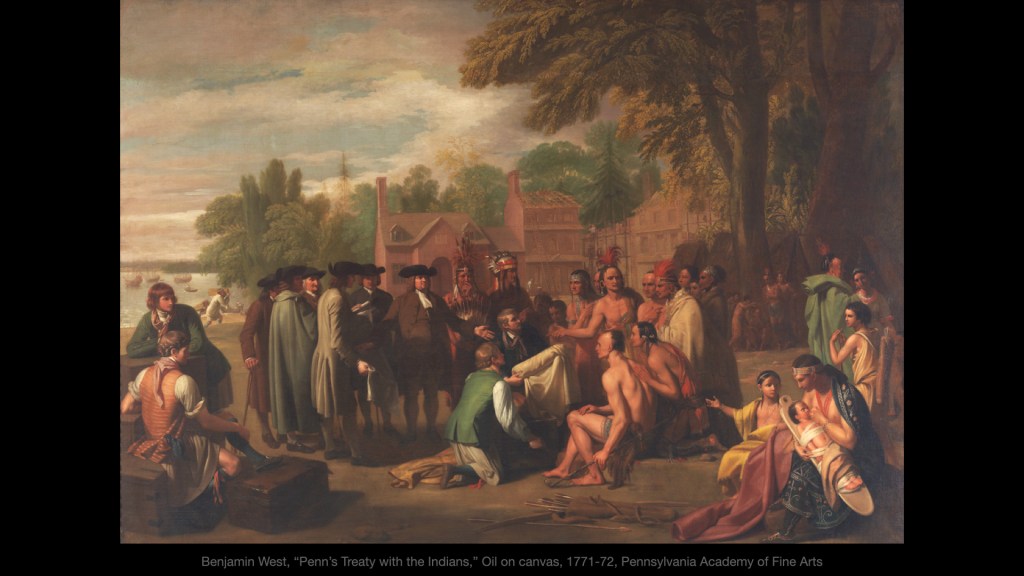
This painting by another Quaker artist, Benjamin West, is the source Hicks used for the treaty scene. It was commissioned by Penn’s son Thomas in about 1771, long after Thomas and his brothers had converted to Anglicanism and turned their backs on the fair dealing that their father had been known for.
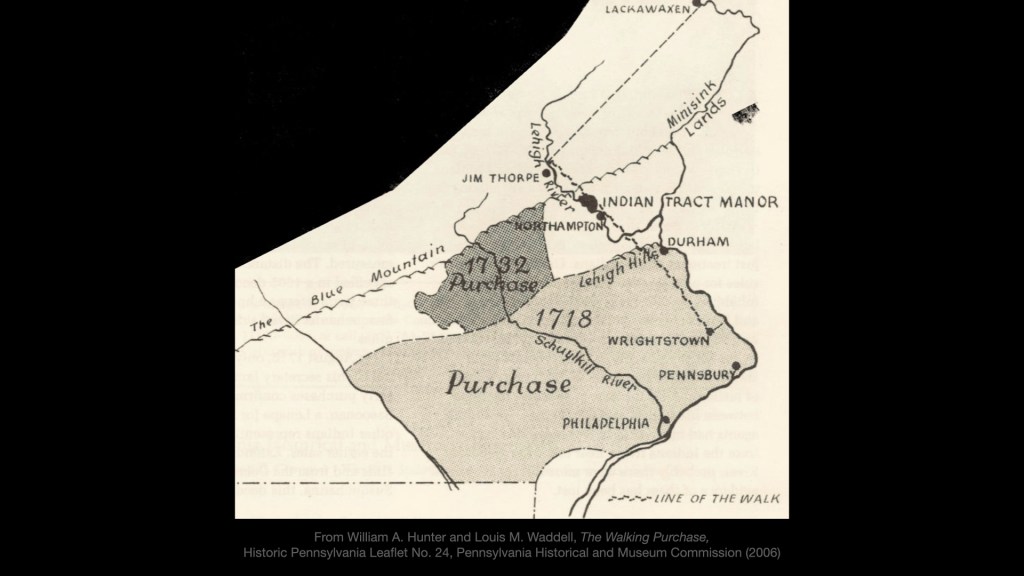
Historic Pennsylvania Leaflet No. 24, Pennsylvania Historical and Museum Commission (2006)
The Penn brothers are best known for a land swindle in 1737 called the Walking Purchase. They falsely claimed to have found a lost treaty made with their father 50 years before. After Lenape leaders agreed to cede the amount of land a man could walk in a day and a half, Penn’s sons and their agents surveyed and cleared the path that would yield them the most land, and trained the fastest runners they could find. One runner completed 65 miles. Drawing a right angle from his finish line towards the Delaware River, the Penns claimed 1200 square miles, about three times the amount the Lenape leaders had expected.
William Penn had been scrupulous about paying native peoples for their land before selling it to settlers. When he died in debt in 1718, his wife and sons did not keep up with paying the Lenape for their land. Meanwhile, there began a massive immigration into Pennsylvania by Scots-Irish people, many of whom squatted on native land west of existing European settlements and formed their own militias.
SHERI: My ancestors had now been settlers in Northkill for almost 20 years. Initially, relations between the European settlers and the Lenni Lenape were good due to William Penn’s values of treating the Native people fairly. But these good relations fell apart after the Walking Purchase and other acts of colonial treachery. Repeatedly, European settlers encroached on the territory of the Lenni Lenape, who were pushed further and further into the western part of Pennsylvania and Ohio Country. There, the Lenni Lenape allied with the French, who had claimed the Great Lakes and the whole valley of the Ohio and Mississippi Rivers. For their part, the English made an alliance with the Iroquois, historic enemies of the Lenni Lenape. The so-called “French and Indian War” had begun, which was essentially a war between two colonial powers who used the Native people and European settlers as pawns in their own power struggles.
The French openly encouraged the Lenni Lenape to attack settlers living on “English” lands, that is, Pennsylvania. Many of the settlers Penn had recruited were pacifist Quakers, Amish and Mennonites. Given this reality, the English purposefully settled the Scots-Irish refugees, who were willing to fight, at the edge of the frontier, where they could serve as a buffer between the attacking Indians and the pacifist Quakers and Mennonites. Many of these Scots-Irish formed militias and made vigilante raids into Indian territories to deal with “the Indian menace.” Though the Amish desired to live in peace with their Native neighbors, they took no part in government affairs and allowed others to deal with questions like the “Indian problem.” Neither did they make any peaceful overtures to the Lenni Lenape. As J. Virgil Miller writes, “The Lenni Lenape could, thus, hardly be expected to distinguish between a ‘peaceful’ settler and a hostile one.”
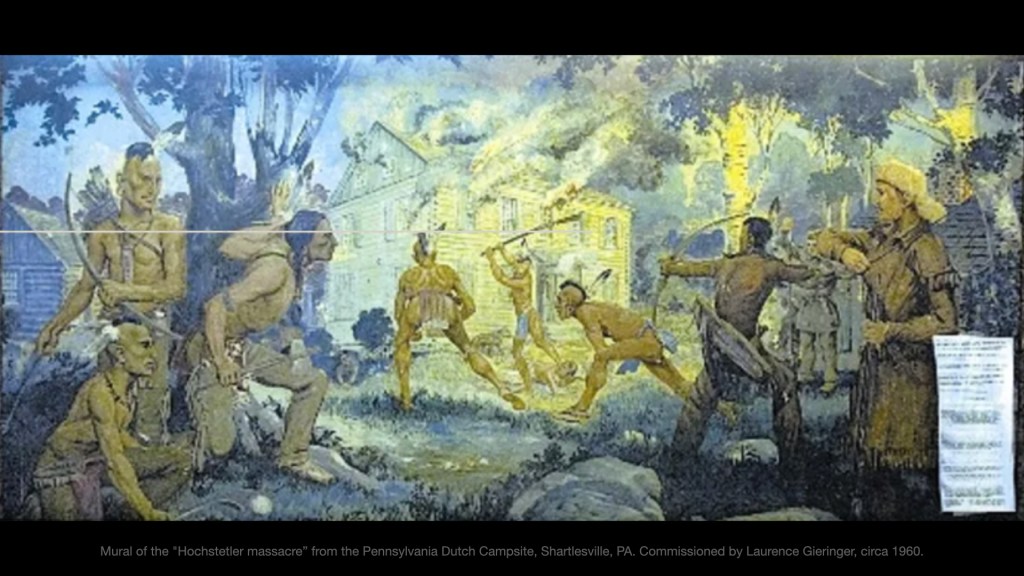
On the evening of Sept 19, 1757, my ancestors were attacked by a party of Lenni Lenape and French scouts. I will not fully recount this story, although I know it in great detail. Suffice to say, Jacob’s wife, son and daughter were killed, and he and his two eldest sons were taken captive by the Lenni Lenape. At one key point, the family might have averted disaster if Jacob had allowed his sons to shoot the attackers in self-defense. He did not, however, and this story has been passed down for generations through Amish families as an example of our ancestor Jacob’s faithfulness in the face of trial. Generations of my ancestors have looked to him as an exemplar of our faith and a model to which we should all aspire. I agree with them.
But the story, which has become known as the “Hochstetler massacre,” also completely omitted any historical context that might explain why the Lenni Lenape attacked settlers like my ancestors in the first place. This is an example of the phenomenon known as “settler innocence.” The story paints our family as good, hard-working, religious people who came to this country seeking the ability to practice their faith in peace. They were brutally attacked by Natives who — bereft of their own story or motivation — simply appeared bloodthirsty and savage, rather than people whose lands had been unjustly taken and their people savagely killed.
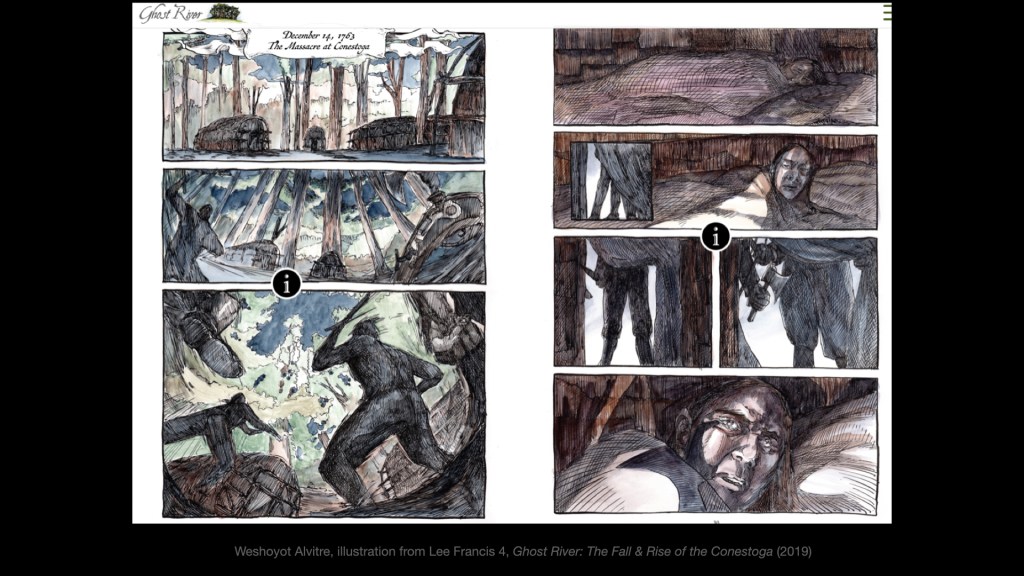
There is another story of a massacre that I never heard. This one happened six years later and is known as the “Conestoga massacre.” The Conestoga were a resolutely peaceful Indigenous group living about 40 miles west from where my family had settled. By 1763, they had lost most of their hunting grounds to Mennonites and other settlers and so had become dependent on begging, financial support from the Pennsylvania government and selling crafts to settlers. For their part, the colonial owners of the former Conestoga land were more inclined to rent and sell that land to Mennonites, whom they regarded as more orderly than the Scots-Irish settlers and who were also wealthier.
On Dec. 14, 1763, a Scots-Irish militia called “The Paxton Boys” committed an act of domestic terrorism when they attacked a village of Conestoga Indians, knowing the impoverished pacifists sleeping inside their huts would not fight back. They killed many and set the buildings on fire. After the murder, local magistrates removed the remaining Conestoga to a Lancaster jail for their own safety. But on Dec. 27, the Paxton Boys rode into Lancaster and slaughtered the remaining Conestoga at the jail — fourteen people, among them 8 children. (Much of this history comes from the graphic novel, Ghost River, mentioned in the above caption.)
While the terrorism of the Paxton boys is easy to denounce and the Mennonites’ pacifist innocence easy to assert, my friend Tim Nafziger has said that “a deeper analysis calls us to reckon with the preferential treatment Mennonites received when it came to fertile land access and eventual property ownership. Mennonite settlers reaped the benefits as Indigenous peoples’ lands were taken out from under them and as other refugee groups like the Scots-Irish served as strategic buffers. Indeed, the Paxton boys’ very acts of violence may have further insulated Mennonites from the brunt of hostilities arising from their occupation of Native lands. I hope we can see how overt acts of terrorism like the Conestoga Massacre can mask deeper layers of violence.”

LISA: Most Quaker kids have probably seen this painting, often in their meetinghouses. Painted by an Irish Quaker during World War I, it’s based on an event from 1777 in New York.
The British had recruited native people to attack colonial settlers. On the arrival of such a war party at a Quaker meeting, a Friend came out to welcome them into worship in their own language—though I think many of us were told that they strode in carrying their weapons but immediately felt the gathered spirit of the meeting and sat down to join the Quakers in worship.
Legend has it that the would-be attackers then placed a white feather over the door to signal that the Quakers were people of peace who should be left alone.
So Quakers are still bringing up children with an idealized story that Penn and the rest of our forebears were “better” than other settlers. And I recognize that I still want to believe that we, of the peace churches, are the “good ones” who make and act on the right choices.
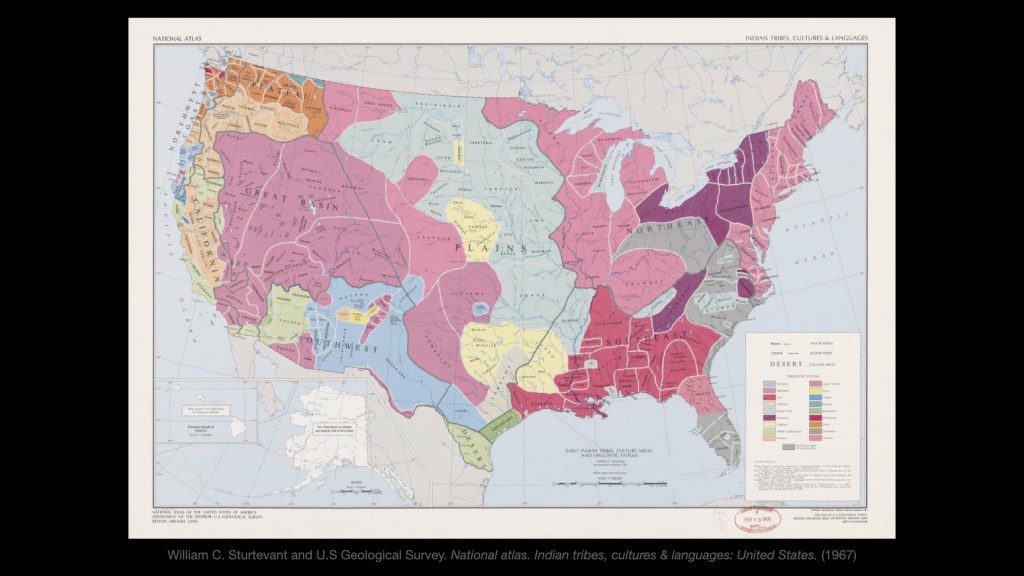
SHERI: We are proud of the ideals of our ancestors, especially their witness to peace and nonviolence. In tangible ways, they lived out those ideals, sometimes at great sacrifice. But those ideals were also compromised by the structural violence of colonialism in which they participated.
What are the stories of your family, the ones who first came to this country? What is your story, if you are the first to come to this country? And what are the stories of the Native people in the place where you or your family first settled or immigrated?
LISA [quoting from FMCSF land acknowledgment]: What can we do to support local Native people, as well as the Native people of those lands, in their work for justice?
What do we need to do or stop doing to live in greater harmony with the earth as tangible ways of honoring the original inhabitants of these lands?