Sermon: Original Sin
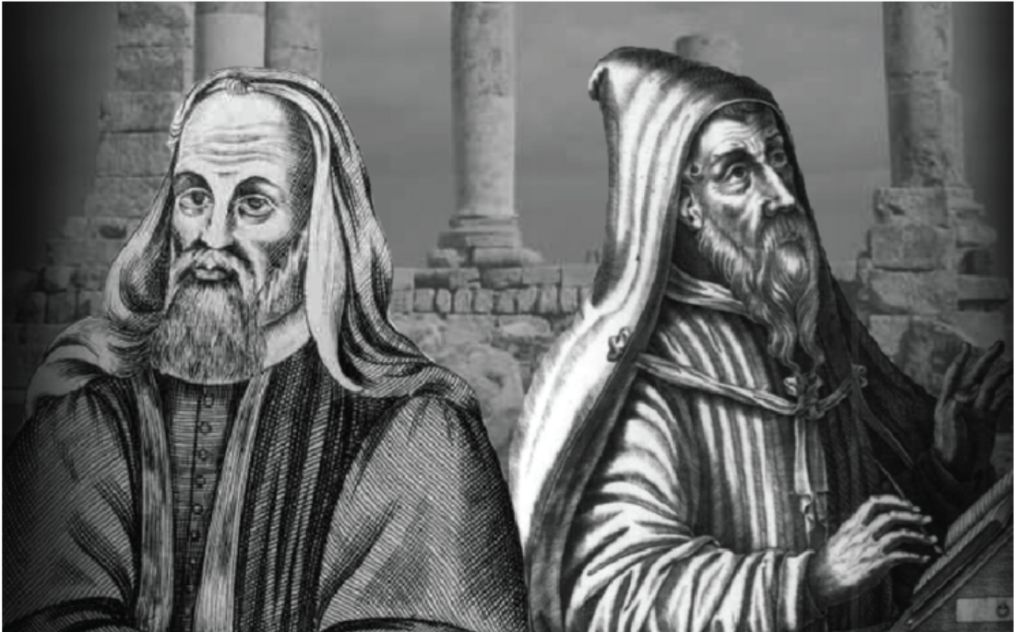
Above: Pelagius and Augustine, who argued over original sin in late 4th and early 5th centuries.
This sermon is part of our annual “Throwback Sunday” series, where we look at older theological concepts that we may not find helpful (or even tolerable) anymore. We ask where they came from, what were their consequences, and whether or not they are still relevant or meaningful in any way today.
Romans 5:12-19
There was a billboard I passed probably every week of my life when I was growing up. It was on the road between Berlin where I grew up, and Millersburg, Ohio — the county seat and where we did our shopping — and it was a billboard of the Four Spiritual Laws. How many of you are familiar with these? The four spiritual laws are a summary of the Christian Gospel formulated in such a way that they made it easy for people to evangelize and stay on message. And though they come from within the evangelical tradition, these four spiritual laws present a Christianity not that different from what mainline Protestantism and Catholicism. The laws were basic Christianity. For me growing up, these four spiritual laws were obvious — on par with saying that gravity was a physical law of the universe. Here they are:
- God loves you and has a plan for your life. (I don’t remember the “has a plan for your life” being on my billboard!)
- Humanity is tainted by sin and is therefore separated from God. This is the doctrine of original sin, which basically asserts that because Adam (and Eve, but it seems only Adam really gets mentioned most of the time) sinned by disobeying God’s law and eating the fruit of the tree that God told him not to eat, he introduced sin into humanity. And so all humans born since Adam are born into this sin and guilt. We are already sinners before we even sin — really before we take our first breath. As the Westminster Confession of Faith — the confession of faith of the Presbyterian and Reformed traditions — states, “we are opposite to all good, and wholly inclined to all evil.” Or as the Church of England Book of Common Prayer puts it, “There is no health in us.”
- Because of this pre-existing sin, God needed to send his only son, Jesus, to die on the cross so that he would take the punishment for this sin onto himself, and through his sacrifice, we would become right again with God. Our sin would be forgiven, and we could be restored to right relationship with God.
- We must individually receive Jesus Christ as Savior and Lord in order to receive this gift of salvation.
The idea of original sin — of being blemished or corrupted by sin from the start — is at the heart of Western Christianity. It’s why infant baptism became so important. Baptism cleanses the person of original sin. It doesn’t means humans won’t sin after baptism, but baptism at least gives us the chance of choosing holiness and godliness. So, if you believe your baby is born into a state of sin, you want to get that child baptized as soon as possible, especially in eras when babies often died in the first few weeks of life. Because if you didn’t, they would end up in hell, in eternal torment in a lake of fire, or in limbo. Lest you think this is a doctrine of a bygone era, when I was training to be a hospital chaplain, one of my fellow trainees dealt with a situation where a woman had given birth to a baby that was struggling. Her mother (the baby’s grandmother) was Catholic and was terrified her grandchild would die before being baptized. Her daughter, however, didn’t want the child to be baptized. The grandmother did a surreptitious baptism — which probably wasn’t seen as legitimate in the eyes of the Catholic church since she did it herself
How did the doctrine of original sin come to be? Let me just start by stating the obvious: Sin is real. Sin is wrong or distorted relationship with the Creator, with ourselves, with each other, with creation. We see evidence of sin or wrong relationship everywhere, right? We humans clearly have the capacity to choose or create wrong relationship or else we wouldn’t be in the multiple messes we’re in. And, in fact, every religion or cosmology has some explanation for why things aren’t as they should be, why suffering and evil happen. Buddhism has the four noble truths, not unlike the four spiritual laws, which include that 1) life involves suffering and 2) the cause of this suffering is harmful desire and ignorance. We suffer because of our mistaken belief that we are a separate, independent, solid “I,” separate from others, that we are not connected with the rest of life. Sounds like wrong relationship — sin — to me.
But no other religion has a doctrine of original sin. Jews don’t have it, Muslims don’t have it, even though both of these religions have the story of of Adam and Eve and the “fall” within their traditions. Buddhists don’t have it, Hindus don’t have it; there are no Indigenous cosmologies I could find that have it. And actually, the early Christian church doesn’t mention original sin much. It wasn’t until the 4th century that Augustine solidified the concept into Western Christianity. He based his idea of original sin largely on this passage from Romans that we just heard, which is a commentary on the story of Adam’s “fall.” And, what’s more, he based it on a bad translation of a key verse in this passage (Romans 5:12). We heard Amy read it as “and so death spread to all because all have sinned.” That’s the correct translation. Augustine had a translation that said something like, “and so death spread to all because in him (meaning Adam) all sinned.”
Why would the Western Church have been so open to adopting this doctrine of original sin based, as it is? As writer John Philip Newell puts it (in his book Christ of the Celts: The Healing of Creation), the doctrine of original sin was a convenient truth for the builders of empire. Keep in mind that Christianity became the state religion in 380 of one of the more effective and brutal empires the world has known, the Roman Empire. It turns out that original sin is a pretty handy doctrine to have on hand on tap if you are an Empire wanting to justify your authority and dominance.
For one thing, it’s a handy way to keep your own “subjects” in line. Here’s this military Empire wedded to an ecclesiastical church, which alone has the power to baptize and thus wipe out original sin. If you believed that you were destined for hell unless you were baptized, and so were your newborn children — if you believed that you were wicked, evil, unless you were baptized — how dependent do you then become upon this imperial church and its sacrament of baptism? The imperial Church alone is the dispenser of salvation which forms, as Newell puts it, a religion of dependency.
What’s more, if you believe that those who are unbaptized are “wholly inclined to evil,” then your conquering of other lands takes on the veil of a divine calling! You are bringing salvation to these people, whose lands you are entitled to take and whom you are justified in killing if they do not accept your baptism. (Or, to be honest, even if they do.) The doctrine of original sin made it easier to demonify those people who weren’t Christian — pagans (Indigenous), Muslims, Jews. All these people were still in that state of original sin, and thus not capable of morality.
And then there are all those who are the collateral damage of this doctrine of empire. Generations of children — including me and many of you here — have grown up with the notion that there’s something fundamentally wrong with us, that we are bad from birth. It’s a form of psychological violence. As I was prepping this sermon, I had a conversation with Sharon Heath who said: “I can’t tell you how much (this concept) shook me as an early teen.” Later that same day, I talked to a woman who grew up Methodist, who kind of shivered as she talked about original sin, like she was trying to shake it off of her. “I believe in original blessing now,” she said. As Newell says, “(Original sin) is a doctrine that has wreaked untold havoc in the lives and relationships of countless (people) in the Western world, including the self-perceptions of generation after generation of children. It has distanced Christ from the heart of the human soul. And it continues to undermine the way we relate, or choose not to relate, to the people and wisdoms of other cultures and communities” (page 20 in Christ of the Celts).
Interestingly, there was a well-known teacher, Pelagius, a contemporary of Augustine’s, who saw the implications of the doctrine of original sin and bitterly opposed it. He taught that we were made in the image of God and were therefore bearers of an unspeakable dignity. He believed that deep within us was the wisdom of God, the creativity of God, the longings of God. Of course, we sometimes lose sight of these depths. (From Newell.) Sometimes, it’s taken from us by people who don’t reflect this truth back to us, or because we are born into sinful systems that don’t treat us as people of unspeakable dignity. Pelagius believed that Christ comes to restore us to our true depths, to our true nature. That’s the salvation that Christ brings — not to wash away our sinful stain with his blood but to restore us to our true selves. The imperial church could not tolerate such teachings. So, Pelagius was banned from the Roman Empire and excommunicated from the imperial church for being a heretic. His teachings were distorted — a distortion that still occurs today, by the way, as theologians still refer to the “Pelagian heresy.”
But this “heresy” never really went away. It lived on in the Celtic Church — the church of Ireland, Scotland, Wales where the reach of the Roman imperial church never extended. And even within the Roman church, whole communities of Christians rejected the Augustinian belief in original sin, including the Anabaptists, our spiritual ancestors. As Lutherans and Calvinists were going full in on the idea of original sin, the Anabaptists never even mention it in their writings. Obviously, they didn’t believe in infant baptism. They were much more optimistic about humans and their ability to do good. This belief was foundational to their belief that discipleship — or a life of following in the way of Jesus — was possible. They believed that, with God’s power at work in our lives, we might overcome sinful tendencies and temptations and follow God’s way together. The Protestant Reformers thought Anabaptists were dangerously optimistic in their assessment of our “perfectability,” and they were often labelled with the slur of being “Pelagians.”
Despite this history, my Mennonite church had been very influenced by the fundamentalist movement of the 1920s and were all in on the four spiritual laws by the time I came along. It took me until well into my 30s before I was able to heal the damage the doctrine of original sin had caused in my psyche. My North Star during this time was a short poem from the writer Raymond Carver, written weeks before he died of cancer. It’s called “Late Fragment”
And did you get what
you wanted from this life, even so?
I did.
And what did you want?
To call myself beloved, to feel myself
beloved on the earth.
Despite being unconditionally loved by two wonderful parents, I didn’t feel myself beloved on the earth. That taint was still there, and the shame it caused. Eventually, through time and inner work and the grace of God, I was able to believe and proclaim a new spiritual law: We are all made in the image of the Creator. We are bearers of unspeakable dignity — every single of us. Deep within every single one of us is the wisdom of God, the creativity of God, the longings of God. We are beloved, beautiful, whole. And we are born that way. Amen.