
Sermon: Ordination Reflection
On Sunday, Jan. 5, we ordained Pat Plude to the ministry. The following is her sermon for that Sunday, in which she reflects on her journey to becoming ordained and what that means to her in the context of our church community and her faith.
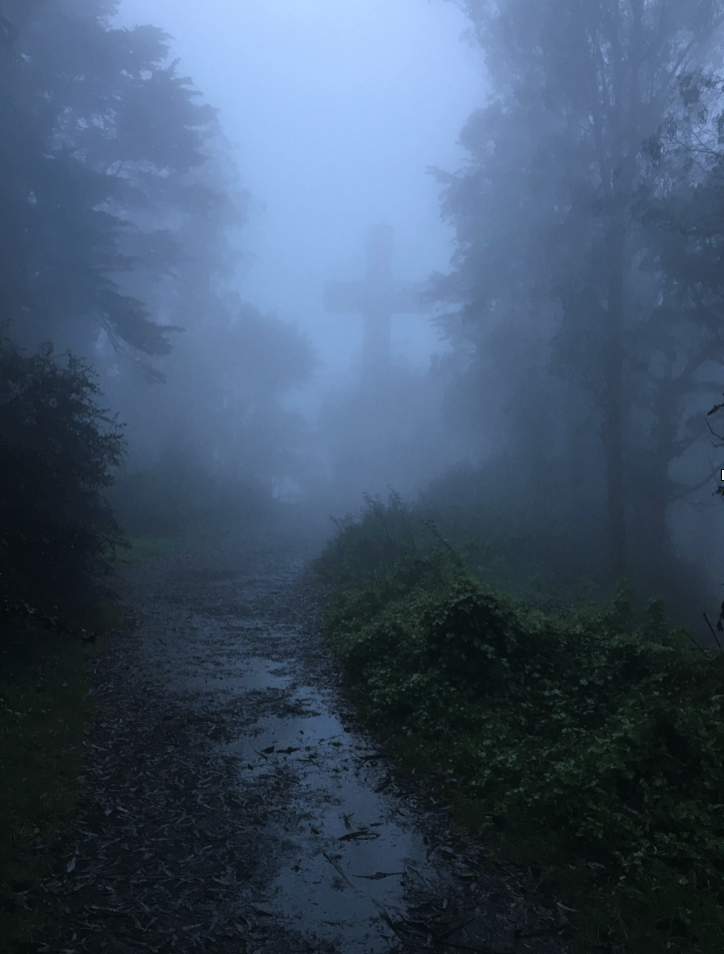
Here’s what Pat wrote about the image below: I took this photo on a pre-dawn pilgrimage to the top of Mt. Davidson in San Francisco on the Winter Solstice, December 21, 2018. The top of this cross is nearly always visible (except when shrouded in fog!) from my living room window on Wawona St. in West Portal, and Mt. Davidson has long been sacred ground for me. For me, this photo captures something about my long journey toward and in the Christian faith—a journey that has often felt misty, shadowy, and mystical, yet always toward a Love that beckons and invites.
I would like to begin by expressing gratitude to our Conference Minister, Stanley Green, for many things, but in this particular moment, for the invitation and encouragement to preach this morning.
The formal licensing and ordination process includes reflecting, in writing, upon a series of questions, first from Mennonite Church USA and then from the Pacific Southwest Mennonite Conference (or PSMC). I’ve been engaging this writing over the past 18 months or so, and after each set of questions I met with the Pastoral Leadership Committee of PSMC. Along the way, one of the questions I was asked to reflect upon was this: “What does ordination mean to you?” It’s a seemingly simple question, which, as you might imagine invites a deep dive.
After my final PLC interview, and after they recommended me for ordination, Stanley, in his quiet wisdom, suggested that I might offer some version of the short essay I had written on that question here, today, as part of my own ordination service. He could have preached, or, he might have encouraged me to invite another person. But Stanley intuited that perhaps this message was important for me to speak aloud—both for myself, and also for us. So while I am more accustomed to being over there, it is with Stanley’s encouragement that I have accepted his invitation to stand here this morning behind the lectern.
Months later, during the summer, when Sheri was doing some preparation for the year come, she asked if there was any way to also weave a nod to this morning’s narrative lectionary scripture passage into my remarks. I nearly laughed out loud. The story of the boy Jesus hanging back to study and learn from his Elders? How could this not speak to one who began her journey with this congregation (and Anabaptism) as a very young woman and mother nearly 35 years ago, and is finally responding wholeheartedly to a call to ordination? Talk about needing and wanting to hang back, hang out, and learn from the Elders!
Many of you have heard me tell the story, that as a young woman I was very drawn to contemplative spirituality. I came to FMCSF following a couple of years of worshipping with the San Francisco Friends Meeting, and during that time, I was actively exploring Buddhism. Even as I inched my way into this community—hooked by the Mennonite practices of engaged and compassionate social justice and 4-part a cappella singing (I’ll let you guess which one was the stronger pull!), I struggled with Christianity writ large. Even then I knew a little about how the Christian church and empire were intertwined in some pretty uncomfortable ways. And I was well aware of all the horrific things that have been done in this world, in the name of Jesus. Let’s just say that for many years, calling myself a Christian was difficult.
So, even as I began a long slow falling in love with Anabaptism, I was still considering jumping ship. But one day as I sat in and with this tension, I heard what I have always known as the voice of the God speaking within me and to me. As if God was right here, wagging a finger in my face, they said, “Uh uh. Nope. That’s too easy. For you, that’s a cop out. You were born into a Christian family, baptized as an infant, and you made the conscious choice as a teen to be confirmed in the Christian faith. Your path is with Christianity. You will stay. You will wrestle. You may never fully make peace, but your path is with, and among, Christians. Figure it out.”
I received this message from God with the fear I imagine people in the Bible feel when they are suddenly confronted by an “Angel of the Lord”: a mixture of awe, wonder, discomfort, apprehension, and maybe (if I’m honest) a little annoyance. “Seriously? Figure it out?!” Despite this, I never doubted the authenticity or truth of the message, and I began a long slow journey that is perhaps captured well by the image I chose for the front of our Order of Worship—a photo I took on the top of Mt. Davidson early one misty, moisty Winter Solstice morning here in San Francisco. (You can view this photo and read a bit about why I chose below.) The act of joining this church—becoming a member—in 1994, just at the start of this journey, was my formal commitment to following the voice of God.
Now I have been among you, learning from and growing with you for thirty-four years. A few years ago, after my 20th Anniversary celebration of ministry, Sharon, in her usual disarming way of speaking truth asked, “So, when are we going to ordain you?” The question began working on and in me, and I began a new level of discernment in my journey of faith. And so, returning to the scripture passage Beverly told so brilliantly, and in the spirit of the Godly Play style our children’s storytellers have sometimes been using, I wonder… I wonder what made Jesus decide to stay in Jerusalem, in the temple, even when his parents left town? I wonder if he heard God speak to him, urging him to stay? I wonder if he felt conflicted and maybe even fearful about staying? And I wonder how that decision to stay behind and learn from his Elders influenced the trajectory of the rest of his life?
**********
As I have been working, writing, and praying my way toward ordination this last year, I have been reflecting on the Bible verses found in all three of the synoptic Gospels, which describe Jesus sending out the twelve disciples to teach, preach, and heal. I offer an excerpt from one account of this story in the Gospel of Luke, Chapter 9, Verses 1-2, 6, which my husband Steve will read now:
Then Jesus called the twelve together and gave them power and authority over all demons and to cure diseases, 2 and he sent them out to proclaim the kingdom of God and to heal.
6 They departed and went through the villages, bringing the good news and curing diseases everywhere. (NRSV)
I read this passage in several translations, and I was especially drawn to the First Nations Version: An Indigenous Translation of the New Testament:
“He then gathered his twelve message bearers together. He gave them the authority over all evil spirits and the power to heal all kinds of sickness and disease. 2 He then sent them out to tell the story of Creator’s good road and heal the sick.
6 The twelve went out to represent Creator Sets Free (Jesus) to all the villages, telling all who would listen about the good story and healing the sick everywhere they went.”
As I have been contemplating the meaning of ordination, I have been thinking about this passage: that ordination is a sort of sending—as a message bearer, on behalf of Jesus, or “Creator Sets Free”—to proclaim the kingdom of God, or to “tell the story of Creator’s good road.” I’ve also been trying to imagine what that moment must have felt like for the disciples. In my version of the story, they were looking at each other and exclaiming something like, “Who me?” Or, “Wait, I’m not ready! Send the others!” Or “You’ve got to be kidding? We’ve only been traveling with you and learning from you for a little while. C’mon, get real!”
Now as I’ve just articulated, I have been blessed to have had a long, slow formation in ministry, held in the care and grace of this community, First Mennonite Church of San Francisco. I have also had the blessing of being mentored and companioned in leadership by two of the best pastoral colleagues ever, Sheri & Joanna; and by so many leaders—of this church, in our denomination, and in other circles of my life, many of whom are present here in person, or on zoom. You are too many to name, so I’m going to trust you know who you are. (And if you have even an inkling that you might be one of those people, you are…) I bow to you in gratitude.
And, of course every member of the community here today has taught me, shaped me, formed me into the both the person and the pastor I am today. So while I certainly can’t claim that last excuse articulated by the disciples of my imagination, I do confess to have been feeling quite a lot of the first response, “Who me?” and—despite my long, leisurely formation in the bosom of FMCSF— some version of the second, “Wait, I’m not ready!”
Then, during our last season of Lent, Joanna preached a sermon on this story as it is told in the Gospel of Mark (Chapter 6, verses 7-13). In this sermon, Joanna likened this sending of the disciples to a line from one of her favorite poems by Rainer Rilke: “I live my life in widening circles that reach out across the world. I may not complete this last one but I give myself to it.”
Joanna went on to say:
[In the Gospel passage] the disciples were sent out for the first time to expand the circle of Rabbi Yeshua’s movement. They had been observing Yeshua’s healing ministry in a variety of contexts and now it was their turn to take it to the streets.
They went together and they went humbly. They did not take extra clothes or provisions – no money or food. They were showing up dependent on the hospitality of others. They were commissioned to heal and restore to community those who had been excluded. They were sharing the good news that they had experienced by joining Yeshua’s movement.
As the Quakers are known to say, now this spoke to my condition! Suddenly I saw ordination as just one more widening circle of my ministry, a widening that, truthfully, has been going on for years. And as I felt this, I let out a sigh of relief.
It wasn’t long though, before another question arose: “Really, just? Just one more widening circle?” As I sat with that question a deeper awareness emerged. Yes, there is something important to acknowledge about the sacred act of being ordained, it’s not just another circle. Ordination carries weight and gravitas. It is an invitation for me to see myself differently. And it is an invitation for the world to see me differently as well. As a small, almost mundane example, I have often reflected that when I sign letters with other clergy within the context of my community organizing role with Faith in Action, I do not use the title Reverend before my name, as most of my Christian colleagues do. Reverend, while not used much in Mennonite circles, is in the broader Christian context, an honorific for ordained ministers, pastors, and priests that carries weight and garners respect—especially when trying to move power in the halls of government, as we are in Faith in Action. I admit that a small part of me does look forward to being able to sign my first letter to a group of legislators with Rev. before my name!
On the other hand, ordination also simply continues a movement of the spirit in my life that has been moving in wider circles for many years—as I have grown in faith and ministry, and as I have claimed my pastoral voice more fully in the world. In the context of these widening circles, ordination offers an outward sign, a public recognition of this slow, steady evolution.
Perhaps just as important is the way my ordination also invites you, my beloved community, to consciously embrace the circles you have been traveling with me, to celebrate your long and patient role in my formation, and to see yourselves differently—as a people who have faithfully engaged in the good, long, and sometimes difficult work of forming me as a pastor. You may not have always known it, but you have also been called.
For we are a congregation who, faithful to our Anabaptist heritage, is dedicated to practicing the Priesthood of All Believers through shared models of leadership, discernment, and learning. We have long invested in training and mentoring young adults, and with the exception of interim pastors, we have ordained every pastor we’ve had since Ruth Buxman. It may have taken me a long time, sitting among you, learning from you, but I stand before you today accepting your call—and God’s call—to take my place in the line of pastors and spiritual leaders you have sent, and will continue to send, into the world to “tell the story of Creator’s good road.”
And so, as I consider what ordination is for me—and for us—I am invited to hold this tension. No, it is not “just one more widening circle.”And yes, it is also “just one more widening circle.”
*****
I want to read the complete Rilke poem now, and with a request for grace from Rilke, I am going to replace his original singular I, with the plural we. As we kick off this year in celebration of the 50th Anniversary of First Mennonite Church of San Francisco, I invite you to place yourselves in this poem with me.
We live our lives in widening circles
that reach out across the world.
We may not complete this last one
but we give ourselves to it.
We circle around God, around the primordial tower.
We’ve been circling for thousands of years
and we still don’t know: are we a falcon,
a storm, or a great song?
In the second half of this poem I find a humility, a willingness to not know what God intends me, or us, to be, but to keep widening those circles anyway. In my reading, there is also an invitation to release our human tendency to see the falcon, the storm, and the song as separate and perhaps in a hierarchical relationship. An invitation rather, to understand them as Meister Eckert does when he writes, “Every single creature is full of God and is a book about God. Every creature is a word of God.” In this way, no matter whether we are falcon or storm, pastor, lay leader, community member, or a fellow traveler on the road, we are all great songs.
And this small, somewhat scrappy Mennonite congregation, founded 50 years ago as an intentional community supporting a new Voluntary Service unit in San Francisco… this community, which still has a propensity for committing to outsized projects of presence, healing, and justice in the world, is a Great Song. We are all, individually and communally, Great Songs being sung by the great, I am.
And so, as we all circle in our own ways around Rilke’s primordial tower; as I accept this invitation to begin a wider circle in my life that includes ordination; and as we, First Mennonite Church of San Francisco, accept an invitation to begin a wider circle in the dynamic life of our community, I invite us all to sing together:
Here I am, Lord. Is it I, Lord?
I have heard you calling in the night.
I will go, Lord. If you lead me.
I will hold your people in my heart.
Voices Together 545
Top of Mt. Davidson in San Francisco