Sermon: Finding Freedom in our Broken and Beautiful World
This is the first sermon in our Advent series called “Finding Freedom in Our Broken and Beautiful World.” We are basing this series on the work of Shannon Dycus, a Mennonite pastor and writer who wrote a lovely Advent Devotional, “The Holy in the Night: Finding Freedom in a Season of Waiting.”
Matthew 24:36-44
Earlier this week, I was interviewed for a radio show about Sarah Augustine’s and my new book. Usually, I’m talking to folks from within my small world of Mennonites or progressive Christians, and so it was good to get outside of the bubble for this show, which goes out to more of a mass market audience. The host was a man who had been a children’s TV entertainer in Phoenix for 38 years. He was personable and kind and I was also caught off guard by the kinds of questions he asked me: “Why hasn’t there been a Native American version of Martin Luther King, Jr.? Is Christianity responsible for our environmental crisis? Do you blame Catholics for colonization? Are people who drive Hummers evil?” And then, at the very end of the show. “Sheri, you have 20 seconds to give us your answer on how to solve the climate and ecological crisis.” It was clear that the host wanted “hot takes,” short, quippy, sure answers to what are complex questions.
Afterward I felt unsettled. I realized I felt pressured throughout that time to perform certainty, to have the answers. It didn’t feel like a space in which I could easily say: “I don’t know.” Or: “That’s a really complex question that I can’t answer right now.” Or: “No one can answer that.” Somehow, that didn’t feel responsible. Or that I would lose credibility if I answered in such a way.
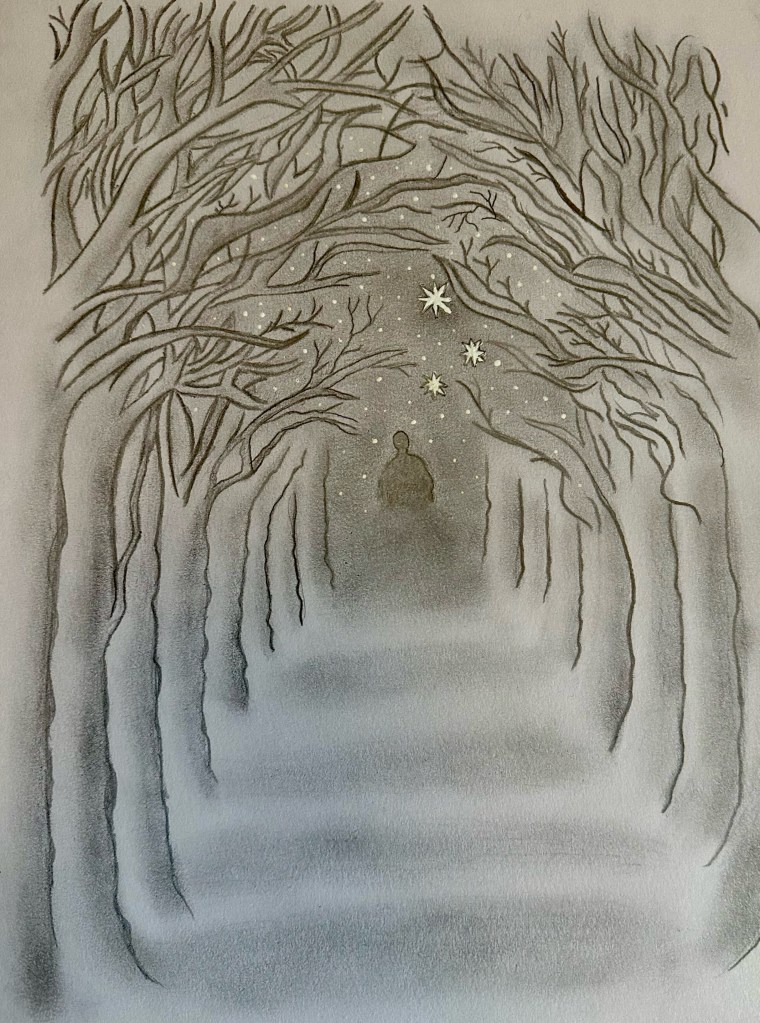
What a serendipitous experience to have during this first week of Advent, given our theme! Because my experience in that interview has everything to do with what we are talking about during this season. What is it like to be in a time of waiting when we don’t know the outcome — and not try to escape that discomfort? What is like to be “in the dark” — and just accept that that’s where we are? I can tell you, that is a countercultural thing to do. Children’s TV entertainers turned radio hosts do not like it.
We don’t like it. We don’t like to wait when the outcome is not certain. We don’t like it so much that we prefer the illusion of false answers over the reality of unanswerable questions. I think we see this all the time in our personal lives. I’ve walked with many people through a cancer diagnosis, and as soon as the word gets out, the “cures” come flooding in from well-meaning but overly certain people: “You should insist on immunotherapy; that worked for my Dad. You must try shark cartilage. We can pray your cancer away.” The exaggerated certainty behind these kinds of suggestions reveals our discomfort with uncertainty, with being in a space of unknowing and vulnerability.
Waiting in the dark make us anxious and, of all the emotions, I think anxiety is the hardest to hold in our bodies. Grief can be overwhelming, but there’s also something about grief that connects us to love. We grieve because we have lost someone or something we loved. Anger can be energizing, in its own way, like we have an electric current going through us; it’s a power source! But anxiety makes us feel like we want to jump out of our own skin. Like we’re trapped, like there’s nowhere to get away. No wonder we are impatient to feel otherwise.
And, as Shannon Dycus says, to “compound our impatience, we categorize experiences of waiting, unknowing, (and) confusion as seasons of darkness. Anytime we cannot see and control our spheres, we name it dark and separate it from the reach of God.” Many of us have been taught that if we are doubting or anxious it is a sign that we don’t have enough faith, that we just don’t trust God enough, that we’re not “spiritual” enough. Even if we don’t have those messages inside us, I think few of us view these spaces of anxious uncertainty as potential holy ground.
What if there was actually more freedom within these trapped spaces of anxious uncertainty than we had imagined? What if we had the freedom to name these uncertain spaces as holy ground, where we might able to experience God’s presence — not as a mighty force eradicating our anxiety and confusion but as a presence co-existing within and among the uncertainty?
With those questions in mind, let’s hear our passage for today.
This passage is one of my least favorite. I can still feel the anxiety rise in me as I read it. I feel trapped. The passage seems to “inspire in us a sense of hurried need — a need to be prepared and to figure out what we don’t yet know,” as Dycus says. It reminds me of the t-shirt I saw long ago said: “Jesus is coming! Look busy.” Jesus is coming. Be hypervigilant and prepared! Figure out what you need to know!
And yet, as the passage says: “About that day and hour no one knows, neither the angels of heaven, nor the Son, but only God.” No one knows. Sit with that for a bit. No one knows, not just you. Not even the angels! Not even Jesus! We’re all here, together, in this space of unknowing. Hanging out. Maybe singing some Christmas carols, sipping a little egg nog together.
As Dycus says, Jesus is not preaching a sermon of preparedness here. “It’s not that we’re out of the loop and must work to restore missing information or resources. There is no loop. There is no way to know.” What Jesus is preaching is uncertainty. He is saying: We are free to not know.
Jesus also refers to the story of Noah in this passage. Initially, Noah get a lot of DIY guidance from God on how to build an ark that’s going to carry him and his family and all the critters through a big flood. But once Noah is inside that ark, the guidance ends. They’re just floating on a big boat for almost a year. “In the absence of God’s voice or direction,” Dycus says, “Noah became attentive.”When he’s just floating on that big boat, waiting, Noah opens the window of the ark. He looks out. He notices. He commences a rhythm of sending out birds to confirm whether the water had subsided. He awaits their winged return. He becomes present to what is around him. He waits.
During our Advent worship planning retreat, Hanneke talked about the end-of-life journey she took with her mother-in-law. There was one sleepless, anxious night after she and her husband, Mark, had taken her to the ER that was particularly hard. What was going to happen? The journey ahead was so uncertain. But as Hanneke walked outside the next morning, she “opened the window” — she felt the sun on her face and heard the birds singing. She said to herself: “The sun will continue to rise and the birds will continue to sing. I don’t have to do anything to make that happen.” In listening to creation, Hanneke heard God’s wisdom. And it was enough.
Breathe with me: I don’t have to know (inbreath). The wisdom of God is enough (outbreath).
There is one more freedom I want to briefly explore: I am free to worry and hope.
One of the things Dycus said she was trying to do in her book is to undo binaries of light/dark, faithful/anxious, hope/doubt. So often, we trap ourselves into either/or thinking. Either things are going well in my life, or I’m anxiously waiting for them to get better. Either I’m happy now, at peace, or I will be as soon as this relationship feels stable, as soon as I figure out what I’m going to do with my life, as soon as we have enough money, as soon as my kid gets out of this really difficult stage they are in and I don’t have to worry about them anymore, as soon as the world calms the heck down. We foreclose on the joy or peace possible in this moment until we possess certainty about the future moment.
What if we could say: I am free to worry and hope. I am free to worry and be joyful. I am free to feel all the feelings and at at the same time. I am free to hold many conflicting thoughts. I am free to hold both the reality of deep compassion around me and profound injustice. I am free to love the planet even as I am free to be freaked out about what is happening to it. As Dycus says, “Maybe God is found not in singular but in layered truths.” She suggests this breath prayer: “I was not made to be simple. God, inhabit all of me.”
Breathe with me: I was not made to be simple (inbreath). God, inhabit all of me (outbreath).
Amen.