
Sermon: Choosing the costly path of life
By Joanna Lawrence Shenk
This sermon is the part of a nine-month series in which we will tell the story of Scripture from Creation to the early Church, using the Narrative Lectionary readings.
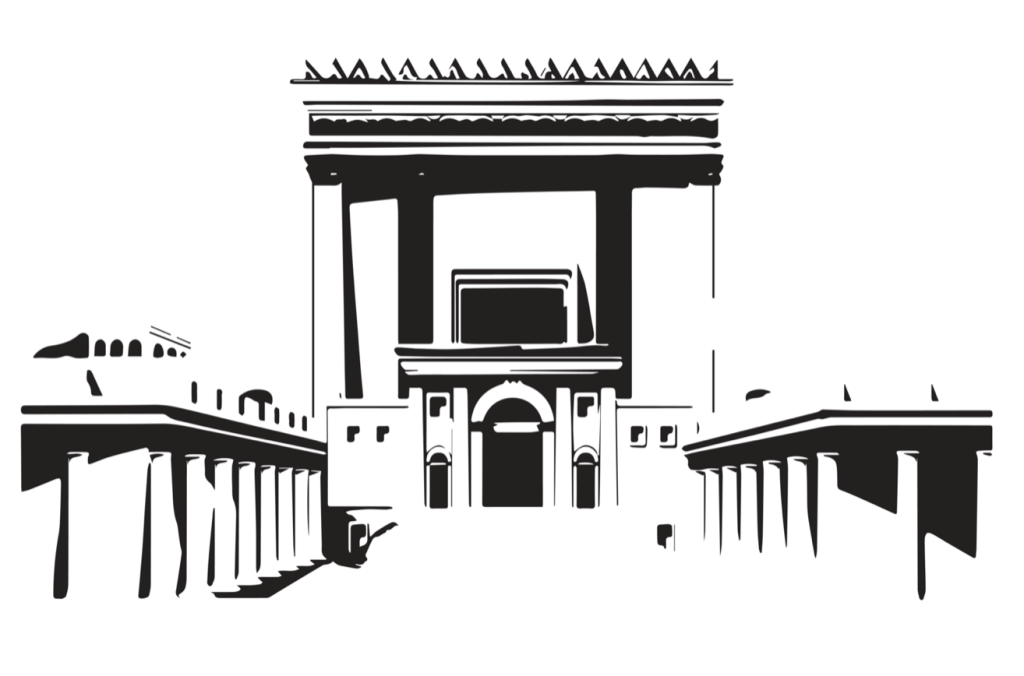
I’d like to imagine the dedication of Solomon’s temple as an epic opening scene in a movie. We begin on ground level in a huge throng of people in the outer temple courtyard. Everyone is exuberantly happy, chattering and looking in awe around them at the glory of the temple compound. They are wearing their best clothes, but it’s obvious that most of them are common people, lacking wealth.
Then the camera pans up and out and we see that there are thousands of people surrounding the temple grounds. Beyond the courtyard and the wall we glimpse the temple itself. The camera then zooms in on the steps of the outer courtyard and there stands King Solomon, in his fine robes poised to make speech. He looks stately, with many attendants and guards behind him. A couple of his most beautiful wives stand to his side. He exudes power and self possession. The trumpets sound to quiet the masses and then the king speaks:
1 Kings 8:27-30
“But will God indeed dwell on the earth? Even heaven and the highest heaven cannot contain you, much less this house that I have built! Regard your servant’s prayer and his plea, O Lord my God, heeding the cry and the prayer that your servant prays to you today, that your eyes may be open night and day toward this house, the place of which you said, ‘My name shall be there,’ that you may heed the prayer that your servant prays toward this place. Hear the plea of your servant and of your people when they pray toward this place; O hear in heaven your dwelling place; hear and forgive.
1 Kings 8:41-43
“Likewise when foreigners, who are not of your people Israel, come from a distant land because of your name —for they shall hear of your great name, your mighty hand, and your outstretched arm—when foreigners come and pray toward this house, then hear in heaven your dwelling place and do whatever the foreigners ask of you, so that all the peoples of the earth may know your name and fear you, as do your people, and so they may know that your name has been invoked on this house that I have built.”
From this speech we get a sense of Solomon’s wisdom – we hear humility as he acknowledges that even this magnificent temple cannot contain God. We hear hospitality as he welcomes foreigners to pray at the temple and as he expects God to heed their prayers. It is also the commonly held assumption that he is the author of Proverbs and the Song of Songs, which are both books of the bible considered to be wisdom texts.
In many ways he fits the bill of what makes for a noble king: he is pious (praying a humble and inclusive prayer), he is a leader who makes things happen (like building the temple), he is wealthy (allowing him to pull off building projects), and he is wise.
But if we apply what we have learned in the sacred narratives so far (pointing to pictures), we recognize that Solomon could not have achieved his seeming greatness without the exploitation of the people and the land, and without turning from God’s path of life. He could not have built the temple or amassed great wealth or assembled a standing army or acquired 700 wives without a great deal of exploitation.
Mennonite biblical scholar Ted Grimsrud summarizes Solomon’s reign in this way:
“He ruthlessly eliminated his opponents, including his half brother who was actually heir to the throne. He built a standing army with career military leaders and horses and chariots. He instituted a policy of forced labor particularly for the construction of his palace and the temple. He gathered wealth for himself. And he entered into alliances with other nations and worshiped their Gods.” If you noticed echoes of Pharoah’s rule over the Hebrew people, you are on to something.
All of these actions by rulers were prohibited by God when the law was given to the people in the wilderness (Deut. 17). The law was given to them to help them maintain their liberation. Then later Samuel explicitly warned the people that if they anointed a king just these things would happen.
Authors in “The Bible as Story” note: “Less than four hundred years after YHWH liberated the people from Egyptian slavery, the People of God were slaves again, belonging to their own king. YHWH’s theocratic freedom was too difficult, so they sacrificed it for the security of human kings… and armies.”
Following the speech we just heard from Solomon, God has a heart to heart with him and lays out two paths that Solomon can take (1 Kings 9). If Solomon is faithful to God and follows the law given to the people then they will know blessing and Solomon’s lineage will continue on the throne. If, however, he is not faithful and refuses to follow God’s law and worships other Gods (like when the people made the golden calf in the wilderness), the land will be taken from the people and God’s presence will leave the temple.
The path of life and blessing was a reiteration of what God had been saying to the people since the beginning. God was reminding Solomon that he and the people were called to be different from other people groups. They were called to observe sacred limits. They were chosen to be a blessing to all the families of the earth. They were called to trust in God’s liberating power and maintain their liberation through political, economic and ritual practices together. And if violence was being done to the vulnerable, they could expect God to upend that status quo.
In keeping with this trajectory it is not surprising that the monarchy experiment was doomed from the start. How could it possibly succeed given who God was and who the people were called to be? Solomon’s reign clearly was doing violence to the vulnerable and God was not going to stand for it. The options were given to Solomon and he ultimately chose worldly power and prestige.
Although Solomon did dedicate the temple to be a house of prayer for all people, God made clear that the temple would not be around very long if the Hebrew people (and especially their leaders) were not living in a way that was actually a blessing to all the families of the earth.
So what is the wisdom in this story for us today? How does this sacred narrative help to ground us in anxious times? As a congregation within the Anabaptist-Mennonite tradition, I believe this story is a reminder that our hope is not in political figures, even the ones who appear noble by comparison to others. Our spiritual forebears were clear that the kingdom of God would not be actualized by those in power but by the people demanding and embodying a different way of being in the world, even when it cost them everything.
While their lords and princes in the 1500s demanded that the Anabaptists pay for and fight in wars, they refused. When they were given the choice to align with one side or the other – catholic or protestant in those days – they rejected that binary. Neither represented their commitments to the way of Jesus.
Solomon might have been noble and wise in some ways but he was perpetuating a political system that could not adhere to the path of life set forth by God. Choosing the path of life would have cost him power and privilege he was not willing to give up. We are also caught up in a political system within an empire that cannot adhere to the path of life. No matter what happens within our political reality in the coming weeks and months, our call as followers of Jesus will not change.
Our allegiance is not to a country or a political party or a candidate. Our allegiance is to the kindom of God that will relentlessly disturb the status quo of every empire. Our allegiance is to the way of peace that does not shy away from conflict with unjust power. Our allegiance is to the way of the prophets who put kings, and presidents, in their place, even at the cost of their lives.
May we continue to choose the costly path of life, which is the only way to the peace our world so desperately needs. May we continue to choose the costly path of life, which spans generations long before us and long after. May we continue to choose the costly path of life set forth by the Creator for the flourishing of all the families of the earth.