FMCSF History Moment: FMCSF & Radical Hospitality
With assistance from Karen Kreider Yoder, Sharon Heath wrote this History Moment on Radical Hospitality.
Our congregation has engaged in what I’m calling “Radical Hospitality” or “Radical Welcome” for the past 40-plus years. Being Pride Sunday, much of my reflection will focus on our calling as a Welcoming Congregation. But that’s by no means all there is to our offer of Radical Hospitality.
Before I get started, I need to talk for a minute about church polity. Prior to 2002, there were two Mennonite denominations in the US, the Mennonite Church, also called “Old Mennonites,” and the General Conference Mennonite Church. Each denomination was made up of area conferences. Our church belonged to both denominations through their conferences, the Southwest Mennonite Conference, which was MC, and the Pacific District Conference, which was GC. In 2002, the two denominations merged into MC USA, and the conferences merged into Pacific Southwest Mennonite Conference.
I also want to take a moment to note that the gay and now queer presence in our congregation has never been more the 30 to 40 percent. Our Radical Welcome has always been led by our “straight” members as much as by our gay members, and we wouldn’t be where we are without the enthusiastic consensus of everyone.
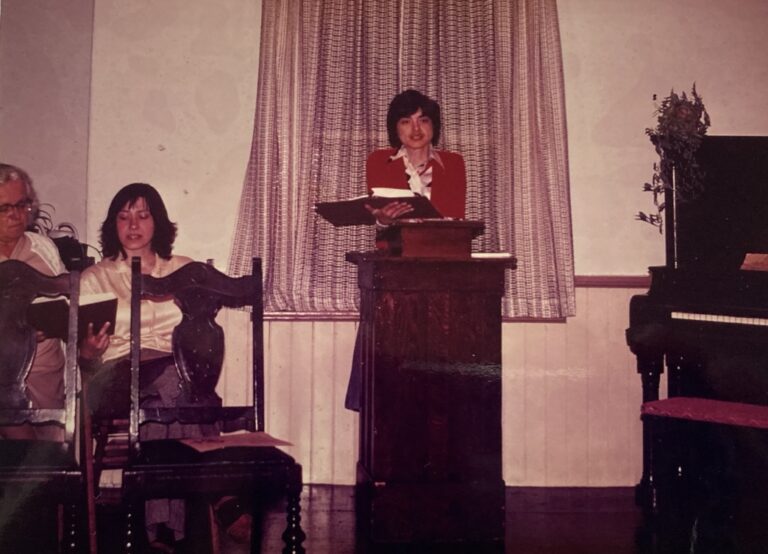
To my mind, our calling to Radical Hospitality began the summer of 1983, when our own Jim Lichti was called to be a quarter-time pastor, along with another member, Ruth Buxman. Jim was well-known in Mennonite circles as a gay man, but our members didn’t care. They saw his gifts of leadership and tapped him for the job.
Other members of the Mennonite Church, however, did care that he was gay and out, and in 1984, at the spring meeting of Southwest Mennonite Conference, Jim’s uncle, the president, tried to kick our church out of the conference. Fortunately, our member Dan Flickinger liked business meetings and stayed until the end, when the question of whether churches with gay leadership should be kicked out of SMC was raised for the first time. Dan objected, because the issue wasn’t on the agenda, and the way I heard the story is that Dan held the floor for two hours until the motion was tabled.
That October, nearly the entire congregation, 24 of 25 of us, met at Dan’s house to talk about what to do with this situation. At the end of the day, we had decided that we wanted to be a part of both Mennonite conferences, and that we did not want to be known as a one-issue congregation. Our “straight” members stepped up and volunteered for many conference committees over the years, since neither conference would allow gay or lesbian people on their committees. I want to shout out here to Ruth Suter, who was deeply involved in the merging of the conferences and then the denominations.
In April 1986, only 18 months after our October 1984 meeting, we hosted the Southwest Mennonite Conference at our worship space at St. John’s Lutheran School. Our members brought food and hosted people in their homes. It was our first congregational act of Radical Hospitality.
We soon became known throughout the North American Mennonite world as a congregation that welcomed gay men and lesbians with no limitations. For those of you not alive in 1984, you probably can’t imagine how radical this stance was. Our Radical Welcome spread, and eventually many churches across the US and Canada became Welcoming Congregations.
Although the conflict between the denominations and conferences and our church continued for years, we worked hard to create a “graced safe space” here in San Francisco. By that, we meant a place where everyone was welcome to come to church, to serve on committees, and to become members. Like I said, this was nearly unheard of until, really, pretty recently.
I think it’s also important to note that, despite the fact that not one of the eight people we have presented for ordination has agreed that couples must be married before having sex, the conferences have ordained every single one of them. So, you can see that “Radical Welcome” has also been extended to us, even if it wasn’t called that.
Of course, it’s as important to be a sensitive guest as it is to be a welcoming host. In 2004 or 2005, just before we moved to Sha’ar Zahav, we spent 6 weeks during Lent exploring the long, horrible history of Christian antisemitism. Sheri led the process and our Jewish spouses, Lisa Katz and Albert Greenberg (husband of Helen Stoltzfus), helped us understand the long history of harm that Christians have inflicted on Jews. This series helped us move into this Jewish space with a different sense of humility and a desire to be good guests. This attitude continues to mark our relationship with Sha’ar Zahav and especially our pastors’ relationships with Rabbi Copeland and Cantor Bernstein, most recently related to our Gaza protests. It led to Rabbi Copeland’s willingness to preach here this past March.
Eventually the differences between our church and PSMC could no longer be ignored. In 2003, Sheri blessed the union of David Wieand and Benjamin McClosky, and then in 2008, when gay marriage became briefly legal, she performed the wedding for Bart Shulman and Russ Schmidt. The Pastoral Leadership Committee of PSMC threatened to suspend Sheri’s pastoral credentials.
In early January of 2010, Sheri, Russ and Bart flew to Los Angeles to meet with the committee members. Bart and Russ not only spoke of their relationship and desire to be married, but they also listened as an Indonesian pastor expressed “how [their] marriage had caused pain and angst for [his] congregation.” Bart also wrote that he came away with an understanding “of the power imbalance between the immigrant churches and the white churches in the conference.” This meeting is an example of Radical Listening on the part of both groups and, as you’ll hear, led to another opportunity for Radical Hospitality.
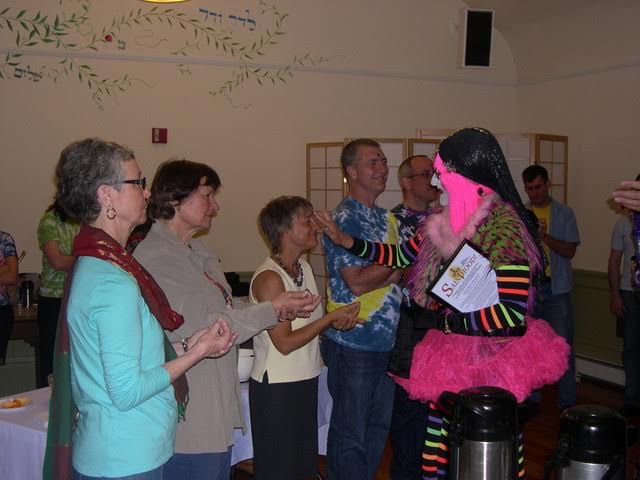
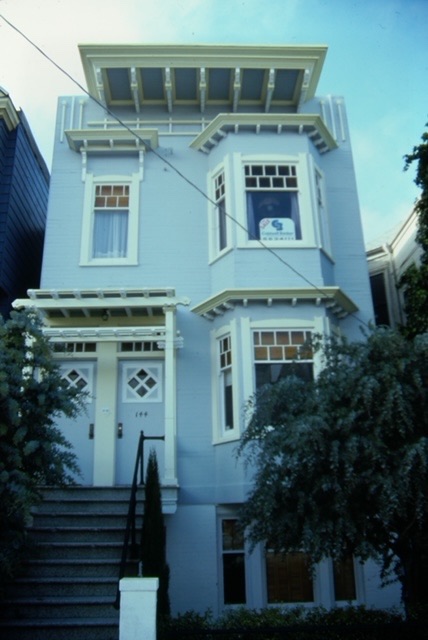
That Fall, we invited the members of PSMC leadership to come to San Francisco for a long weekend. Leaders of our church had dinner with the PSMC leaders at a restaurant on Friday night, hosted them in our homes, toured them through the VS house on Saturday, and again ate dinner with them on Saturday night, this time at the home of Doug Basinger and John Flickinger. The piece de resistance came on Sunday, with a wonderful worship service followed by an intense time of sharing and listening. The question was, “What does First Mennonite mean to me and why,” and people took turns sharing. The depth of honesty, the pain of prior rejection, and the joy of finally finding belonging in a church drew tears from many, including the PSMC leaders. That weekend of Radical Hospitality opened hearts and changed minds and was a watershed moment in our church’s relationship with PSMC.
Another development began in 2010 — we started to grow. For several years, our attendance had hovered at around 40 to 50, but all of a sudden we were seeing 60, then 75, then 100 on a Sunday morning! I remember thinking, “Who are you and why are you in my church?”
The leadership began to address this “problem”— the transition from a church of 50 to one of 150 is difficult and often treacherous. We met several Saturdays at Dan Flickinger’s home to think about how to manage this change. We expanded our welcome by changing our committee structure, creating new Sunday school classes, and increasing the snack supply on Sunday mornings. We hired Eli Ramer to help Sheri with pastoral care, and then we hired Joanna as our co-pastor. Radical Welcome took on a different look.
In 2012, Sheri officiated at Kenda and Charity Horst’s wedding, and, again, there were rumblings of sanctions and threats to Sheri’s ordination. So, that summer we hosted the June conference for PSMC, and we threw a party! We hosted all the attendees in our homes, we had a pie and ice cream party on Friday night, and we made breakfast on Saturday morning. On Sunday, quite a few attendees came to church. And somehow talk of disciplining Sheri just kind of went away. We decided that the conference could kick us out or not, but we were no longer going to justify our actions to anyone. And since then, no one has really paid any attention to who our pastors marry.
In 2019 we again hosted PSMC, but without the pie party and breakfast. It was just an ordinary meeting, which is perhaps the most radical outcome possible.
We could also talk about the radical shift to Zoom that our pastors made with the help of Bart at the beginning of the pandemic. They put so much effort into making the Zoom Church experience welcoming and inclusive.
Last year, the Elders and some others spent a Saturday with Sue Park Hur learning about how to increase our cultural competence.
Most recently, we have welcomed into our congregation families from Uganda, Tanzania and Columbia with love, wisdom, professional advice, and financial support. A few Sundays ago, we listened as they and Sylvanna told us a bit about the worship styles in their home countries. Worship Committee is working on incorporating some of their styles into our weekly worship. At a minimum, we’re singing more songs, or at least verses, in Spanish and even occasionally in Swahili. We continue to embody “Radical Hospitality.”
No doubt there are more examples of our Radical Welcome. And no doubt there are ways we have failed to extend radical welcome. I personally am sorry that we have not been able to convince trans people to join our motley band. And our fellowship time can be rough on people who are introverted and don’t quite know how to enter a conversation.
Despite some failures, I am convinced that Radical Hospitality is our church’s “charism,” the Greek word for “spiritual gift.” I think it is almost magical — it has changed me, and it has changed and shaped our congregation for many years. We aren’t the same congregation that we were in 1975. But in many ways, we are the congregation that we started to become in 1983. Hardly anyone is still here from those days, but all of you who are here today are here because of the Radical Welcome that happens every Sunday. And every Sunday, you extend Radical Hospitality to each other and to our guests and visitors. It’s our charism. It’s what we do. Can we do better? Yes. And we will, because now more than ever it’s important to welcome with Radical Hospitality everyone who comes through our doors.
Amen.