
Easter Sermon: Reconstituting the World
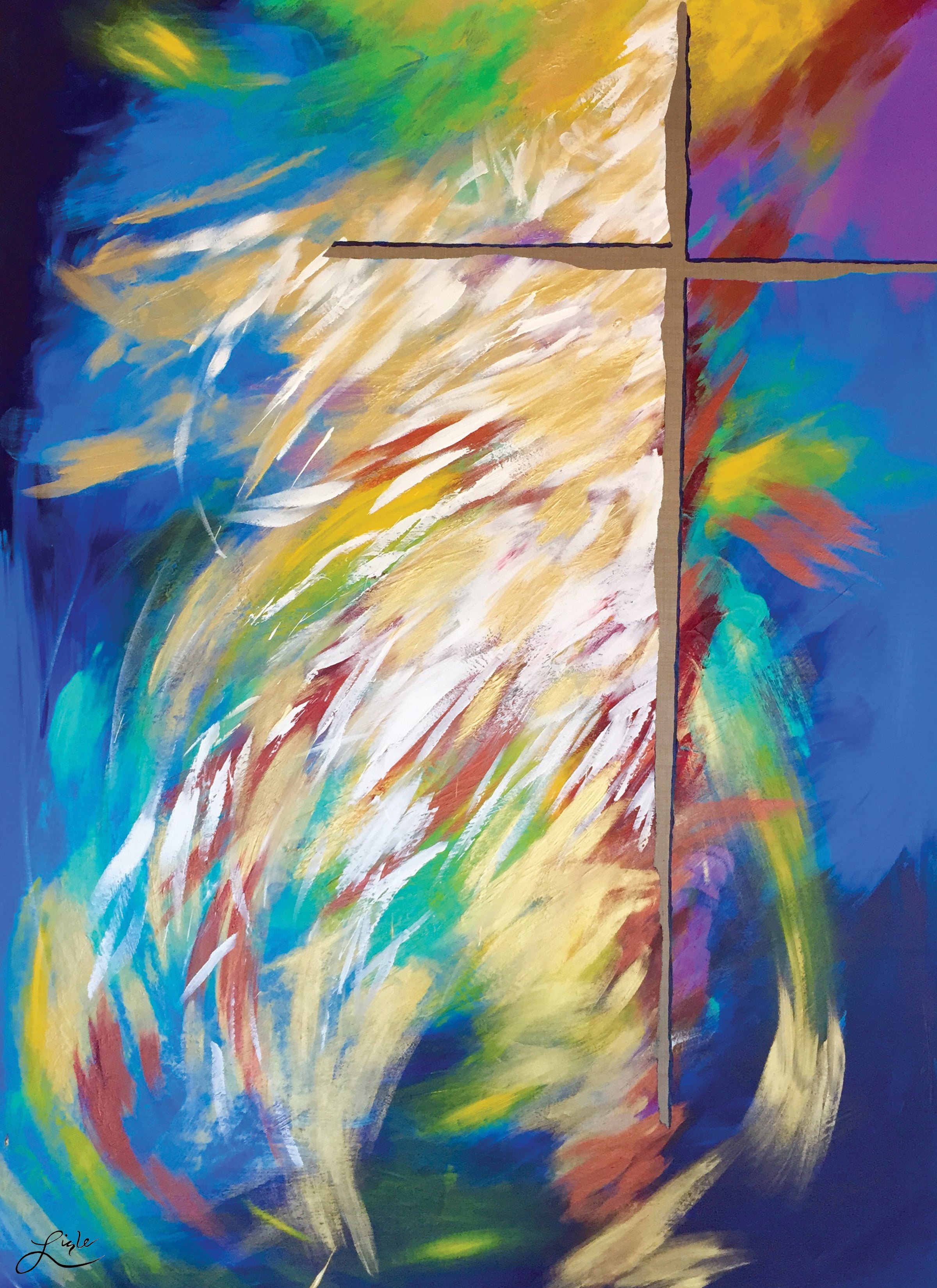
“Mourning Light,” by Lisle Gwynn Garrity © A Sanctified Art. Used with permission
John 20:1-18
I’m going to be weaving the sermon with the poem (in italics) on this passage that I wrote for the book Drawing Near: A Devotional Journey with Art, Poetry and Reflection.
In the beginning, on the first day, Jesus, rising, apparently took the time to roll the cloth covering his head and place it, neatly, to the side.
Did you catch that detail in the story we just heard? John says that Peter goes into the tomb — he bends down to do so, because the entrance into tombs carved into rocks back then are low — and (I’m quoting) “sees the linen wrappings lying there (those would have been the bands of cloth wrapped around Jesus’ body) and the cloth that had been on Jesus’ head, not lying with the linen wrappings but rolled up in a place by itself.” I have pored over this passage many times in the past 25 years, and I never noticed that, according to the story, the resurrected Jesus takes the cloth covering his face, neatly rolls it up and places it deliberately away from the cloth covering his body. He didn’t just burst out of the tomb, leaving behind mounds of cloth strewn about for someone else to clean up. Was Jesus thinking something like: “Hey, those bands covering my body probably can’t be reused (they would have been slathered in ointments and spices) but you can probably reuse my face cloth. Here it is — over here, away from all the mess.” Jesus has just risen! Why is he bothering to attend to this small detail of caretaking, of orderliness? And why does the Gospel writer even mention it? There is no Biblical scholarship I could find that speaks to this detail. I became obsessed with it. I wrote a poem about it.
Before astonishment and disbelief, before breaking bread on the beach,
before the disciples spread and said, “I have seen the Lord,”
before house churches and persecutions, before cooptation and Constantine
and the entire tired history of crusades and inquisitions and witch hunts,
before enslaving and stealing land in the name of this Jewish man,
long before all this, Jesus made his bed, as his mother had undoubtedly taught him.
The long arc of mainstream Christian history is grim. Within 300 years of Jesus’ death at the hands of the Roman Empire, the religion founded in his name becomes that Empire’s official state religion — a religion embraced by the wealthy and powerful. Over the next centuries, “Christian” leaders force this religion on other people, and persecute those — notably Jews — who aren’t. For almost two centuries in the Middle Ages, they go on crusades to fight the “Muslim infidel” and seize the Holy Land for themselves. They burn witches and heretics like Anabaptists. They enslave millions of people from the African continent and steal large swaths of land throughout the world and kill the people who lived there. Today, they advocate a form of Christian nationalism that is trying to destroy our democracy. And all of this violence, all of this domination was done — and is being done — in the name of the Jewish prophet, Jesus.
This form of Christianity is the antithesis to the message and the movement of Jesus. A man of great spiritual power, a man upon whom the Spirit of Life had descended in the form of a dove, this beloved One starts to build the beloved community. He starts to build this community among his people, who have been living under an autocrat, who have to deal daily with his cruelty and the cruelty of his regime, who have to watch as their beloved ones are taken away to God knows where and done God knows what to, who are taxed and tariffed so heavily they have no money to buy bread for their children, whose imaginations have been stunted by the seemingly overwhelming power of this ruthless regime.
Jesus reminds these people who they are — the beloved ones of the Creator of the world— and he reminds them of their sacred calling: They are to be a blessing to all the families of the earth by showing how to live in right relationship with each other, with God, with creation. Even here, even now, Jesus says, a world of right relationship is possible. Especially here, especially now, this world is possible — this world he calls the kindom of God.
I think of a line from a poem by Adrienne Rich,
“My heart is moved by all I cannot save:
so much has been destroyed.
I have to cast my lot with those
who age after age, perversely,
with no extraordinary power,
reconstitute the world.”
I think of those who plant the seeds in fields ravaged by war,
who mend the garments made ragged by violence, who bake the bread,
mind the children, make the fire while the men are gone,
conscripted into someone’s grand plan to save the world by conquering it.
I think of those who bathe the body, anoint it with myrrh and aloes,
who watch and weep.
We — the ordinary people of this world — we often think that we aren’t powerful. I can tell you this — that those who wield power over, who dominate, subjugate, violate — they want you to think you’re not powerful. And indeed, they have the power to inflict a lot of pain, a lot of suffering on human bodies and on the body of the earth. That’s what the story of Jesus’ passion that we tell on Good Friday is all about: bodies being crucified by cruelty. That is the power of autocrats, of those using power over — they have the power to cause death, whether to the spirit or body.
But there is force more powerful. And that is the power of life. The power to generate life, to protect life, to nourish life, to restore life.
It’s the power of this community when we came around Katelin’s family and close friends in the wake of her shocking death. At a time when death might have been all these grieving people (including us) could see and feel, we held a service where we sang, remembered, grieved, and prayed together. And it wasn’t just us up front leading the service doing this — we were all doing it. Several of you missed worship because you realized there wasn’t enough food as you saw all the guests streaming into the sacntuary, and you went out to buy more food and prep it. And there were those of you who saw the large numbers of children going down to child care and went downstairs to help take care of them. You minded the children and prepared the bread so the rest of us could hold each other.
It’s the power to accompany very frightened immigrants to court hearings — as several of you have done— and through the power of our presence, let them know that they are not alone.
It’s the power of gardeners, who plant seeds in the earth that produce vegetables that nourish our bodies and that produce flowers that restore our spirits. It’s the power of the soil that takes in the seed and mysteriously causes it to grow.
It’s the power of people marching in the streets and saying “Hands off!” saying no to unjust power. Never forget that people power has brought down tyrants. As we heard last Sunday, it’s the power of power of people encouraging other people to vote. It’s the power of people who file court cases to protect life. It’s the power of people who heal bodies and spirit.
It’s the power of all of us who attend to the small details of life, who reconstitute the world in dozens of small ways every day — who make beds and bread, who mind the children, who do the ordinary work of nourishing, protecting, generating, restoring life. I could go up to every single one of you and tell you how you are a life-giver, a life-protector.
The power of life is more powerful than death. Say it with me: The power of life is more powerful than death. The power of life is more powerful than death. And so we who age after age, perversely, with no extraordinary power, reconstitute the world — we are more powerful than those who bring death.
You have to bend down to enter the tomb, to even look within it.
You must lower yourself to the ground.
For centuries, the coopted church has wanted to ascend, to build spires and endowments, to raise money and armies, to be the one triumphal truth.
From the beginning, it was clear: Unless you get low,
you will not enter the place of new life.
We are powerful not because we exercise the power that dominates — power-over — that seeks to make itself big and puff itself up and rise above it all. We are powerful because we are humble, close to the ground. Because we know that we are connected to each other and to the web of life. We know that we are strong because the God — the Spirit of Life — is always on the side of those who protect and restore life, is always with those people in their struggle.
You know, empires fall, eventually, because of inequality and ecological degradation. There’s so much scholarship around this. Societies fail because they don’t live in right relationship with the earth and with each other. Power-over is actually the ultimate weakness. Those who are most resilient, the most strong are the ones that cooperate with each other and nature, the ones who exercise power-with.
And that is who we are. We are the ones who perversely, with no ordinary power, reconstitute the world. We are the ones who live out the sacred calling to be a blessing to all the families of the earth.
The work of Resurrection begins by tending to what matters — bodies, beds, bread.
From this lowly place, we rise with Him, to refashion the world until
all bodies are minded, fed, loved, wept over, restored, reconstituted.
Christ is risen. Christ is risen, and we rise with him. Amen.
Benediction
For I am persuaded that neither death, nor life, nor angels, nor rulers, nor things present, nor things to come, nor powers, nor height, nor depth, nor anything else in all creation will be able to separate us from the love of God in Christ Jesus. Go in peace.