
All Saints Day Sermon: Ancestors with Bounce
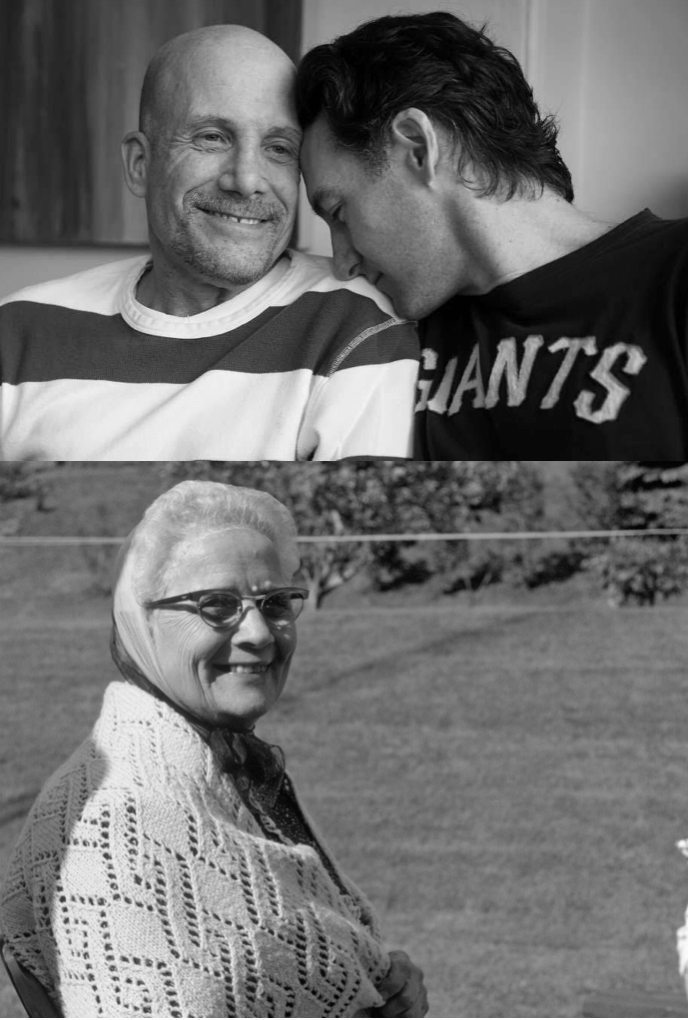
The photos above show Nick Grillo and his husband, Kirk, and Sheri’s grandmother, Anna Troyer Hostetler Kurtz.
Rev. 7:9-17
My grandma Anna was not a dainty, reserved, modest Mennonite woman. She was large-boned and brassy, opinionated and direct. It used to be said of her, “She wore the pants in the family.” My father was warned about her temper when he began dating my mother. Sure enough, during their courtship my grandma once slapped my Dad— she disliked the way he was teasing my mom in that particular moment — and I think my Dad always felt proud of the fact that she had only done this once during their 50-some year relationship.
Grandma Anna wasn’t a martyr for her faith like the people mentioned in our passage from Revelation, but she went through her share of ordeals. Her family was poor and moved around all the time when she was young, chasing after jobs and some semblance of security. She was one of the oldest children and had to leave school in 8th grade when her mother died so she could take care of her younger siblings. Later, after she had married and had children of her own, her husband Oris — my grandfather, whom I never met — died of a brain tumor in his 40s, leaving her on her own to raise children and run a farm. A few years after he died, their barn burned down.
But life’s ordeals never got the upper hand over my grandmother. She was indomitable. My favorite story about her is from near the end of her life. She was 91 and had diabetes. She loved sweets and snuck them as often as she thought she could get away with it. One day, she developed a wound on her leg that wouldn’t heal and, sure enough — as happens with 91-year-old people who have diabetes — she eventually had to have that leg amputed below her knee. My Mom was certain she wasn’t going to survive the surgery and certain that, if she did, she’d have a long and painful recovery.
But nothing like this happened. As soon as Anna was out surgery and awake again, a nurse asked her if she wanted anything. “A milkshake!” she said. “She drank the whole thing,” my Mom reported to me, later, with great surprise. Anna healed quickly, adjusted well to her more limited mobility and actually felt a lot better with half a leg because, as she told me, she now had less body to move all that blood through. She eventually died, peacefully, about a year later.
What stories of your ancestors give you strength? What resilience did they have that you can draw from?
Life is hard right now. It seems like everything is falling apart. Our institutions are failing. What was once certain is no longer. There are wars and rumor of wars. Every week, there’s more dire news about the climate or something. Almost 80% of people in this country think that life is going to be more difficult for their children than it was for them, a percentage almost twice as high as it was in 2000.
How do we stay resilient through these times? How do we equip our children to be resilient through these times? Resilience is the ability to meet and not be crushed by the challenges and stresses of life. To not only overcome obstacles but to learn from and be transformed by them. Resilience is bounce — the ability to recover from adversity. My Grandma Anna had bounce.
According to psychologists who have researched this, it turns out that one of the best things we can do to build bounce in ourselves and our children is to tell stories of our ancestors. To place ourselves within a lineage of people who had bounce — who have been through adversity and survived and, sometimes, thrived. Keep in mind that your ancestors don’t have to be related to you by blood. We are blessed in the Anabaptist Mennonite tradition to have so many stories of spiritual ancestors who demonstrated incredible courage and bravery in the face of persecution and hardship. Those of you who are lgbtq+ have so many courageous ancestors on whose shoulders you stand. You enjoy freedom because they persisted in the face of oppression, because they lived and loved and fought. Close your eyes, if you wish. Can you feel all these ancestors — biological and spiritual — standing behind you? How they have carried you into this moment, into this time? Can you sense their strength and how it is yours as well?
I invite you to open your eyes. Look around. One of the beautiful things about being in a community is that we become each other’s ancestors. Let me tell you how. Nick Grillo began attending our church in about 2000. He was forced to leave home at 17 when parents found out he was gay. He lived at the YMCA for awhile before eventually finding more stable housing and employment. Life was not easy for Nick, but he kept going and he kept growing as a person. By the time many of us met him, he was a tough-looking but tender-hearted New Yorker with a great laugh, a generous, joyful and gentle man.
Around 2010, Nick was diagnosed with ALS, Lou Gerig’s disease. ALS is a disease that progressively degenerates nerve cells in the brain and spinal cord. It is, for most people, a terminal diagnosis. I remember when Nick went to the doctor early on to broach the subject of whether or not the doctor would help him end his life if it became intolerable. The doctor indicated they could talk more about that when the time came but said, “Nick, you can’t predict how you are going to feel about your life as the disease progresses. Now, you can’t imagine being paralyzed but many people who are paralyzed from ALS greatly enjoy their lives.”
This sounds like a depressing story, but it isn’t. Nick became more even more joyfully alive as his ALS progressed. He was profoundly grateful for every blessing, no matter how small. He radiated love and peace. I felt like, as his body atrophied, his spirit shone even brighter. I know Nick had moments of real emotional pain and suffering, especially when his disease progressed to a new level of lower function. But I also know that he overcame all of those moments to come to an even deeper sense of joy and peace and gratitude.
Nick died in 2016, and he is now our ancestor, who taught those of us blessed to have known him how to have bounce in the face of some of some of worst adversity many us could imagine, how to live well while dying.
Look around at our children. We are their ancestors. They are learning, from us, how to bounce back after defeat. How to keep on keeping on in the face of grief and despair. How to taste joy even when life is far from perfect — to drink the whole milkshake.
Helen Keller said, “Although the world is full of suffering, it is also full of the overcoming of it.” In times such as these, may we draw on the strength of our many ancestors, who overcame. Amen.