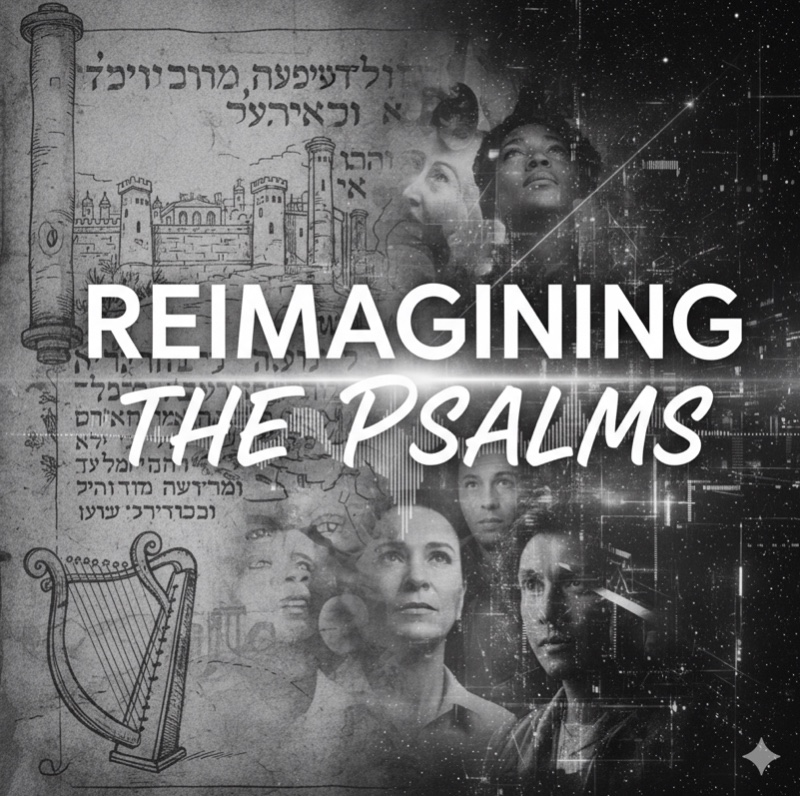
Reimagining the Psalms
The following is a guest sermon/drash given by Rabbi Howard Steiermann of Congregation Sha’ar Zahav.
Psalm 137
I would like to share with you the story about how I got interested in, and empowered to, write my own rendition of the biblical psalms.
As I am used to delivering sermons based on Torah text (the Torah is the first 5 books of the Bible), I would like to mention that this week’s Torah portion is found in Exodus and is named Yitro, Jethro, after Moses’s father-in-law. One of the stories we read in this portion is The Ten Commandments being revealed to the Israelite People at Mount Sinai [Exodus 20:1].
Jewish Tradition teaches everyone at Mount Sinai – no matter their age, gender or station in life – all heard the voice of GD according to their own ability to understand. It is also taught, that in spirit, all of us were there at Sinai.
So if I heard the Ten Commandments as I could understand them, perhaps that’s what I have been doing with Torah study for nearly four decades: grappling with how to understand the Holy Words. For me, one way that’s been successful in my understanding is to rephrase parts which befuddle me. In turn, they become more real to me, and thereby more relevant.
An example of my rephrasing can be found in the Sha’ar Zahav prayerbook (pg 39). The traditional Birkat Hagomeil ברכת הגומל blessing, in which an individual thanks GD for making it through a perilous event such as a sickness, a dangerous journey or after being released from captivity, is translated as:
Blessed are You, Eternal our God, Ruler of the Universe, Who bestows goodness upon the one in debt to You, and who has granted me all good.
My contemporized version restates that as:
I am indebted for the bounty of love, health, and peace I now enjoy. Let me embrace my renewed appreciation for my life. May I be inspired to perform acts of tzedakah (charity and justice) and tikkun olam (assisting in repairing the world).
That is one example of how I was already used to rephrasing liturgy and texts I encountered.
So on to my Psalms story. As an adult, I began to engage in ritually washing the deceased prior to them being placed in a casket for burial. This is called Tahara.
I had been familiar with the Jewish tradition of reading Psalms while watching over the deceased prior to their burial. I learned that psalms are also read during the Tahara itself. Additionally, Psalms are chanted on the way to internment. I was becoming more involved with our tradition’s rituals around death: conducting funerals and learning to participate in the honor of performing Tahara. Psalms are a central text in both.
Unfortunately, the Psalm translations I was familiar with, mostly from prayer books which had been written decades before, were stilted and didn’t come across as poetic to my ear.
If I was going to be comfortable in the sterile environment of a funeral home or in the deceased’s home to perform a Tahara, I knew I would want to read or hear Psalms that could comfort me. If I was leading the procession of the Aron Hakodesh (casket) to its final resting place and reciting psalms along the way, I wanted what I was reading aloud to mourners to be meaningful, heartfelt, and touching.
I wondered where could I find a translation of the Psalms which were meaningful, heartfelt, and touching?
Fortunately, over the years I have spent many hours at used bookstores. So, in my home library I had Norman Fischer‘s Zen –inspired translation of the psalms entitled Opening to You. While much of his poetry did speak to me, his book included only a selection of the Psalms rather than all 150. I also had the accomplished poet Steven Mitchell’s A Book of Psalms, but again he only adapted some, not all of the psalms.
Hmm, was it crazy for me to consider writing my own rendition of the Psalms to use when I needed to call upon them?
There are numerous examples over the millennia of people ‘updating’ texts into words that spoke to them.
Psalms, like other biblical books, went through changes—the actual original text of Psalms is sadly not preserved. We do have clues as to the original: for example, Psalm 72 concludes: כָּלּ֥וּ תְפִלּ֑וֹת דָּ֝וִ֗ד בֶּן־יִשָֽׁי “End of the prayers of David son of Jesse,” indicating the Book of Psalms originally ended there.
Another example of biblical changes or iterations can be found in Psalms 14 and 53, which are quite similar, yet not identical — leaving us a trail of changes, as the psalms were transmitted seemingly with some errors perpetuated across the millennia.
So, if the original psalms were added onto and sometimes changed by scribal error, it dawned on me that my simply rephrasing the currently existing Psalms is not that much of a stretch.
As I spoke about earlier, over the years I have written my own rendition of prayers. I had also written brand new prayers. Each time my goal was to create writings that were meaningful for me, that “spoke” to me, and in doing so hopefully “spoke” to others.
As a service or prayer leader, it is my practice to research the origin and traditions surrounding rituals. Only once I learn the history do I feel empowered to innovate.
My original business card read: Creative Innovative Rituals, Grounded in Tradition. I wrote the words “grounded in tradition” to let people I work with know our work together is based on a solid foundation. This allows even the most creative adaptations to feel authentic.
With my decades-long practice of being grounded in tradition prior to innovating, I started researching and studying the Psalms. My library now contains probably four dozen versions of the Psalms as well as study guides and commentaries. Because my command of Biblical Hebrew is elementary at best, my intention was not to write new translations from the Hebrew, but rather write a new rendition, focusing on traditional but referencing contemporary translations as well.
In Eugene H. Peterson’s The book of Psalms, The Message, he wrote that the Psalms
“…gives us a language adequate for responding to the GD who speaks to us.”
I was craving to find such language. As I hadn’t, I decided: Yes, I’ll write my own! Peterson continued,
“The impulse to pray is deep within us… Faced with the prospect of conversation with a holy GD who speaks worlds into being… We feel awkward… We excuse ourselves on the grounds that our vocabulary is inadequate.”
Since I had written a variety of prayers as well as a new Yom Kippur mincha (afternoon) service, I knew that adequate vocabulary was within me. Peterson also wrote,
“Prayer is elemental, not advanced, language. It is the means by which our language becomes honest, true and personal in response to GD. It is the means by which we get everything in our lives out in the open before GD.”
I knew I had songs within me needing to be sung. I realized the best path for my interior music to be heard was through reworking the 150 psalms into verses which sounded right to my ear, and landed lovingly on my heart. So, I donned my kippah and started to write.
Sometimes when I am sitting at the table, writing, part of me realizes that the undertaking is quite chutzpahdic (presumptuous). The question that can come up is: Who am I to write my own rendition of the Psalms? But then again, why not me?!
Benjamin J Segal in his book, A New Psalm, The Psalms as Literature wrote,
“Although there are 12 Psalms specifically referring to an incident or occasion in (King) David’s life, all related to events recorded in the book of Samuel, in most cases they divert from the historical text. This suggests that we have a work of poetic imagination…”
So, if the original biblical Psalms were a work of poetic imagination, then using my own poetic imagination appears to be solidly grounded in our tradition!
Segal’s book also pointed out that we can
“discern three stages in the poem’s Journey: the Psalmist confronting life; the Psalmist seeking to communicate that observation for the consideration of the reader; and the reader confronting life, the psalm being his or her bridge to insight.”
So, here I am confronting life by building my own bridge.
In my studies, I learned many, if not most people have been taught the Psalms were all written by King David. While 72 of the psalms are attributed to David, the superscription (or opening) to Psalm 90, is: “A prayer of Moses, the man of GD.” That psalm is attributed to Moses, with some psalms to other authors. Some of the psalms are attributed to no particular author and are known, in the tradition, as ‘orphan psalms’. It is incorrect, therefore, to say that in the traditional view David is the author of all 150 psalms. This view of Davidic authorship was not left unquestioned in the Middle Ages and is rejected by all modern biblical scholars as anachronistic. Psalm 137, for instance, speaks of the period, hundreds of years after David’s death, when the Temple had been destroyed and the Jews were in exile in Babylon.
The book of Psalms is now seen as a collection or anthology of psalms compiled at different periods, though there is no real reason to deny that some of them may go back to David himself, with psalms or groups of psalms added later to the collection.
I see my rendition as a continuation of the collection. My 20th and 21st century perspective will hopefully add nuances appreciated by a 21st century audience.
The 20th century Chernobler Rebbe who lived in Boro Park, NY, taught
“the Torah is not a historical document but rather a garment of GD’s light.”
The versions of the Psalms I had previously read felt like an ill-fitting garment. So, like a tailor using scissors and thread, I removed and added words – constructing Psalms which reflected my style and life view. For example, I added references to women, as well as self-empowerment, thereby reducing the psalms’ reliance on men and GD to ‘save the day.’
With the hope of having my Psalms also used by others, I work toward voicing universal feelings.
In his book, From the Depths: The Use of Psalms, Rabbi Simkha Y. Weintraub says this eloquently.
“Illness, suffering, and loss mute us – they leave us without words. Whether overwhelmed, confused, distraught, despairing – or profoundly grateful, reflective, renewed, attuned – whatever our state, we are often left speechless, feeling that words fall flat or do not convey what we want, need, or intend. In the face of these challenges, those who are in pain, as well as those who care for them, may need new ways of communicating, new tools for talking, and new modes of relating.”
Working on writing my own rendition of the Psalms has made the psalms more relevant, more familiar, and richer to me… they now speak, and even sing to me. I look forward to when other people gain insights and a connection with the Psalms through my writing, and thereby influence peoples’ appreciation of these sacred texts.
So, whenever you are blessed to be confronted with holy words, be it a momentous revelation similar to Mt. Sinai, or in a quiet moment of solitude, may those holy words be meaningful to you.
Or, may you have the wherewithal to reframe them so they become meaningful to you.
May we all be blessed with a Sabbath that recharges our bodies, our minds and our spirits. And may you come to understand that which has been revealed to you.
I would like to conclude with the words of that great Jewish scholar and musician, Leonard Cohen:
“There’s a blaze of light in every word
It doesn’t matter which you heard
The holy or the broken Hallelujah
I’ll stand before the Lord of Song
With nothing on my tongue but Hallelujah”
Please join me: 🎶
🎵 Hallelujah, Hallelujah
🎵 Hallelujah, Hallelujah