
Sermon: Getting Low
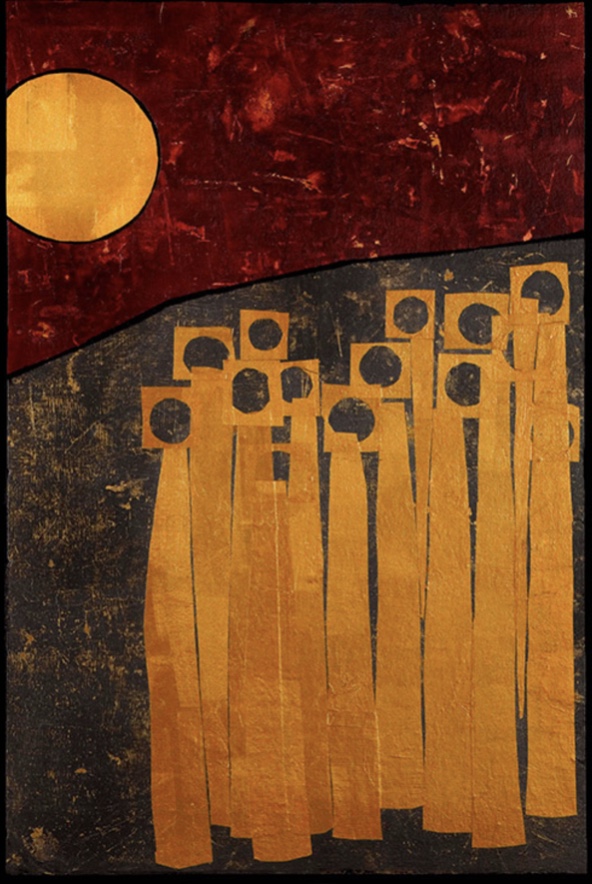
Luke 6:20-23
October 29, 2025 — All Saints Day
A little more than 11 years ago, my Mom died. Thanks to this community, I had the leave to be with her for several days before she died, to be present at her death, to plan and attend her memorial service three days later, and to spend the week that followed with my father. By the time I came back home, I had been fully submerged in the river of grief. I was sopping wet.
The day after I returned, I saw my neighbor — a friend — and he asked how I was doing. I decided to answer honestly. I trusted him enough to be a little more emotionally open than I might be with other neighbors. But as I spoke, tears began to rise in my eyes, and I saw a look come into his — discomfort. I had crossed over into an emotional landscape he did not wish to enter. So I pulled the conversation back into the “safe zone.”
I wasn’t angry with my neighbor. His reaction was normal in my culture. Outside of this community and close friends, I actually don’t expect most people I know to be able to handle even a small measure of grief. As the wise Karla McLaren says, ours is a grief-impaired culture — and a death-denying one.
We are a culture of ascent. And grief, death, loss — these are downward movements. In our dominant culture, we prize progress, upward mobility, achievement, and rising above our circumstances. We are told to climb the ladder, reach for the stars, shoot for the moon. Our economy must always grow, and corporations must always scale up.
Silicon Valley is the temple of this religion of ascent. Our tech lords dream of transcending death, biology, even Earth itself — by optimizing their lifespans, upgrading their bodies, and uploading their consciousness to “the cloud.” Anything to escape the downward pull of embodied life and its limitations.
Even our spiritual language can reflect this obsession with ascent. We speak of mountaintop experiences, of higher consciousness, of rising above negativity. The resurrection of Jesus is sometimes interpreted as a triumph over descent and death—proof that we can bypass the hard, painful places because the victory is already won.
Your mom just died? Hallelujah! She’s with Jesus now. Your child died before you? It was all for the best — he’s in a better place.
But the true mystery of our faith is not that death and grief are transcended. There is no triumph over death; the triumph is that we go through it, and something transformative happens when we do. We descend into grief. We enter into the tomb, which becomes the womb of new life. And, in time, we emerge—transformed. That is the holy movement of our faith: not ascent without descent, but life that moves through death to rise into life anew. Death, grief, failure, loss, brokenness — this is sacred terrain.
And in today’s Gospel, Jesus blesses this very posture of descent:
“Blessed are you who are poor, for yours is the kindom of God.
Blessed are you who are hungry now, for you will be filled.
Blessed are you who weep now, for you will laugh.”
Jesus doesn’t bless those who rise above suffering. He blesses those who are brought low—the poor, the hungry, the grieving, the excluded. The kindom of God begins not at the top of the ladder, but at the bottom.
When death or irretrievable loss comes and we refuse to descend—to fall to our knees, to drop to the ground—we may think we’re avoiding pain. But we’re not. Because the grief just backs up inside us.
I often think of a grief as an river that needs to move through us. When we try to dam it, it becomes a stagnant pool—murky, even toxic. Stagnant grief can show up as emotional numbness (we may not feel pain, but we can’t feel joy either), as distraction (binging on entertainment, alcohol, shopping, anyone?), as disassociation or rage. Honestly, I think much of the societal and political rage we’re seeing now is really unprocessed grief—grief over lost status, lost communities, lost human connection, lost security.
Because, here’s the thing — our grief is larger than only grieving those who have died.
Karla McLaren reminds us that grief arises whenever something is irretrievably lost. It might be the end of a relationship. The loss of health or vitality. The loss of a cherished goal or dream. The loss of normalcy or stability. Grief can also arise from never having had something we’re told is basic—like safety, health, or a happy childhood.
When I widen my own circle of grief beyond death I can feel the ache over the loss of the world I imagined bringing my son into — a world that no longer exists. I can feel the grief of my changing body, the awareness that my bodily youth is definitely gone and that the road ahead will include more breaking down than building up.
Now, there are hopeful things to say about both of those truths. Believe it or not, I thing the world that is possibly being born in the possible collapse of this one has the potential to be more just, more humane. And I believe aging brings its own grace and wisdom. But for now, I’m inviting us to stay with the descent—to dwell with the grief. But that is sacred terrain. That is holy work. The only way out is through.
During our candle lighting, you’re invited, if you wish, to name one of your beloveds that has died, especially in the past year — although not only. And you’re also invited to name a loss other than death as well. That’s why I called this time Remembering Our Dead / Naming Our Losses. During the Education Hour that follows, we’ll continue that practice—sharing not only about those who’ve died, but also about what we have lost along the way.
I look forward to this Sunday ever year because I have experienced the gifts and graces of getting low, of descending:
- Grief pulls us toward the earth—toward embodiment, humility, and dependence on each other and God.
- It slows and grounds us.
- It exposes our lack of control, our limits, our mortality — the truth.
- It teaches that falling apart or falling downward can be a kind of sacred initiation—the soil from which compassion, tenderness, and wisdom grow.
Like a seed breaking open in the earth, or compost becoming the soil for next season’s life, grief is the sacred passage through which new life is born. We do not rise by avoiding our sorrow. We rise by yielding to it — by trusting that the way down is also the way to more abundant life.