
Guatemala Reflections
Youth from FMCSF and three adults traveled to Guatemala July 9 – 19, 2025. On Sunday, August 10, the youth led the service and shared these reflections with the congregation.
Leah:
Hello everyone and welcome to First Mennonite Church of San Francisco. Today, Youth Group will be sharing about our recent trip to Guatemala in July.
We would first like to offer a land acknowledgement to honor the original stewards of this land; the Ohlone and Bay Miwok peoples, who, like the Mayan people in the highlands of Guatemala, have faced displacement, threats to their lands and lives throughout history.
One of the first things our guide Karla told us when we arrived in Guatemala is that “Guatemala is not a poor country.”, explaining how the country has large amounts of wealth, natural beauty, and culture, even though it also has its issues. She urged us to begin with this in mind, so that we would be able to learn from the country and take in the many things it has to offer.
Throughout our trip, we visited places and organizations that demonstrated these things, creating real change in their respective communities through holistic approaches to the issues affecting them. ANADESA, an organization promoting gender equity created a community bank families could use to start their businesses. Puerta de Esperanza, which runs education programs for children, ensured every child was given breakfast and a chance to wash their hands. Rujotay, an organization providing composting services for families in San Juan Comalapa also made a cafe serving local produce, creating a third space for youth in the community.
Everywhere we went in Guatemala, it was clear to me that tackling our issues together, with empathy for one another, is how we are able to move towards a more peaceful world. By learning more about the culture & history of Guatemala, what Karla had told us at the beginning of the trip seemed even more important.
As we go into the reflections today, I ask you all to listen to us with the same mindset: Guatemala is not a poor country. When we share with you all today, we hope that you too will be able to take something away from this, and reflect on what we share with critical thinking, vulnerability, and compassion.
Ollie:
For our Children’s Time Ollie wrote this story, comparing and contrasting the experiences of a child in Guatemala (Marisol) and a child in the United States (Liam). Ollie mentions Puerta de Esperanza which was an organization we visited that supports children and their families who have recently migrated from the highlands to Guatemala City:
Liam lived in a big city in California. He liked writing, playing soccer, and eating pancakes before school.
Marisol lived in Guatemala City. She helps her mom and sister run a fruit stand. They sell all kinds of fruit that you couldn’t find in a grocery store.
Liam woke up to breakfast ready on the table and a ride to school in the car. Marisol woke up early to help sell fruits. After she puts on a uniform and heads to school she can’t always eat at home but her school program called Puerta de Esperanza gives her a warm, homemade breakfast.
Liam’s classroom has a big screen, lots of books, and even a field to play on. Marisol’s school didn’t have the same things, but Puerta de Esperanza helped her with homework, gave her lunch and even gave her family medicine if they couldn’t afford it.
They both discovered their talent for writing and when they were older they both wrote many books, giving others the chance to learn about a different culture.
Zoe:
In mid-July our youth group took a 10 day trip to Guatemala, traveling around to a few different cities, but first we spent time in Guatemala City. On our first day we got to explore the main city plaza called Plaza de la Constitución, which is kind of equivalent to our Civic Center area. Then we went to a church that had the names of tens of thousands of people who had disappeared or were killed during the internal conflict in Guatemala. After that we went to an underground market, where we split into teams and we each got 10 quetzals (about a dollar in the US) and our teams had to try to get as much fruit as we could and bargain down the prices.
Then we went back to SEMILLA (which means seed) which is a Mennonite seminary and language school campus that has dorm like rooms that we stayed in the first 4 nights. On the second day we went to Puerta de Esperanza where we got to see a bunch of little kids and learned how competitive it is to get into school. From there we walked around another part of town where we got to meet a lot of the parents whose kids participated with Puerta de Esperanza. The parents talked about how much Puerta de Esperanza helps them run their business and helps feed their kids when sometimes they can’t afford to. After that we got to see where a lot of families lived. For about US$20 you could get 6 x 9 room which normally slept about 3 to 4 people.
Overall one thing that really stuck with me is how much I take for granted in the US without even realizing it, like clean water, the ability to have a free education, and clean places to live and sleep. Even though we were foreigners and there was a language difference, everyone welcomed us with open arms and helped us feel like a part of their community.
Nora:
When we first arrived in Guatemala I had no idea what to expect. Growing up in Oakland as well as a progressive church in SF I have always had a negative view on the word “traditional.” When I think of traditional I’m reminded of the conservative—most of the time oppressive—Christian ideas, and the impact on marginalized communities. Going on this trip has reminded me of the beautiful customs and culture that come with a devout tradition.
Throughout our journey we had been learning a lot about the Mayan people in Guatemala. On the second day we had a history lecture explaining the racism that the Indigenous people face. In my bilingual school we always learned about Indigenous communities, but it was mostly shedding light on the racism that they face inflicted by white people in the U.S not so much the racism that has been inflicted by the Latino or Latina community or more specific to Guatemala: Ladino community.
One thing that stood out to me was how the Mayan communities are advertised in Guatemala and in the U.S. When we were walking around and going to a museum, there were so many references and information sites about the ancient Mayans but not the modern Mayans who are still here and are ignored. In the U.S., things like textiles or beaded jewelry are very common in airports and as tourist souvenirs but are still a huge part of Mayan tradition.
However, one of the places we went to, San Juan a La Laguna, seemed to combine a very strong sense of tradition, while still depending on a tourist economy. Our tour guide explained that virtually everyone who lives there is of Indigenous ancestry, but it was the place I saw the most tourists on our trip.
In Santiago Atitlan the main activity that we did was going to an organization founded by women called Anadesa. There we took traditional cooking class and learned about what they did. Out of all the organizations that we went to, Anadesa spoke to my interests the most, especially their classes on gender politics for Mayan men and women to improve men’s behavior toward their wives as well as education for children.
It amazes me how someone can combine a traditional way of life but still teach progressive classes. This shows biases I have coming from a progressive place where those things don’t always go together. We also had a day of doing many small activities around San Juan. Such as learning about bees, textiles, medicinal herbs, an art gallery, and chocolate! Again I am amazed how this town depends on tourists for the economy but yet still has an entire community rooted in Mayan culture, and how the products they sell never seem to lose the meaning behind them.
There were a lot more topics and activities that I didn’t cover. What I wanted to say the most is how much I loved this trip for all the different things we did, both touristy and for learning purposes, as well as getting to know everyone!
Dahlia:
During my time in Guatemala, I was most inspired by the culture’s connection to ancestry and religion. We spent time with many indigenous locals both in Guatemala city and in towns surrounding lake Atitlán.
The two experiences that stuck with me the most were our time at Anadesa where we cooked traditional dishes with Mayan women who taught us about the customs surrounding the cooking tools and the important roles women had in Mayan culture. Although there was a language barrier, I felt close to the woman who was teaching us. It was probably the first time in the trip where I felt truly relaxed and happy.
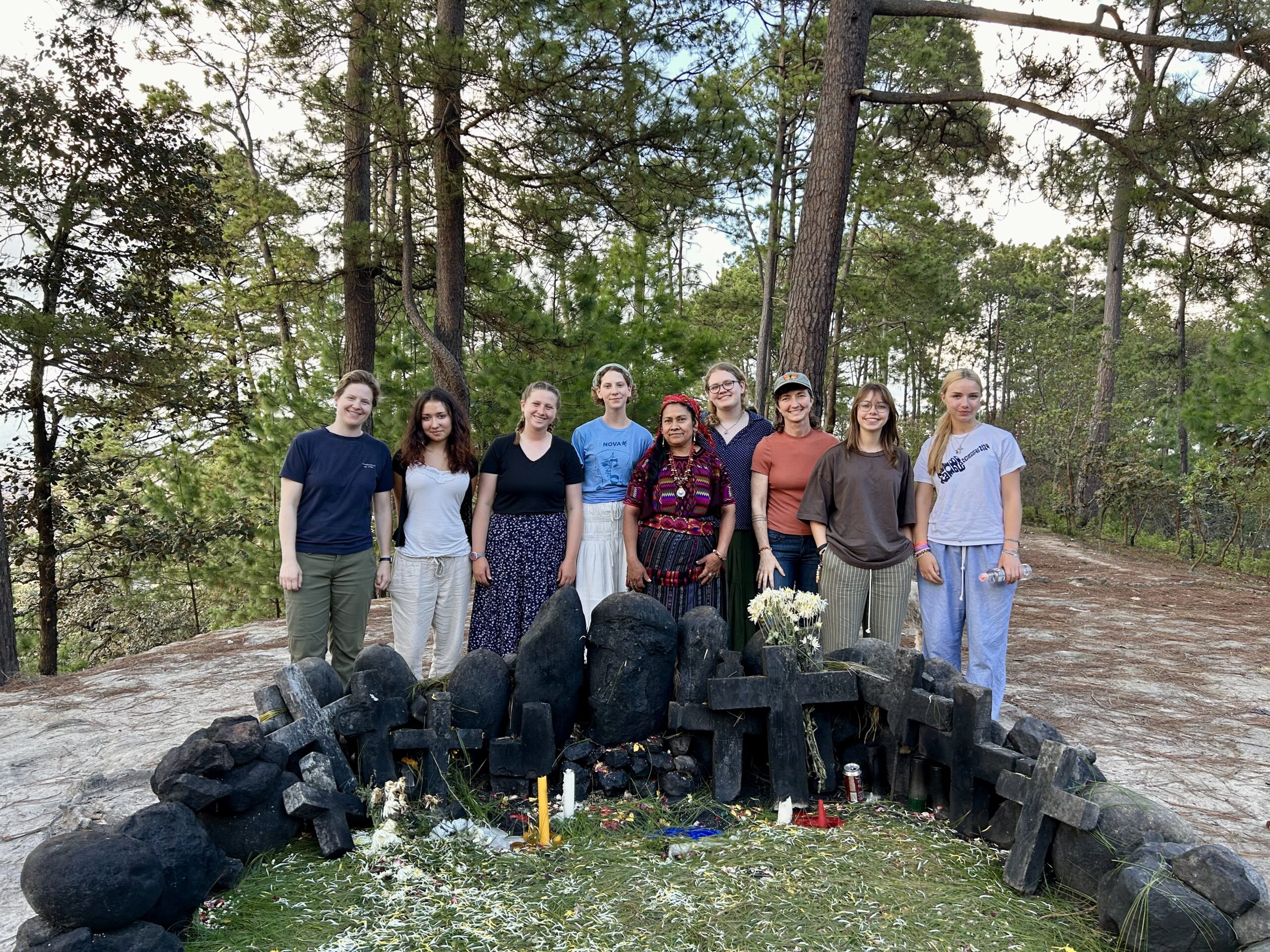
The second experience was a Mayan fire ceremony in Chichicastenango where we hiked up a hill and a Shaman or “Ajq’ij”, Tomasa de Ignacio, shared her story of how she became a spiritual healer. She was born with the gift of spiritual healing but denied it because of life events. The denial caused her so much physical ailment that she eventually began her spiritual journey.
During the ceremony, themes of self-forgiveness, ancestral communication, and emotional release were shared through the burning of pine balls, Tomasa’s praying in k’iche, and herbal branching, a light tapping of the body with herbs to release energy. Although I felt some relief during the ceremony, most of the healing from it was gradual the more I reflected on the ceremony and moved past the immediate surprise of the unfamiliar customs. I was especially inspired by Tomasa’s dedication to her community and tradition while also holding a strong sense of self.
During the ceremony I was reminded of my grandma and how she held similar traits of a strong faith. I thought about her often throughout the trip as we talked about migration, cultural history, and resilience. She, along with my dad and grandpa all migrated to the U.S. at the eve of a civil war in El Salvador. Like Guatemalans, civilians in El Salvador suffered (and still suffer) oppression at the hands of a corrupt government. Thousands of civilians and guerrilla members went missing and many people were forced to leave to a country that had contributed to their government’s corruption.
On this trip we still saw missing persons posters all over Guatemala City which was a form of civilian resistance. My grandma was an example of fortitude in the face of discrimination. She protected her identity as did the Indigenous women by their dedication to peace and community. Their example and my remembrance of my grandma was something I really needed in this time of transition as I search for self-love and independence.
In my recent experience abroad I learned about a number of different religions. In Italy I took a Greek and Roman mythology class, in Turkey I learned about Islam, and in Guatemala about Mayan culture. In all of these religions there are common areas and distinctions. I feel drawn to each of them in some way.
A story of all the religions that I found interesting was the creation of mankind. In Greek and Roman Mythology the creation of men took 5 different stages: gold, silver, bronze, heroes, and iron, all gradually getting worse. In the Iron age Zeus then sees the corruption of human kind and creates a flood to cleanse the world until two characters rebuild humans from stone. You can see the resemblance…
Both Christianity and Greek and Roman mythology endorse the idea that humans were born corrupt. But Islam and Mayan religion offered a different perspective. In Islam, God created Adam and Eve with the purpose of learning and exercising free will. When they bite the apple, instead of that being regarded as the original sin, it is regarded as the first act of free will. God wanted followers that choose him rather than follow from obligation.