
Pentecost Sermon: Unthinkable
Acts 2:1-21
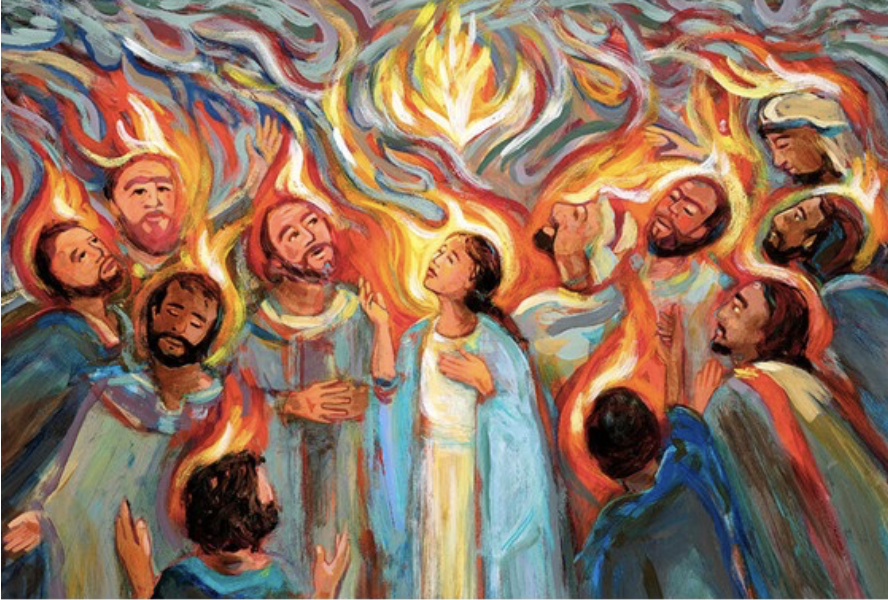
Pentecost is the day when the unthinkable happens. On Pentecost, 120 people sit in an upper room, waiting to be baptized with the Holy Spirit, because Jesus told them this was going to happen. I doubt any of them could have imagined what this meant.
And so they wait, in a room that I imagine to be rather hot, stagnant, maybe a bit stifling — the kind of thing that happens when 120 people gather in a place without air conditioning on the second floor in a hot climate on a summer day. And then suddenly, the air begins to shift. It starts vibrating, pulsing and that pulse increases and gets stronger and then something like a great wind moves through the room, through each of them. Some door in their spirit and body and mind blows open, and, unthinkably, they begin speaking in a language not their own, a language they don’t know.
This attracts the attention of the multi-lingual, multi-cultural group of Jewish people who are gathered outside to celebrate the harvest festival of Shavuot. These people are immigrants from all over the Mediterranean basin who now live in Jerusalem, and who speak languages other than the one of Galilee, where most of the 120 are from. But now they hear these Galileans witness to the mighty work that God had done through Jesus in a language they can understand. Impossible.
This isn’t the kind of speaking in tongues that will happen later in Acts, called glossolalia. I don’t know if any of you have ever been in a Pentecostal church service, but in that kind of speaking in tongues, the person speaks a language that is not an earthly language, and they don’t know what they are saying. Often, someone else with the gift of interpretation interprets their speech.
But in this story, the Holy Spirit empowers Jesus’ followers to speak in a known language, erasing the linguistic walls that separate them from each other. People who don’t speak the same language can easily connect and share the Good News, the Gospel. And everyone is mystified, surprised, amazed because what is happening is unthinkable. Mind blowing.
And I’m sure many of us are thinking: Yeah, that’s can’t happen. But I wonder. Patrick and I had a little getaway trip to Point Reyes earlier this week. As we were driving, we listened to the first two episodes of a podcast called “The Telepathy Tapes” that Joanna had recommended. The show documents the prevalence of telepathic communication among non-speaking autistic children and youth. The children in this documentary communicate mind to mind with a trusted caregiver or parent — almost always the mother — and with each other. In fact, one parent said it is less telepathy and more like she and her child share a consciousness. Needless to say: Mind blowing.
What makes this so poignant is that all of these parents have been told my doctors, by Western science, that there is “no one in there,” when it comes to their non-speaking autistic child. They’ve been told that their child has the intelligence of a toddler, that they should give up hope that they will ever be able to communicate with them, to know if anything is going on in their child’s mind. And then, when these children are taught to communicate by spelling out words on an iPad or other device, the mothers realize they are extremely intelligent, spiritually gifted human beings. Among those gifts appears to be the ability to communicate in ways that many of us see as impossible, unthinkable.
Stories shape our world. And the stories that our culture tells us — stories so ingrained we don’t even think of them as stories — these stories makes some things thinkable and other things unthinkable. “This is true — but that? That’s hogwash. Delusional. Woowoo.”
All cultures have stories that shape worlds. It’s how we humans make meaning, how we make the world make sense. Especially in a time when the world as constructed by our stories does’t seem to make sense anymore, it’s good to step back and look more closely at the stories shaping our world.
So I want to talk briefly about our dominant Western story — what sociologists like my husband call the cultural default mode. Our dominant Western story — which has since come to influence a good chunk of global civilization — has produced good things: democracy, freedom, individual rights. Thumbs up to that.. But there an underside to our cultural default mode because a lot of it is based in a story based in separation. Separation from each other, separation from the web of life that sustains us, separation from God or Spirit or anything that can’t be seen or measured or studied or verified via the scientific method.
Many believe that our story of separation began with the ancient Greeks and continued through the rise of Christianity and the Scientific and Industrial Revolutions. 17th century philosophers such as Francis Bacon led the call for humankind to “conquer nature,” while others like Rene Descartes and Thomas Hobbes introduced the view of “nature as a machine” that has dominated Western thought ever since.
Europeans applied the power gained by conquering nature to conquering the inhabitants of much of the rest of the world. They justified this domination because those people weren’t like them — they were less than, not as good as, sometimes subhuman. Separate. As Europeans colonized other lands, they imposed their worldview on those who survived their onslaught, instilling core values of power and exploitation that have formed the basis of today’s global capitalist ethos. We took God out of heaven, put ourselves in that place and said: We have become as gods. That story of separation has led us to now — to our current global rush toward possible catastrophe in the form of climate change and overexploitation of natural resources. (These last two paragraphs draw heavy and sometimes quote verbatim this article by Jeremy Lent.)
This story of separation is killing us. It is killing us. This story makes thoughts and actions that could bring us back into right relationship with each other and nature and God unthinkable.
But there is another story. There’s always been another story, a story that has existed since the beginning of time. And on this last Sunday of our narrative lectionary arc, where we have looked at the big story of Scripture for nine months, it is good to remember this story that pulses throughout the cosmos, the created world:
God created a good world and made us good — in the very image of the Creator. The Creator placed us in this good world and gave us instructions on how to live in right relationship with each other, with creation, with God.
We messed up. We live wrongly, we believe wrong things. And so we keep messing up. And God keeps sending us messages called prophecies, called dreams, called visions, called the Gospel – the Good News. God keeps sending us messengers called prophets, called Jesus, called the Holy Spirit.
The say the same thing, a message which pulses throughout time: You are not separate. You are kin, family to each family on earth, called to be a blessing to all the families of earth, including non-human families. And it is in God, the Creator, that you live and move and have your being. You could not exist for one second on your own. You are interdependent, interconnected, interwoven with all of life in ways you may not be able to yet imagine. You are interdependent, interconnected, interwoven with all of life in ways that are unthinkable.
May the Holy Wind, the Spirit, move through us, move through us all, blowing open the doors of separation.