
Reflections on Luke 15:1-32
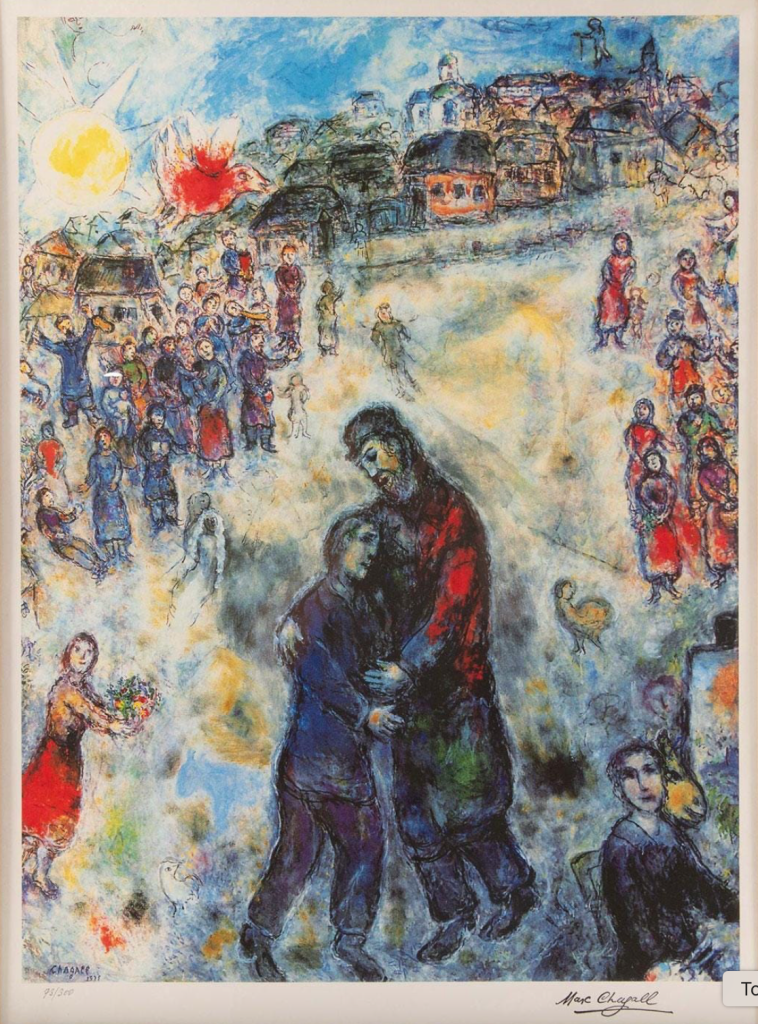
Return of the Prodigal Son” by Marc Chagall
A reflection by Sharon Heath on Luke 15: 1-10
We start chapter 15 with Jesus hanging out with tax collectors and sinners. The Pharisees are apparently nearby, sneering that Jesus “welcomes and eats with sinners.”
Jesus then tells three stories to those around him—the story of the lost sheep, the lost coin and the lost child. Jennifer will talk about the lost child, so I’m focusing on the first two. These are well-known stories, so let’s see if we can find anything new here.
In the first parable, a shepherd starts out with 100 sheep, which seems to me like a lot for one person to keep track of. And, sure enough, when he counts them, one is missing. Now, instead of taking the 99 that he has and going home to put them in the sheep fold before going back to search, he leaves them “in the open country” and goes looking for the one lost sheep. When he finds it, he goes home (presumably taking the other 99 with him) and invites everyone to a party to celebrate.
Similarly, in the second story, a woman loses a coin in her house. She lights a lamp and sweeps the floor. When she finds the coin, she also invites everyone to a party to celebrate.
In both stories, there is a frantic quality to the search, especially in the story of the lost sheep. In both stories, the lost item is rather valuable—a sheep was perhaps worth a month’s wages, and one commentator suggested that the lost coin was part of the woman’s dowry. And both stories end the same way, with the angels in heaven “rejoicing over one sinner who repents.”
The traditional interpretation of these stories is that the shepherd and the woman are God who is looking for sinners to save. That’s the interpretation that I was taught, and it’s what most of the commentators suggested.
But I want to propose another possibility: I wonder if Jesus was offering his listeners the opportunity to put themselves into the stories as the shepherd and the woman.
Would the Pharisees have seen themselves as likely to go searching for the tax collectors and sinners, as the shepherd did for the lost sheep and the woman did for her money?
And while they might have liked the idea of the Pharisees as the sinners, would the tax collectors have imagined that they would diligently search for a lost Pharisee?
And then comes the zinger: There is great rejoicing in heaven over one repentant sinner! Jesus asks his listeners: “Now what are you going to do?? Are you going to search out that sinner and try to get them back in right relationship with God??”
The idea of searching for a sinner may have disgusted the Pharisees who were listening, until they heard the part about the angels rejoicing.
Similarly, the tax collectors, who knew they were sinners, may have had no interest in searching for a Pharisee, or even in being the object of the search, until they heard that angels in heaven would be rejoicing. Each group found their view of the other one turned upside down.
The final point to recognize is that the angels rejoice, not when the sinner is found, but when the sinner repents. The Jewish understanding of repentance, which would have been Jesus’ understanding, is the act of “returning”, of turning around and going the other way.
Perhaps one of the best examples of repentance in the Bible is the story of Zaccheus, the wealthy tax collector, which is just ahead in Luke 19. As you will recall, when Jesus came to his house for dinner, Zaccheus told him that he would give half of what he had to the poor and pay back to those he had cheated four times what he had stolen! Now that’s repentance! Imagine the party the angels must have thrown when Zaccheus repented!!
What does this mean for us?
As Sheri said at the beginning of Lent, these stories are here to help us understand what it means to be righteous—in right relationship with God and with each other. And in these stories, Jesus shows us one requirement—repentance. It is through repentance, turning around and going a different way when we’re wrong, that we get into right relationship with each other.
With this in mind, let’s go back and look at these stories again. In each of them, the object that is being sought, the sheep and the coin, have done nothing wrong. The sheep is just being a sheep, and the coin presumably got dropped. It is the shepherd and the woman who must recognize that something’s not right, drop what they are doing and make things right. They repent—go a different way—when they stop what they are doing and look for the sheep and the coin.
I think this is the real meaning of these parables—we are the shepherd and the woman. When we know something is wrong, between ourselves and God or between ourselves and a family member, or even within ourselves, we must drop everything and make it right. We must repair the relationship. That is repentance.
In 1971 I was a senior in high school in Watsonville. Watsonville is farm country, and the United Farm Workers were organizing farm workers in the area. The father of my close church friend, Sylvia, was an entomologist for Driscoll Strawberries, one of the largest berry growers in the area.
The UFW was striking Driscoll, so Sylvia asked me and a couple of other church friends to come on a Saturday to pick strawberries. We loaded into my old Peugeot station wagon and drove through the picket line.
If you’ve never picked strawberries, let me tell you that there is no easy was to pick strawberries. You can crawl on your knees from plant to plant, or squat if you can, or you can bend over at the waist. They are all hard and painful. After three hours, I was exhausted.
We loaded back into the car, drove back across the picket line, and went home. I had never really seen the farmworkers that I passed by as my brothers or sisters, and that morning, I was able to see them for as people like me, only harder workers. As I drove home, I knew that, no matter how much increase in pay the farm workers wanted, it wasn’t enough for the work they did. And I vowed to myself that I would never cross a picket line again.
In short, I repented.
A reflection by Jennifer Adams on Luke 15:11-32
When I was in high school and college, I loved a good evangelical read… give me all the Phillip Yancey’s and True Love Waits books to soak and try to understand who I was supposed to be a Christian. Those were, if I’m being honest, more instructive to me than the bible back in the day. Telling me how to live and what not to do was exactly what I needed as a people pleasing perfectionist, oldest daughter of an oldest daughter. Or what I thought I needed. And while there was instruction on what to do and not do, they also mentioned this word “grace.” With their own interpretations of it, of course… And many used the story of the prodigal son to explain this concept of grace and I sure did love the story of the prodigal son as a young Christian… Give me all the grace/mercy for my baby sins and acceptance from God even though I was a sinner, I thought. Listening to non-Christian music, no problem, just repent and come home to Jesus… I had a beer when I was 19. Forgiven. Sex before marriage? Yes, God accepts me right back. So many sins, so little time. This is how my teenage Baptist brain interpreted this story. In his story of homecoming, Henri Nouwen says “God rejoices not because the problems of the world have been solved, not because all human pain and suffering have come to an end… No God rejoices because one of God’s children who was lost has been found.” This made so much sense to me as a “sinner.” Struggling and feeling guilty for not being perfect but then also knowing God rejoiced in me despite of this was my truth for so long. I could walk down and aisle and accept Jesus in my heart time and time again. After some repentance and tears, of course.
Now over 25 years later, this isn’t the truth I want or even need any more. Sure, I love the idea that God delights in me, but it isn’t always easy to believe, especially now. Because I want the problems of the world to be solved and I don’t want humans, any human, to suffer. I don’t want our animals and trees, or planet to suffer. I want a God who rejoices because suffering is eradicated, because we all have a place to be safe and commands, we do this for each other. To feel home and make home for everyone in our world. A God that demands that we fix the stuff we broke. The stuff our ancestors broke… But that’s the view of a first-born daughter of a first-born daughter. So maybe I might (just a little bit) overidentify with the older brother in this story… responsible and all.
And at the same time, I do feel a little lost these days. Maybe y’all do too. Our world is hard. Life is a struggle sometimes. Oh, what would it be like to return to a time when life felt more accepting and brighter? When I was more accepting and brighter for myself. When others were also able to offer me this. And I could freely give this back…
Are y’all familiar with Marc Chagall’s lithograph of the Parable of the Prodigal Son? If not, check it out. Many of you know the Rembrandt painting but I love this version even more. Perhaps it’s because I love brightness and abstract design and the irony of a Jewish man, who escaped the Nazi regime and lived in the US for over 6 years never to learn English, mind you, depicting perfectly what I think Jesus is trying to say in this parable. There is a sense of childlikeness that feels like a circus, like a party with balloons and a bouncy house and all the things that feel delightful. And the whole neighborhood came out to show their love. This lost son got to come home again and become a child. To regain not only a family, a community but this status of child. And while I’m glad I get to do adult things these days, I am also, a child, we are all also children, loved even when we aren’t perfectly aligned with each other and with ourselves, and that we can offer this to one another in community is, well, a gift. A close embrace, a listening ear, a gentle challenge, a party, dancing and music and pizza parties. All the good things we need to thrive in our broken world. So, we can come home, that might be with ourselves, or maybe with our community, or maybe in a broken relationship that needs some healing, or with our planet even. But we get to come home. Let’s be that home to one another, to ourselves and to the world.
And maybe just maybe we have a God, who will seek us out and find us when we get lost and throw us a party, maybe even an ethical circus, and call us home. To be settled, to be held and to valued as a child. Just because. Nothing we do or say or believe. Just because.
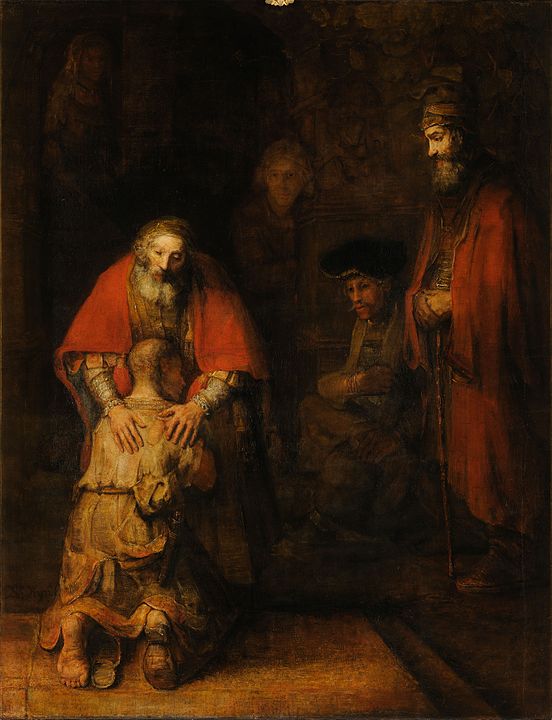
“Return of the Prodigal Son” by Rembrandt