Sermon: Catching People
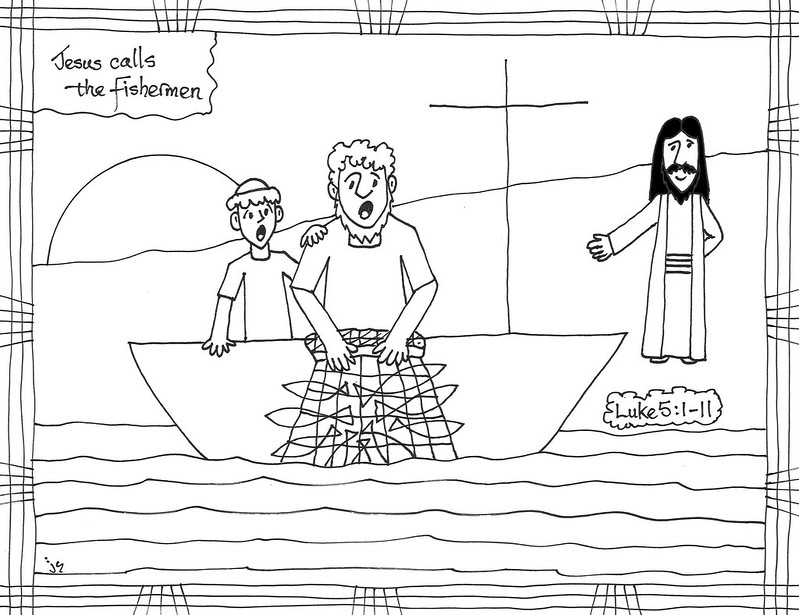
Luke 5:1-11
Almost five months ago, we began grounding ourselves in our sacred story — this story through which Jewish and Christian and Anabaptist communities across millennia have found strength, hope and courage. And we did this because we live in anxious times. Remember back in September? We didn’t know who was going to win the election, and that was anxiety-producing. And then we found out in November who won the election, and that was anxiety-producing. And then the person who won took office on Monday and that is anxiety-producing. And no matter who the president is, we are living in the midst of what many call a polycrisis, which basically just means there’s a lot of stuff going down all at once, and that’s anxiety-producing.
And so we are grounding ourselves in our sacred story, the story through which people in other anxious times have found strength, hope and courage. I want to remind us of that story we’ve been hearing since September but — before we do so — I want to also say that some of the stories we have heard thus far are hard stories — there’s violence and lots of other suspect, strange stuff. And there’s many many stories we haven’t heard that are truly horrific — one Biblical scholar refers to them as “texts of terror.” But I want to remind you of a way of doing Biblical interpretation that has been handed down to us by our Anabaptist ancestors. They believed that we must read the entirety of scripture through the life and teachings of Jesus. And what doesn’t conform to the life and teachings of Jesus can be set aside as not (or not as) authoritative.
And so to the story:
- We are earth creatures on an earth created good — very good. We were given sacred limits as we serve and tend this garden planet. But we violated those limits and entered into wrong relationship with Creator, creation and each other.
- To address this mess, Creator chose one family — that of Abraham and Sarah and Hagar — to bless with descendants and land so that this family could be a blessing to all the families of the earth by showing how to live in right relationship with Creator, creation and each other.
- This family’s descendants are enslaved by an Empire. The Creator God sides with these oppressed people and frees the people from slavery.
- In the wilderness, Creator makes a holy covenant with the freed peoples and gives them the law. The purpose of law was to provide the political, economic, and ritual structures for the liberated people to maintain their liberation.
- But the people struggle to trust their Creator God and to live according to the liberating Law. This becomes even more difficult once they cross over into the land promised to them. (And that’s an especially hard story.) They have a string of bad, corrupt leaders; there’s infighting; they are constantly threatened by their external enemies. It’s a mess — again.
- The people of Israel see that other nations have a king and decide they want to be like other nations too. A king seems to promise security they desire. God says “OK” even though God knows the people rejecting are God’s leadership and law. Though the prophet Samuel, God warns them what having a king will really mean: military conscription for their sons; their lands and crops expropriated for the king’s army and servants; heavy taxation; their children forced into labor for the king. In short, the monarchy will be the exact opposite of God’s liberating law, of God’s political economy.
- In response to the monarchy, God continually raises prophets to speak truth to kingly power. A huge section of our sacred story is the words and actions of the prophets, which tell how they rebuke, chastise, mourn, and implore the people and their leaders to return to God’s law.
- In addition, God gives the people a promise that God will one day raise up a just ruler through the line of David, which implants in the people of Israel the hope for the messiah — the anointed one who will bring true peace and true justice.
- At this juncture, the Jewish story and the Christian story part ways. Christmas marks that dividing line. Most Jews do not believe Jesus is the Messiah, the one promised by God. Many Christians do. And even if you don’t, not quite in that way, you likely believe that Jesus is a teacher to be taken seriously. So let’s come into Jesus’ time, where we will be through the rest of this sacred story. Though not enslaved, the people of Israel have been colonized by the Roman Empire, one of the most “successful” empires the world has ever known.
- Into this world, Jesus is born. So far, we have heard stories of young Jesus at the temple, of a slightly older Jesus being baptized, of Jesus beginning his public ministry by reading from the prophet Isaiah: “The Spirit of the Holy One is upon me because God has anointed me to bring good news to the poor, to proclaim release to the captives and recovery of sight to the blind, to set free those who are oppressed.” By choosing his mandate for ministry from the prophet Isaiah, Jesus enters into the long stream of Jewish prophets who, as Joanna said in her sermon last week, “constantly remind the people to embody God’s original instruction — to be a blessing to all the families of the earth” by being in right relationship with the Divine, each other and creation.
Let’s take a deep breath.
Our stories about Jesus have all been from Luke; this is the Gospel we will be hearing stories from for the next three months. Luke was a physician and traveling companion of Paul’s. He’s an educated man, and he is writing to an audience likely comprised of Roman citizens (mostly Gentiles) and others who had been formed in the educational and cultural system that produced that society’s elite. Much like young people in our time who go to elite private schools for high school and then on to Ivy League schools, etc. Luke’s goal was to convince those who had been formed or were being formed in this elite system that “The way of Jesus would actually provide what he empire promised but could not deliver: peace, justice and abundance for all” (for Wes Howard-Brook’s book Come Out My People).
Jesus is a wandering rabbi, teaching throughout the area of Galilee, an area quite far from the central powers of Jerusalem. The Galilee is often described as a hotbed of resistance to Roman rule. Think political unrest, political assassinations, tax revolts, even banditry. Jesus is obviously a very compelling person to these radical folk. He gathers large crowds around him and people who have never met — like Simon Peter — do what he asks them to do. Think of a compelling political/spiritual leader from our time — Gandhi, King, Mandela— and you get the vibe. We also hear that Jesus seems to command the forces of nature, including fish. That will be a common theme we’ll hear in weeks to come, which we can unpack later,
Obviously, this is one powerful person. When Simon Peter falls down and says “I’m sinful” and everyone is astounded by Jesus — these are the reactions of people who know themselves to be in the presence of a person of great spiritual power. Jesus says to them “Don’t be afraid,” which is always what people are told in Scripture when they freak out in the presence of the Divine.
And then Jesus says to Simon Peter, “From now on, you wil be catching people.” I want to talk about that phrase for the last few minutes of my sermon because I think how we understand that phrase is really important to how we understand Jesus and what he’s about.
I was taught that “catching people” was a metaphor for convincing people who didn’t believe Jesus was the Son of God and died for our sins that he was the Son of God and died for our sins. But even as a young kid who believed that Jesus was the Son of God and died for our sins in a very traditional way, I thought the metaphor was awful. Who wants to be compared to a fish with a hook in its mouth or flopping around in a net? Captured and, you know, eventually dead? Who wants to do that to someone else? So maybe “catching people” means something else? Something more in keeping with the Jesus who said his mandate is, “I have come to bring good news to the poor”?
Fishermen were laborers on the lowest rung of Rome’s hierarchy of occupations. They didn’t own land — big strike against them — and they were forced to pay for both the right to fish on the emperor’s lake and the right to sell the fish they caught through a toll exacted on their catch. How interesting that Jesus recruits people to his movement from this slice of the most exploited people. And on this particular day, Jesus knows that the only thing filling nets of the fishermen was a debt to the empire that could not be paid since they had caught no fish. (This is an almost direct quote from this wonderful commentary on the Scripture by Lea Schade, on which I rely for the rest of the sermon.)
In addition, just behind this story, I think of the vulnerable people impacted by this exploitation. I think of elderly people whose children and grandchildren had to leave that fishing village because they couldn’t make enough money to sustain their families — who had to go into the cities to find work as low-paid laborers. By the way, this is still happening all over the world today, including in our own country. I think of farmers who can’t compete with big agribusiness (because all the government subsidies, etc. benefit big ag) who sell their farms and move elsewhere — or their children do — leaving hollowed-out communities in the middle part of this country with lots of older people and little else. Exploited communities have lots of vulnerable people.
What if “catching people” means to catch people who are falling — people made vulnerable because of an exploitative economic system? What if Jesus is saying: “Let’s catch these folks, let’s care for them.” What if the “catching” net was not one of entrapment, but a safety net?
And here’s an even more radical interpretation of this phrase, from a Biblical scholar and organizer T. Wilson Dickinson — one I have never heard. “Catching people” like a fisherman catches fish is actually an image from the prophetic tradition. In Jeremiah 16, for instance, God expresses disgust with the self-serving practices of the elite by saying, “I am now sending many fishermen… they shall catch them… For my eyes are on all their ways… nor is their iniquity concealed from my sight.” The prophet Amos says that those who oppress the poor and crush the needy will be taken away “with hooks, even the last of them with fishhooks” (Amos 4:2). In the prophetic tradition of which Jesus is a part, “catching people” means to bind or restrain injustice. Kind of like Spiderman does. As Ann said when we were talking about this, with this interpretation, we’ve moved from the net of entrapment to the net of safety to a net of binding or restraining.
To follow Jesus is to join with other to use our collective power to bind or restrain what is not fair or right. To follow Jesus is to build — with others — just laws, just policies, just systems based in right relationship. Two things: binding or restraining and building.
I see this caring, binding and building happening all over the place. Where do you see this happening?
I want to end from a quote from Biblical commentator Leah Schade: “Peter and his fellow fishermen didn’t need convincing. They knew that the extraordinary haul of fish was not meant to give them just a bit extra for surviving within the net that held them. It was to demonstrate Jesus’ power to flip the net inside out, turn the tables, upend the system and build something that served their community and not their overlords.” Amen!