Sermon: Nobodies changing the world
By Joanna Lawrence Shenk
Luke 3:1-22
It is good to be here together this morning. I imagine many of us are coming with heavy hearts due to the devastating fires in Southern California and the ways they are impacting people and places dear to us. I feel a multi-layered grief recognizing the direct impact on friends, the long term impacts on the region, and the root causes of greed-induced climate change.
Alongside the grief, I have been moved by the networks of support holding people in crisis. Pat, Sheri and I were able to join prayer calls with Pasadena Mennonites folks over the last few days. PSMC is collecting donations to support impacted congregations. Members of congregations are hosting people who have been displaced or lost homes. Already on Wednesday a member of PMC had created a comprehensive congregational list and was checking in with each person and family to see what they needed or what they could offer in support of others. I’m sure this is just a microcosm of the networks of support that are popping up all over southern California.
I am glad we are here together, practicing community, because we do really need each other, and the world also needs us. As we see diversity, equity, and inclusion commitments getting trashed by corporations, transgender people targeted by hateful legislation, our tax dollars being used for a genocide in Gaza, and our soon-to-be president threatening to take over other countries it can be overwhelming, to say the least.
But when I ask myself, am I actually surprised that billionaire CEOs don’t care about diversity, equity and inclusion if it will threaten their bottom lines? Am I surprised that fearful and self-hating Christian nationalists are scapegoating vulnerable people? Within a capitalist reality, am I surprised that the profits of weapons manufacturers outweigh every Palestinian life? Am I surprised a fascist leader would want to expand his global reach? No, I’m not surprised, and it’s all still really terrible.
Right now the world needs communities who soberly understand how we’ve gotten here, who are willing to say (hell) heck no to all of this, and who are embodying a different way of being. We are so blessed to have examples of groups who are on this path, throughout history and today. I wonder who comes to mind for you along these lines?
[call out groups] Apache Stronghold, Interfaith Movement for Human Integrity, Joanna Macy and the Work that Reconnects, Zapatistas, Mennonite Action, Coalition DDD, Abolitionists, … We are not alone.
I want to step way back in history to our scripture text for today, to look at one such group.
In the fifteenth year of the reign of Tiberius Caesar, when Pontius Pilate was governor of Judea, and Herod was ruler of Galilee, and his brother Philip ruler of the region of Ituraea and Trachonitis, and Lysanias ruler of Abilene, 2 during the high priesthood of Annas and Caiaphas, the word of God came to John son of Zechariah in the wilderness.
The political backdrop is empire and we first hear all the names of powerful men, political and religious. But where does God show up? In the wilderness with a wild man. We have a contrast between the powerful and prophetic. The people – an occupied people – were moving away from the centers of power and toward the wildness of the Spirit embodied in the prophet John the Baptist.
We’ve been talking about prophets for a while in our narrative lectionary series and I’m wondering if anyone could name their role in our scriptures?
One way to sum up the role of the prophets in our scriptures is that they were constantly reminding the people to embody God’s original instruction – to be a blessing to all the families of the earth. This instruction came with the blessing given to Sarah and Abraham. They were not chosen by God because they were better than others. They were chosen in order to share God’s blessing with all the families of the earth.This required them to be in right relationship with the Divine, each other, and creation.
So the prophetic call is always about returning to right relationship. John articulates this in pretty stark terms:
7 John said to the crowds coming out to be baptized by him, “You brood of vipers! Who warned you to flee from the coming wrath? 8 Therefore, bear fruits worthy of repentance, and do not begin to say to yourselves, ‘We have Abraham as our ancestor,’ for I tell you, God is able from these stones to raise up children to Abraham. 9 Even now the ax is lying at the root of the trees; therefore every tree that does not bear good fruit will be cut down and thrown into the fire.”
As the prophets that came before him he’s challenging the people AND the kings for the ways that they are not being a blessing. His critique of King Herod results in his arrest and eventual beheading. In this text the people, unlike King Herod, are actually interested in what they can do to return to right relationship. In response, John gives them clear instructions:
“Whoever has two coats must share with anyone who has none, and whoever has food must do likewise.” Even tax collectors came to be baptized, and they asked him, “Teacher, what should we do?” He said to them, “Collect no more than the amount prescribed for you.” Soldiers also asked him, “And we, what should we do?” He said to them, “Do not extort money from anyone by threats or false accusation, and be satisfied with your wages.”
The people are compelled by John’s instructions and seemingly want to join his movement, so they ask whether or not he is the Messiah. John is like, “oh buddy, not even close!” So Jesus of Nazareth enters the text as a part of the prophetic lineage, joining this counter-imperial movement of the Spirit in the wilderness.
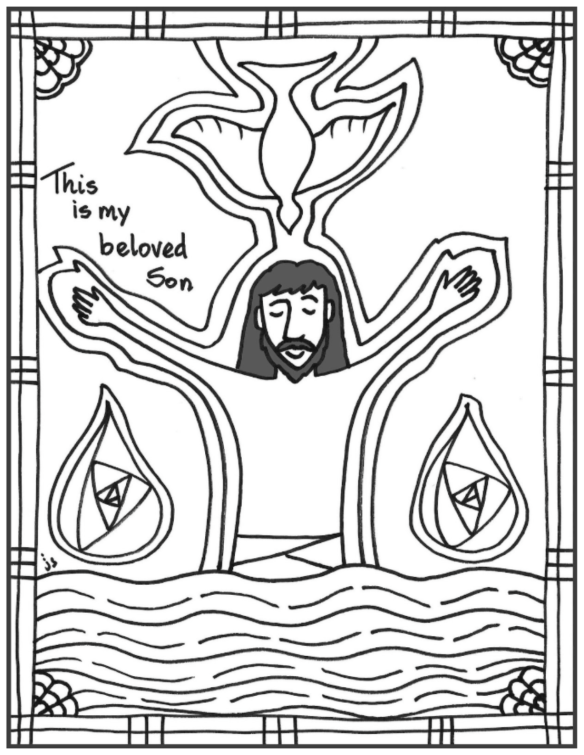
21 Now when all the people were baptized and when Jesus also had been baptized and was praying, the heaven was opened, 22 and the Holy Spirit descended upon him in bodily form like a dove. And a voice came from heaven, “You are my Son, the Beloved; with you I am well pleased.”
Many of us have heard this verse so many times we probably miss its subversive nature. Roman caesars were God, and the heir to their throne was a son of God. Jesus of Nazareth on the other hand, was a poor Galielan Jew living under occupation. He was a nobody, from nowhere who would initiate a poor people’s movement threatening the power of kings.
Five hundred years ago another group of nobodies made a bold decision that would change the world. [Read from Through Fire and Water]
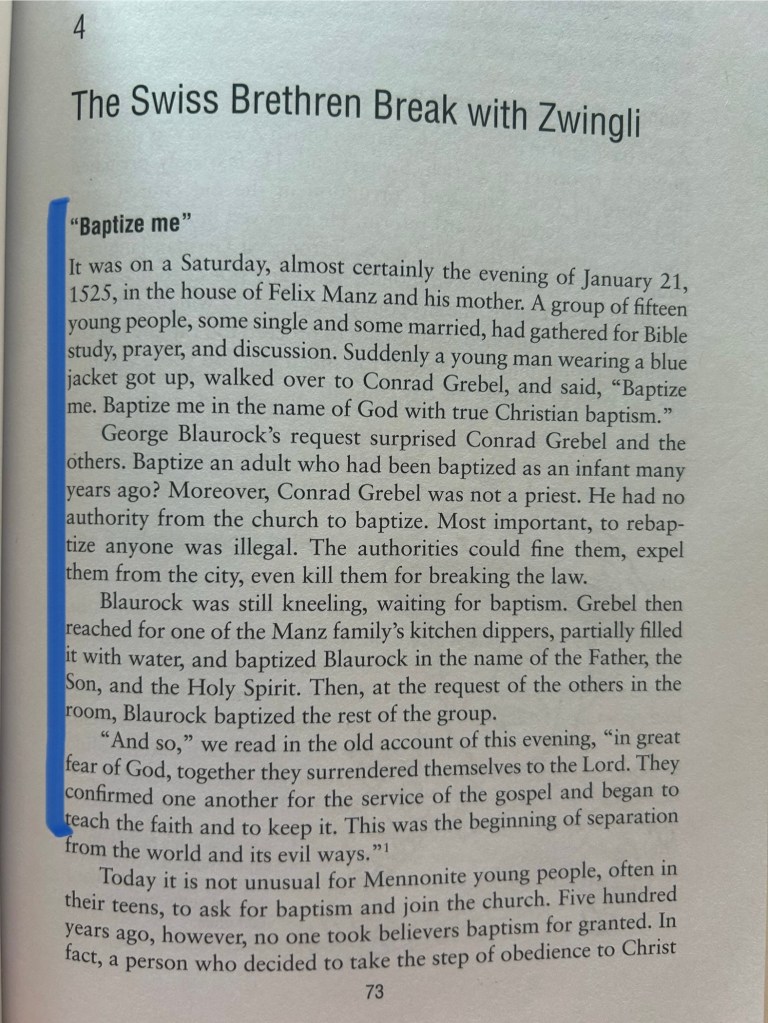
The Spirit was present with our spiritual forebears, the Anabaptists, who took great issue with Christendom (the fusion of Christianity with the nation-state). In their understanding of the scripture, Christendom was antithetical to right relationship with God, humanity, and creation. They were a prophetic movement, challenging the powerful of their day.
As Anabaptist-Mennonites we are called to be a prophetic voice today, especially with the rise of Christian nationalism. The gospel calls us to renounce systems of domination and orient our lives toward right relationship. Our spiritual forebearers modeled how to confront power hungry leaders with courage and clarity, whether they be politicians, clergy, or wealth-hoarders.
On Tuesday, January 21 a group of us are planning to meet at noon in San Francisco’s UN Plaza to recommit ourselves to this path of discipleship, 500 years after the first subversive baptisms took place. We plan to sing and share communion together. All are welcome to join us, although I know it’s tricky given work schedules and our geographical spread. Those of us present will hold all of you in prayer – this beloved community of FMCSF – as we together bind up the brokenhearted and share the good news of liberation. We need each other and the world needs us. Amen