Sermon: The Power of Anger in the Work of Love
This sermon is part of a nine-month series in which we will tell the story of Scripture from Creation to the early Church using the Narrative Lectionary readings. It is also the first sermon in our Advent series, “Waiting for God’s Justice.
Daniel 6:6-27
Imagine: An occupying power has taken over northern California. People — no matter their religious identity or lack of one — are forced to attend Christian churches or risk imprisonment. Statues of Jesus appear in public squares, and folks must bow down as they walk past or run afoul of the law. Muslim women are not allowed to wear headscarves, and Jewish people are not allowed to wear kippahs. Halal and kosher grocery stores are shut down, as are Buddhist and Hindu temples. All people must sign up for military service, even those who object to war for religious reasons, and heavy prison sentences are given to those who refuse.
I know some of you may feel like this imagined world is too close for comfort, given the rise of Christian nationalism in this country. For ancient Jews, this world was often — usually — their reality. From the 8th century BCE through the time of Jesus, Israel was conquered and occupied by various Empires: the Assyrians, Babylonians, Persians, Macedonians, the Greeks, the Romans. And so Jews are constantly living as subject people, constantly wrestling with questions like: How do you resist? How much do you resist? How faithful are you to your beliefs, your values? How much do you assimilate to the occupying powers’ beliefs and values?
This brings us to our story for today. Remember last Sunday’s children’s story, in which the prophet Jeremiah warns everyone that if they don’t get right with God, disaster will befall them? Well, it did around 600 BCE—the disaster was Babylon invading their land and carting off their king and elites into captivity. The exile. That’s the literary setting for this story from Daniel.
But, the book of Daniel wasn’t written down in its final form until more than 400 years after the Exile, during the period of Greek rule— specifically during Antiochus the Fourth’s persecution of the Jews. In 167 BCE, Antiochus outlawed Jewish religious rites and traditions. He turned the temple at Jerusalem into a Greek temple by erecting a statue of Zeus and by sacrificing a pig in the temple which was incredibly sacrilegious to the Jewish people. He even forced the high priest and other Jews to eat the flesh of pigs. So this story from Daniel set during the Exile provides a glimpse into how some Jews were wrestling with these questions four hundred years later:
How do you resist? How much do you resist? How faithful are you to your beliefs, your values? How much do you assimilate?
Daniel has companions with him in exile — three other young elite men, all of whom have Babylonian names — Belteshazzar for Daniel and some of you will know the other names — Shadrach, Meschach and Abednego. It is noted in the text that they are very handsome young men. This, perhaps, was a large part of their appeal at the Babylonian court, in which they serve. In fact, they are serving so well in the king’s court— or maybe it’s just because the king is crushing on them — that they get promoted. In addition, these young men receive a Babylonian education, and they adopt some of the local practices.
So, obviously, these Jewish exiles are assimilating to some degree. But they are drawing a very clear line. There are some Jewish practices on which they will not compromise. In particular, they will not do anything that involves the worship of any king or god other than their God. Earlier in Daniel, they negotiate with their overloads to not eat Babylonian food because it would have been considered unclean by Jewish dietary laws and because it was often sacrificed to Babylonian gods before being served. Other than having to thrive on a vegetarian diet, this particular line didn’t cost them that much. But later Shadrach, Meschach and Abednego refuse to bow down before a Babylonian idol. For this, they risk death. They are thrown in the fiery furnace, but emerge unharmed, saved by an angel of God.
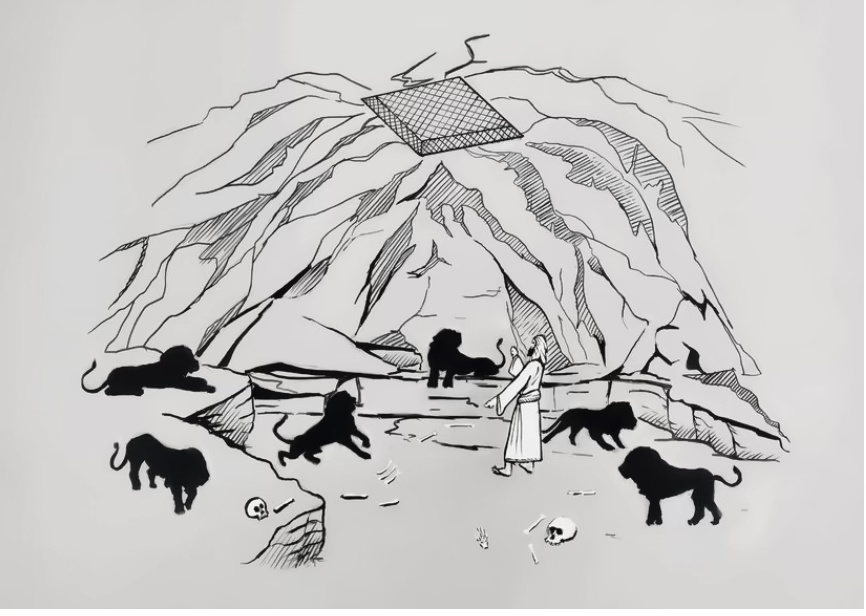
Three chapters later, Daniel has his own experience with the consequences of line drawing. Daniel is rocking it in the court of King Darius, and other courtiers are jealous of him. So they get the king to pass a law that will ensnare Daniel — for 30 days, whoever prays to any god or human other than the king will be thrown into the den of lions.
At this point, a part of me is thinking, “Daniel, just pray to the darn king for 30 days. Just one little, ‘I praise you, O King.'” Surely, the God of Israel would understand. Not only does Daniel not do this, he continues to pray three times to his God in front of an open window. Daniel is broadcasting: “I will serve in your court, but I will not worship your gods. I will be in your world but I will never be fully of it. I will be faithful to my beliefs, my God, and my values and you are going to have to forcibly stop me if you want me to stop.”
How easy would it have been for an up-and-coming young man like Daniel to assimilate? He was doing so well that he could have risen to a position of great power and wealth. Perhaps, like Joseph, he would one day be the second in command to the king himself. I believe it is Daniel’s anger, that inner fire, that allows him to resist. That allows him to draw the line and say no.
When I was a seminary student, I read an essay by the feminist ethicist Beverly Harrison that was very formative for me. It was called “The Power of Anger in the Work of Love.” That essay said a lot of great things, but what has stuck with me for 35 years is the title itself and the wisdom it conveys to us.
Anger is a natural response when boundaries are transgressed. When we are invalidated or abused or when people or creatures or places that we love are abused. Anger is, simply, a boundary — a no arising from within us — telling us that something must be protected, that something is not right.
Being a woman from an Amish-Mennonite background, I was taught pretty much from birth to suppress my anger. But it’s not just me — so many of us are. And it’s true that, like fire, anger can either transform or destroy. And the unskillful use of anger can destroy relationships.
But, as Harrison says, “suppressed anger robs us of the power to love, the power to act… we need to celebrate anger’s rightful place within the work of love.” Anger is not the opposite of love, she says, but a sign that all is not “well in the world around us and that injustice needs to be addressed.”
If we shut down our anger when boundaries have been violated, we empower those who wrong us, who wrong others. If we shut down our anger when boundaries have been violated, we diminish the prophetic, Divine spark within us that can empower us to take action for the good. (From a sermon given by the Rev. Sue Koehler-Arsenault in March 2024.) We shut down the Divine fire within us that allows us to resist, like Daniel, even when the consequences of that resistance are rea.
What makes you angry? Can you feel it? Where do you feel it? (Silence) For me, I feel it right here in my solar plexus, and it’s almost like a furnace, like a ball of energy. This anger, this fire, tells us that something precious is being threatened and must be protected. And then we use our anger to protect ourselves or other beings or the waters and lands. We do that skillfully, nonviolently. Teach the nonviolent stance.
There is power in our anger. It is the power to resist what must be resisted. And there is going to be a lot to resist come Jan 20. It is the power to protect what must be protected, and there is going to be a lot to protect come Jan. 20. And it is the power to love, the power to act. It is the power to birth the kindom of God that Jesus came to announce and enact.
At Advent, we begin to anticipate the coming of this Jesus into the world. And here, on this first Sunday of Advent, I invite you to anticipate this coming by connecting to your inner fire, to your sacred anger. We’re going to sing the song “How Can Our Anger Give Life.” I invite you to continue connecting with that inner Divine fire as we sing.
For all the fires that give life, we thank Creator God. Amen.
Much of the background for this sermon comes from this commentary and podcast on the Working Preacher website.