Sermon: Hannah’s Prayer
by Joanna Lawrence Shenk
Here we are at Sunday number six in our sacred narrative series. Let’s review the stories we’ve heard so far:
- We are earth creatures, given sacred limits as we serve the earth. But we violated these limits and entered into wrong relationship with the Creator, creation and each other.
- The Creator’s “healing strategy” to address this mess was to choose one family — that of Abraham and Sarah and Hagar — to bless with descendants and land so that this family could be a blessing to all the families of the earth by demonstrating how to live in right relationship.
- Forgiveness is essential to living in right relationship.
- The Creator — and creation — side with oppressed people and fight for their liberation. God frees the people from slavery and gives them rituals to remind them of God’s faithfulness.
- The people struggle to trust God and Moses convinces God to keep the covenant with them despite their unfaithfulness.
From the story of the golden calf, we jump quite far in the text to the story of Hannah, which is our focus today. First, I’ll do an ever so brief recap of what came between these two stories and how it relates to some of the themes we’ve already named. So here we go with Leviticus, Numbers, Deuteronomy, Joshua, Judges and in some bibles, Ruth.
The people continue in the wilderness for a while – practicing the covenant they have made with the Creator which is an ongoing way of decolonializing themselves from empire. As Sheri shared last week, “The purpose of law was to provide the political, economic, and ritual structures for the liberated people to maintain their liberation.”
After all that practicing in the wilderness, they make it to the promised land. This land was given to them by the Creator so that they could be a blessing to all the families of the earth. The conquest narratives related to the land are a troubling departure from this original blessing to the family of Sarah and Abraham and Hagar. And I don’t have time to go into all of that.
Judges are then appointed to lead the people, and most of them are not good leaders and there is also a lot of violence with other groups, and within the tribes of the people as well. Clearly, like in the stories of the past, the people are going wrong, away from the covenant and the guidance given to them by God in the wilderness. The book of Judges ends with the words “in those days the people were without a ruler, so they all acted as they pleased.”
In the Hebrew bible, the book of Samuel follows Judges, and in the Greek and Protestant bibles Ruth comes after Judges. The story of Ruth is a stark contrast to Judges, with its violent conflicts with neighboring groups and within the Hebrew tribes. In this story a Moabite woman Ruth – an outsider, becomes family with the Hebrew people and even becomes a part of the lineage that leads to King David (who we will talk about next week).
So now we have arrived at the story for today, recorded in the book of 1 Samuel. We are introduced to a woman, Hannah, who is enduring much shame due to her inability to have children. She is barren, which echoes the barrenness of Sarah earlier in this series. A barren woman in this context was someone seen as unworthy or even disposable.
It is notable that her husband, Elkanah, loved her even in spite of her barrenness and favored her, much to the chagrin of her sister-wife who loathed her entirely, and took every opportunity to taunt her. The taunting was so bad that Hannah grew gravely depressed and refused to eat.
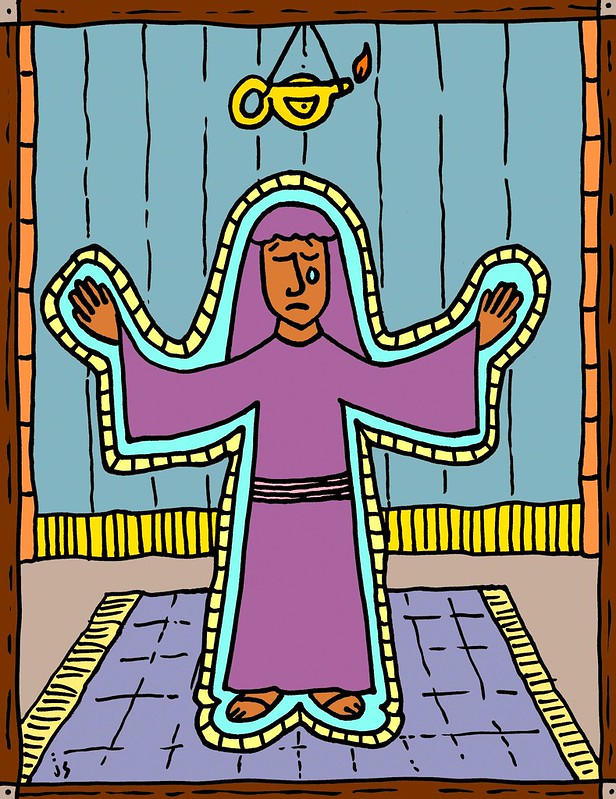
In her distress, Hannah went to the Tent of Meeting which is the place where God’s presence resided among the people. She was weeping and praying silently with her lips moving. She prayed that if God would give her a son, she would dedicate him to God’s work.
The priest there, Eli, was quite dismissive. He assumed she was drunk and said, “How long are you going to continue in this drunken state, sober up lady!”
Despite his disrespect, Hannah addressed him directly, naming her grief and saying that she was pouring out her heart to God. Eli, chastening by her response, granted her a blessing as she left – that God would give her what she asked.
Indeed she was granted a son who she named Samuel. When he was old enough to be away from her, she took him back to the Tent of Meeting and presented him to Eli, reminding Eli of her prayer. She and her husband dedicated Samuel to God and he remained at the Tent of Meeting with Eli.
Following the dedication, Hannah prayed this prayer:
1 Samuel 2:1-9
Hannah prayed and said,
“My heart exults in YHWH;
God is my strength
My mouth shames my enemies
because I rejoice in God’s victory.
There is no one holier than you,
no one besides you;
there is no Rock like our God.
All bragging must cease;
let not arrogance come from your mouth,
for YHWH is all knowing,
and weighs all mortal deeds.
The bows of the mighty are broken,
but those who stumble gain renewed strength.
Those who were full have hired themselves out for bread,
but those who were hungry are satisfied.
The barren ones birth seven children,
but she who has many children is forlorn.
YHWH deals out both life and death;
God brings down to the pit and raises up.
YHWH makes poor and makes rich;
God brings low; God also exalts.
God raises up the poor from the dust;
and lifts the needy from the ash heap
to make them sit with princes
and inherit a seat of honor.
For the pillars of the earth are God’s,
and on them the world is set.
God will guard the feet of the faithful ones,
but the wicked will perish.
It is not by their own strength that the just prevail.
In Hannah’s prayer we hear echoes of the song the people sang after being freed from slavery in Egypt. It is God who grants victory. God is with those who are devalued or seen as less than by the powerful. God creates reversals that upend the status quo.
Hannah’s prayer will also carry forward in the biblical story, echoed by Mary in the Magnificat. As we will see, the theme of God lifting up the lowly is traced through the entire biblical text.
As I mentioned earlier, in the Hebrew bible the story of Hannah is in stark contrast to the end of the disturbing book of Judges. Biblical scholar Ellen Davis, reflects on it in this way, “Just one chapter separates Hannah’s spiritual victory cry from Judge’s extended account of the kidnap, rape, and even dismemberment of voiceless and nameless women, providing narrative perspective on the deteriorated moral and political condition of the people.”
Those are very hard stories, known as texts of terror. They make clear that the violation of vulnerable women is the measure of how unjust and immoral the people had become.
Here I want to pause and reflect on a reality in our world today. In this country there are approximately 4,200 unsolved cases of missing and murdered Indigenous women.
Outside of Indigenous communities and networks there is very little public awareness of this violence which is coupled with the reality that non-Indigenous law enforcement don’t prioritize these cases. In a recent blog post Sarah Augustine, who is Indigenous, wrote:
“The issues surrounding the disappearance and murder of Indigenous women is controversial and uncomfortable. Many of the women who disappear and are later found dead are commercial sex workers and addicts, throwaway people… There is no motivation to examine the underlying injustice that puts women like me in dangerous situations.”
From our sacred narrative we know that God is with those who are oppressed and that God fights for them as they seek liberation. Any ideology or theology that perpetuates abuse and then blames victims is counter to the way of the Creator. In this we see the utter perversity of the Doctrine of Discovery which provided the theological foundation for the violence towards Indigenous peoples and the land, that continues today.
Just as Hannah, disregarded by society, played a key role in the unfolding narrative of her people, we must follow the lead of Indigenous women (and allies) who are playing a key role in naming the systemic violence resulting in missing and murdered Indigenous women. As we celebrate Indigenous People’s Day tomorrow, I invite us to learn from those who are speaking out and organizing and fighting for liberation from this violence. Sheri and I will share resources in the weekly email along these lines, especially as it relates to the work of the Coalition to Dismantle the Doctrine of Discovery.
In our story today it was Hannah’s prayers and faithfulness that shaped her son into a faithful leader of the people. Her son Samuel led the people out of chaos and violence. He anointed the first kings of Israel, although it was against his better judgment, and he called them to account for their injustices.
Hannah’s story shows us that the Divine works through people who are seen as lowly, and that God is prone to upending the status quo, especially when it is doing violence to vulnerable people.
In our world today may we notice the Spirit’s presence at work in unexpected places. May we pray through our grief for the world that we need. And may we continue to join with people of Spirit, across many communities and traditions who are walking in the way of the Creator, honoring sacred limits, and seeking liberation from all that holds us bound. Amen.