Sermon: Exodus: Joining the Freedom Side
By Joanna Lawrence Shenk
This sermon is the part of a nine-month series in which we will tell the story of Scripture from Creation to the early Church, using the Narrative Lectionary readings.
Today we have the opportunity to reflect on a well-known, troubling, and I would imagine beloved bible story for many. Thank you Karen for bringing this story to life during our Children’s Time.
A brief recap of our series so far…
– We are earth creatures, given sacred limits as we serve the earth.
– We have been blessed by the Creator, to be a blessing to all the families of the earth.
– In the midst of estrangement and betrayal, we are empowered to choose forgiveness.
In preparing this sermon, I was interested to learn that the exodus story may not have happened historically. It was likely written during the era of Babylonian captivity as another powerful origin story for the Hebrew people, along with the creation narrative.
Biblical scholar Walter Bruggemann notes that it’s not really possible to affirm or deny the historicity of the story but that is not a reason to discount its message. He calls it a “paradigmatic” narrative. It is making a claim of intense particularity, but the particularity invites and permits rereading in a variety of circumstances and contexts.
We pick up the story following the reconciliation of Joseph with his brothers. The family of Jacob, later called Israel, finds a home in Egypt as refugees fleeing famine. Chapter 1 of Exodus notes that this was a good move for the family: “The Israelites were fruitful and prolific; they multiplied and grew exceedingly strong, so that the land was filled with them.”
One perspective on the unfolding narrative highlights a potential shadow side to Joseph’s leadership in Egypt. The HarperCollins Study Bible notes: “Under Joseph’s authority, the Egyptian populace is gradually impoverished and even enslaved, resulting in a concentration of Egypt’s wealth into the hands of the Pharaoh and the priests. This dismaying condition, combined with traditions about preferential treatment of Joseph’s kin, provides a cogent explanation of the backlash soon to erupt against the Israelites.”
(Exodus 1) Now a new king arose over Egypt who did not know Joseph. He said to his people, “Look, the Israelite people are more numerous and more powerful than we. Come, let us deal shrewdly with them, or they will increase and, in the event of war, join our enemies and fight against us and escape from the land.” Therefore they set taskmasters over them to oppress them with forced labor. But the more they were oppressed, the more they multiplied and spread, so that the Egyptians came to dread the Israelites. The Egyptians subjected the Israelites to hard servitude and made their lives bitter with mortar and bricks and in every kind of field labor. They were ruthless in all the tasks that they imposed on them.
So what is the narrative trying to communicate? The Hebrew people were outsiders in the land and the people who controlled the land saw them as a threat and sought to control them. Because of this treatment, they cried out to God for liberation, and God heard their cries. They needed not only physical liberation, but also mental and spiritual liberation. They needed to get free from the external and the internal bondage of empire.
It’s not clear how long the descendents of Jacob were in Egypt, but it was long enough for them to become an imposing group – so at least a handful of generations. This was also long enough for them to acclimate to life within the empire and, I imagine in many cases, internalize its values and worldview. Although oppressed, they had shelter, food, community, and were protected from outside threats by the might of the Pharaoh and his army.
So in calling for liberation and trusting in the God of their ancestors, they were making a huge paradigm shift. They were acknowledging there was something more powerful than the might of Pharaoh. The passover practice was one important part of this paradigm shift. It was a way to regularly and ritually remember God’s liberating power.
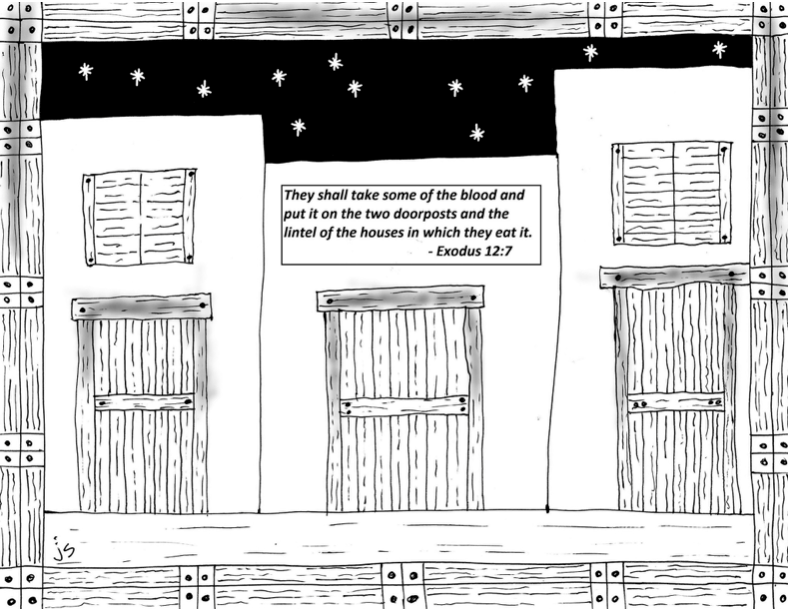
(Exodus 12) The Lord said to Moses and Aaron in the land of Egypt, “This month shall mark for you the beginning of months; it shall be the first month of the year for you. Tell the whole congregation of Israel that on the tenth of this month they are to take a lamb for each family, a lamb for each household.
They shall take some of the lamb’s blood and put it on the two doorposts and the support beam of the houses in which they eat it.
This is how you shall eat it: with your belt buckled, your sandals on your feet, and your staff in your hand, and you shall eat it hurriedly. It is the Passover of the Lord. I will pass through the land of Egypt that night, and I will strike down every firstborn in the land of Egypt, from human to animal, and on all the gods of Egypt I will execute judgments: I am the Lord. The blood shall be a sign for you on the houses where you live: when I see the blood, I will pass over you, and no plague shall destroy you when I strike the land of Egypt.
“This day shall be a day of remembrance for you. You shall celebrate it as a festival to the Lord; throughout your generations you shall observe it forever as a feast day.
Recently I was talking with a Jewish friend, Noah, who I work with as a part of the Beyond Christian Dominance network. We were talking about how it is so hard to live outside of the modern, Western Christian cosmology. By cosmology, I mean the way of understanding the world and how things came to be the way they are, and what we assume to be the bounds of what is possible.
Noah noted that Jewish practice is a gift to him in this way – with its own calendar and rituals that long predate modernity. The Jewish new year, 5785, will begin in a couple days with the celebration of Rosh Hashanah.
In the exodus story, part of their liberation is in creating their own calendar apart from the dating system of empire. This calendar, revolving around the saving works of God, will be a constant reminder of God’s faithfulness to them and their breaking out of empire.
As they flee Egypt other dispossessed peoples come with them. They are a weaponless group pursued by a technologically advanced army that will surely wipe them out. But, with the Creator on their side, the land and waters protect them, and their enemy is destroyed.
(Exodus 15) Then Moses and the Israelites sang this song to the Lord:
“You O God have triumphed gloriously;
horse and rider you have thrown into the sea.
The Lord is our strength and might,
and has become our deliverance;
We will praise you, the God our ancestors.
YHWH is a warrior;
I AM is your Name.
Pharaoh’s chariots and his army you have cast into the sea;
his elite officers were sunk in the Red Sea.
The floods covered them;
they went down into the depths like a stone…
Then the prophet Miriam took a tambourine in her hand, and all the women went out after her with tambourines and with dancing. And Miriam sang to them:
“Sing to the Lord, who has triumphed gloriously;
Who has flung horse and rider into the sea.”
Ted Grimsrud names three elements from the exodus text that are particularly important to the overall biblical narrative:
- God liberates the oppressed.
- God’s acts of salvation are not achieved through military action.
- The Hebrews reject the unjust ways of empire.
My summary would be: The Creator (and creation for that matter) takes a side. God is on the side of the oppressed and fights for their liberation.
The narrative in Exodus is a story central to African American Christianity. For people who were enslaved in this country, the United States and especially the south, was Egypt and the promised land was often understood to be the north or Canada. This is of course the flip of how Manifest Destiny understood the United States – as the promised land for settlers.
Generations of resistance to enslavement by Black people which led to emancipation was followed by the entrenchment of the racist economic order in other forms. Black people could see through the lies of the American empire and Black Christians leaders called for the white church to repent. Some advocated that Black people return to Zion on the African continent, while others like Martin Luther King Jr and Vincent Harding, called on this country to truly become a home for all peoples, reckoning with its violent and genocidal origins.
I find the story of exodus both clarifying and sobering. It is clarying because it prophetically challenges a white Christian status quo that says the wealthy and powerful deserve to rule and that nation-states like the United States and Israel have God’s unwavering blessing. The exodus narrative unequivocally says no to Christian nationalism and Christian Zionism and exhorts us to decolonize ourselves from those lies.
I find it sobering because we have all internalized the empire. And no matter who we are, we need to get free. The more we have been colonized by the way of empire, the more we need teachers to help us recognize our bondage.
When Jim Lichti and I talked with Wendsler Nosie of the Apache Stronghold during their spiritual convoy three years ago in SF, he said the Apache people were some of the last Indigenous people to be colonized on Turtle Island which means they are the least acclimated to colonization. They have a role to play, he said, in helping others to break free from the chains of colonization. For people who came from Europe, he said, your colonization was so long ago you don’t even remember it happened. You can’t see your chains.
He said “what we’re doing at Oak Flat is a call to all people to see the chains of colonization, now in the form of capitalism, and break free. No matter where you are from or how you came to be where you are now, we can join together with one prayer, one drum and one circle to throw off the chains.”
This is an invitation to be on the side of creation and the Creator, who are always on the side of the oppressed.
Moses, a key player in the exodus narrative, grew up in Pharaoh’s house and took sides with his kin who were enslaved. Although some in Egypt were benefiting from the exploitation of the Hebrew people, I’m sure many Egyptians were suffering as well. The text says there were those who left Egypt with the Hebrew people, risking all they had for the promise of liberation.
Those who are crying out know that they are oppressed – they see the chains of empire in their lives. They trust that they can get free and they are willing to risk everything to make that happen. They are on creation’s side, on the side of the Creator.
Palestinians are crying out for freedom, experiencing the onslaught of empire all around them as the genocide continues in Gaza. Rev. Munthar Isaac, a Lutheran pastor from Bethlehem who I heard speak in August, says that Gaza has become the moral compass for our world. You are either with justice or apartheid, he said.
Haitian faith leaders in Springfield, Ohio (my hometown) are demanding an end to hateful, violence-inducing rhetoric and are calling on people of faith to stand with them. They are challenging the white supremacy that is deeply rooted in this country.
There are many other teachers crying out against oppression in our world and inviting us to join the side of the Creator. What are the stories of liberation that we tell each other and pass on to younger generations? What are our ritual practices that reorient us to freedom and healing?
The invitation is always before us, to shed the bondage of empire. It can be scary because even our imaginations have been colonized. But we are not alone on our journey.
Take a moment to think of a teacher or a community who is helping you, and us, get free. They might be in this room or across the world, past or present, human and more than human. Take a moment to thank them for their clarity and courage, for their embodiment of the possibilities beyond the straight-jacket of empire.
May we continue to choose the side of life and liberation, the side of creation and the Creator. This is indeed our birthright as earth creatures. Our journey out of empire is our homecoming into the family of creation. May it be so. Amen.