
Sermon: How Do We Live Together in Peace?
This sermon is the part of a nine-month series in which we will tell the story of Scripture from Creation to the early Church, using the Narrative Lectionary readings.
Genesis 37:3-8, 17b-22, 26-34; 50:15-21
I don’t watch reality TV shows, but I get the gist of what they’re about: humans behaving badly. Actually, many scripted TV shows are about that also. Many times when reading the story of Joseph, I felt I was reading the ancient equivalent of a TV show about a large dysfunctional family, like the one in “Succession.” Parents having a favorite child, which then causes insane jealousy among the other siblings? Check. Deception? Check. Violence? Check. Dramatic reversals of fortune? Check.
Before we get to this story of brothers behaving badly, let’s step back for some larger context. The book of Genesis is made up of two big sagas. The first — from Genesis 1-11 — is the saga of all humanity, and from Genesis 12 onward we get the saga of the four ancestral families. The first saga begins with creation and tells us who humans are and how to live in right relationship with God, each other, and creation. Of course, humans don’t respect sacred limits around their behavior, and all sorts of consequences roll out from this breaking of right relationship, starting with the first murder in Genesis 4, when Adam and Eve’s son Cain kills his brother Abel. And it just keeps getting worse for the next seven chapters.
As we approach the end of Genesis 1-11,“It is as if the human race has in short order run its course, then rendered itself powerless to do anything but self-destruct,” as Mennonite theologian Ted Grimsrud put it — and as Joanna quoted in her sermon of last week. When we meet Abraham and Sarah at the end of chapter 11, they are barren, childless, which is in keeping with the idea that humanity has run its course.
But God has an answer to the humanity’s self-destructiveness. God wants to draw humanity back to right relationship and chooses Abraham, Sarah and their descendants to be agents of God’s project of healing, as Grimsrud calls it. They will be blessed, God says, with land and many descendants — blessed in order to be a blessing to all the families of the world. Thus begins the saga of the ancestral families.
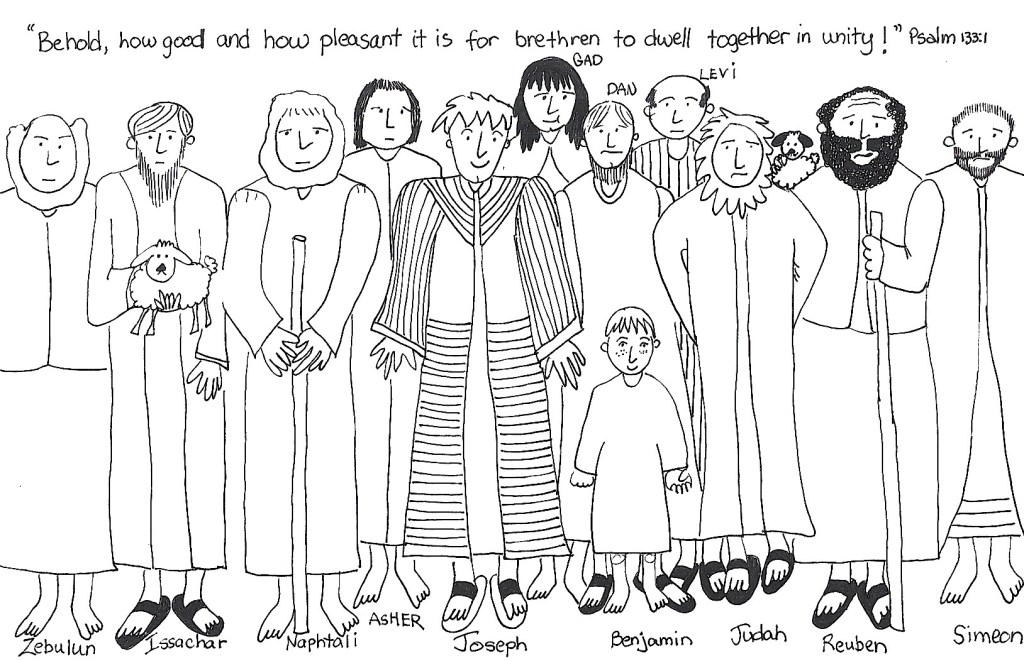
Abraham and Sarah, now quite old, finally conceive a child, Isaac. (Of course, the son Abraham bears with an enslaved woman, Hagar, is Ishmael, who becomes a key figure within Islam— thus forever binding Jews and Muslims as kin.) Isaac and his wife Rebekah give birth to Jacob, whose story takes up another big chunk of Genesis. Between Jacob’s “sister wives” Leah and Rachel and their “handmaidens” Bilpah and Zilpah, Jacob ends up with 12 sons, Joseph being the second from the youngest. It is in this generation that we see the promise of descendants starting to be fulfilled. Those 12 sons will go on to form the 12 tribes of the nation of Israel.
At 14 chapters, the story of Joseph and his 11 brothers is the longest continuous story in Genesis — it makes up a quarter of the book of Genesis. They are a broken family, which does not really distinguish them from other families within this family saga. In Genesis, brothers and conflict go together like hammer and nails. Brothers are often in conflict and, in the case of Leah and Rachel, sisters too. The famous Hebrew scripture scholar Walter Brueggerman calls it “the problem of the brother” that begins way back with that first murder. The central question emerges: How do we live together in peace, in right relationship? So, to Joseph…
Read Genesis 37:3-8.
Right away, tensions flair. Abraham loves Joseph the most and gives him a rare and expensive gift — a beautiful robe that Joseph wears every day, thus giving his jealous brothers a constant reminder of his favored status. The 17-year-old Joseph makes tensions worse when he shares with his brothers a dream that is blatantly about his supremacy over them. Is he bragging? Is he just stupidly naive? The father, Jacob, also doesn’t help when he sends the younger Joseph to check up on his older brothers, who are tending a flock of sheep almost 65 miles from home. Jacob wants Joseph to see if “it is well” among the brothers, that is, if there is peace among them. Hs is obviously aware of conflict in the family, but he rather stupidly lights a fuse when he sends Joseph into their midst to, in a way surveil them. Not surprisingly, a bomb goes off in this deeply troubled family.
Read Genesis 37:17b-22 and Genesis 37:26-34
The only good thing that comes from this wretched episode is that Joseph’s brothers don’t repeat the Cain and Abel story by killing him. They plot to kill him but don’t. Ironically, none of the brothers’ schemes work out in this story. Reuben wants to double cross his brothers and rescue Joseph, but doesn’t. Judah convinces them to let Joseph live, but sell him to the Ishmaelites. Instead, Midianites come by, take Joseph out of the pit, and they sell him to the Ishmaelites. As Scripture scholar Gene Roop says, “Despite all of their schemes, the brothers have managed no murder, no profit, no dramatic rescue, and they have no idea where Joseph is.” (From the Believers Church Bible Commentary’ book on Genesis.) Upon arriving home, the brothers deceive their father, leaving him devastated. As Roop says, his grief “reflects the disintegration of the family — the family through whom all other families were to receive a blessing.”
It feels like we are back where we were at the beginning of the saga of the ancestral families, wondering if humanity has again run its course. Perhaps it’s impossible for humans to live in peace. Perhaps there’s no way out of endless conflict, brother against brother, sibling against sibling. Humans behaving badly.
Years go by and lots more drama. Joseph, after being sold by the Midianites to one of Pharaoh’s officials, rises to prominence within this household. The official’s wife decides she wishes to sleep with this handsome Hebrew, he says no, she accuses him of trying to sleep with her, and he lands in prison. The prison warden soon appoints Joseph as his right-hand man. Joseph also successfully interprets the dreams of the pharaoh’s jailed cupbearer and baker, correctly predicting that the cupbearer would be released from prison and the baker hanged. Two years later, Pharaoh himself has some dreams, which none of his advisors are able to interpret. Remembering the Hebrew youth from his prison days, the cupbearer suggests that Joseph be summoned. Joseph, then thirty, interprets Pharaoh’s dreams as a Divine prediction of seven years of plenty followed by seven years of famine. He advises Pharaoh to prepare by storing grain during the first seven years. The impressed Pharaoh appoints Joseph as his viceroy, second only to Pharaoh himself, and tasks him with readying the nation for the years of famine. Joseph’s dream of supremacy has come true! And Joseph does successfully avert widespread famine for the people of Egypt — and, it turns out, for his family as well.
Because, back in Canaan, Jacob’s family is feeling the effects of the famine. Hearing that there was grain in Egypt, Joseph’s brothers journey there to buy food from the viceroy, not realizing that he was their very own brother. There’s a lot more drama, but basically there is eventually a heartfelt reunion between Joseph and his family, who end up settling in the Goshen section of Egypt. Not Indiana. (Teaser for next week: This is a setup for the Hebrew people’s eventual enslavement in Egypt and the Exodus.) The patriarch Jacob — after he endures his family transitioning from being shepherds to famine victims to refugees to fairly prosperous immigrants in their new country — finally joins his ancestors.
So, things change when a parent dies. When my last parent died, I wondered what would hold the family together. There’s tension between my brothers, and even though they live fairly close, they don’t often see each other — except for when they were with my parents. As for me, I wondered how often would I go home once my parents were gone. What would happen to our family? I’ve known many other families who have fallen apart or fallen into conflict at the death of the last parent.
This age-old reality is apparently on the minds of Joseph’s brothers. Would Jacob’s death release Joseph’s retaliation, the revenge that has, perhaps, been simmering underneath the surface? Would he calculate their offenses against him and attempt to settle scores? Would there be peace or a regression to brokenness?
Read Genesis 50:15-21
Finally, a new thing enters into this saga of the ancestral families: Forgiveness. Joseph is not a perfect person, by any stretch, but he forgives his brothers for their attempted murder of him, for kidnapping him, for attempting to sell him as a slave, for separating him from his beloved father for decades. Perhaps he even forgives them for likely making up a lie about his father’s deathbed instructions. He says, instead: “Am in the place of God?” Earlier in Genesis, we hear that Joseph understands his calling in Egypt to be about preserving life (45:5). He believes God’s mysterious hand was at work in all of this family horror, in all of this family trauma — because Joseph is now in a position to save his family and many other families as well. As one commentator said, “God has entered in (to this broken family) and changed the math, and it now adds up to zero. Forgiveness… is the great equalizer.”
How much do we need forgiveness? How much do we need people saying, “I will not stand in the place of God. I will not perpetuate the evil of so many generations. I will not keep repeating the same old tired crappy story. I will not harm the other, my brother, my sibling, no matter how much the other has harmed me and and intends to continue to harm me.” This is so hard to do. Forgiveness is hard. But it is any harder than endless conflict? Is there any hope for the world without it?
This is a hard time to talk about forgiveness. There are age-old injustices that must be righted, and it can be hard to know how to talk of forgiveness when historical harms have to be confronted — although I know none who speak so profoundly of this as Lakota elder Basil Brave Heart, whom Sarah and I interviewed on our podcast. What he said about forgiveness left me in tears. Right now, in our country, our political climate — on the both the right and the left — is not about forgiveness. It is not about seeing the humanity in the person who we see as causing harm by intending to vote for the person we believe may bring about the downfall of this country.
Forgiveness is a process. It is its own kind of saga, it’s own kind of spiritual sojourn. At some point, to live as the Creator intends, we have to step into this journey and begin walking it.
And so, I wonder if you have someone or something to forgive?
I wonder if you need to step into this journey?
I wonder what additional help you need to walk it?
I wonder how you will feel once you do forgive?