
Sermon: Labor Justice
By Matt Boyer, FMCSF congregant and labor organizer
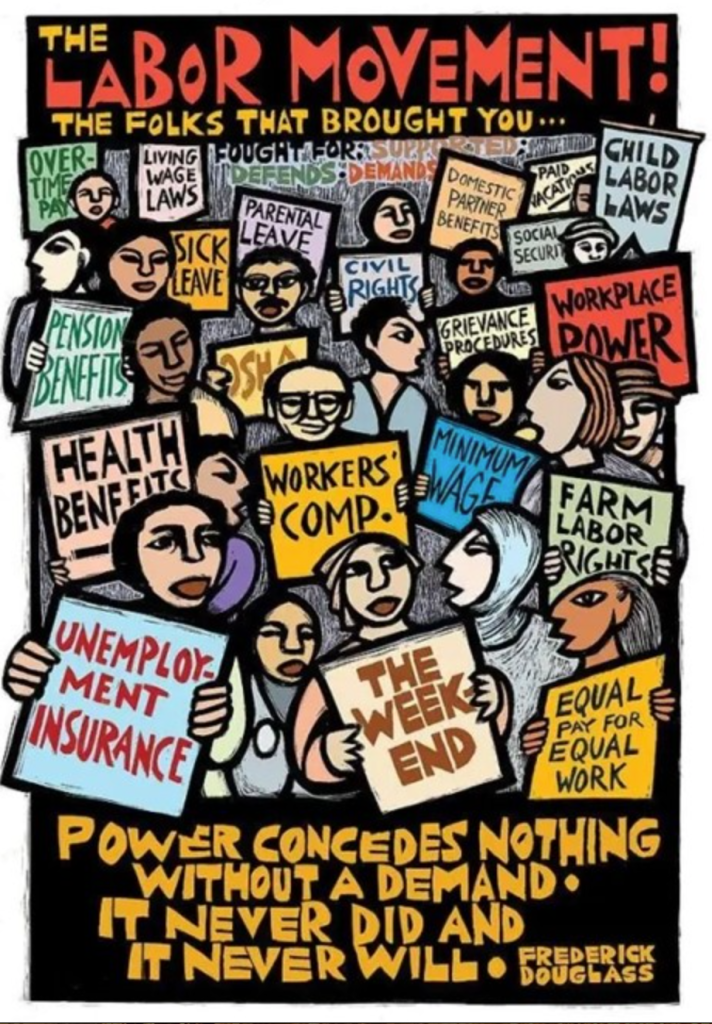
‘The Labor Movement’ by Fredrick Douglass, Source: Ricardo Levins Morales Art Studio
When I was in my early twenties, and living in Arizona, I went to a nearby, progressive church on Easter. It had been a while since I’d been to church and I wanted to feel the excitement of the highest holiday. On this day, we could celebrate that the Kingdom of God could not be killed. On Easter, we are reminded that the poor people’s movement against the Roman Empire did not die with Jesus’ crucifixion. Or as the Chicago Black Panther leader Fred Hampton put it, “You can kill a revolutionary, but you can never kill the revolution.”
Well that is decidedly not the experience I had that Sunday. After a hymn, a woman went up to the mic to reprimand the church for using “that word – the one owned by the deists.” I realized she meant the word “God.” And then later the preacher’s Easter sermon was encouraging the church attendees to give the resurrection story a chance—that there was something worth salvaging here in the midst of triumphalism.
Look, I know well that evil and unjust things have been done in the name of Christianity. Many of us know that experience first hand. So I don’t mean to diminish that. I also don’t want to give you the same feeling that I had that Sunday. I don’t want you to hear that “that word,” you know, “freedom,” is owned by the capitalists. I don’t want you to come here on Labor Day Weekend and hear me say “give it a chance.” I don’t want to explain that it’s worth paying attention to the labor struggle, especially to people who probably already agree. I want you to feel invited into the movement. I want you to hear that, “you can kill a revolutionary, but you can never kill the revolution.”
I should share a little about myself. Being Brethren and anabaptist has always been an important part of my identity. I come from a long line of anabaptist ministers going back hundreds of years. Sometimes I joke that it’s the family business. I spent every Sunday until I went to college going to church and plenty of weekdays too. I spent every summer at the Annual Conference and at Camp Alexander Mack. I was baptized in the La Verne Church of the Brethren at the responsible anabaptist age of 29.
I’ve also been part of the labor movement for nearly 20 years. I’ve organized unions of child care providers, bus drivers, dining hall workers, custodians, x-ray techs, groundskeepers, and now nurses. I’ve organized along the southern border of New Mexico, in the shadow of the tabernacle in Salt Lake City, in the bluegrass of rural Kentucky, and in the projects of San Francisco.
I believe I’ve ended up in this work because of the church. I’ve received some strange looks trying to explain that, from both church people and labor organizers. One of the more extreme cases was at an info shop in Arizona where I was volunteering. In case you’re not familiar, an info shop is a place for radical leftists, socialists, communists, anarchists, etc., to get books and zines. It’s a place to read, socialize, and organize. This info shop in Flagstaff was founded by Diné activists and was often a meeting space for indigenous people organizing against police violence or for immigrant rights. One evening there was a discussion group and the first question was: what originally brought us to radical politics? The person before me was indigenous and shared his hatred for Christian colonization and how learning that history had radicalized him. So when it came to me next I sheepishly said, “the church.” Cue the strange looks. I shared how I grew up in a small, conservative town in Indiana. And yet the church there began discussing sexuality and inclusion when I was in elementary school. I watched and even participated in a democratic process that led the church to vote that all people were welcome and invited. My pastor mother was subsequently demonized on the front page of the local paper and boycotted at a national church conference. And yet the local church stood by that decision even as the town ostracized them and the denomination punished them. That experience remains some of the best political education I’ve received in my life.
I have a special place in my heart for the novelist Kurt Vonnegut. He was a Hoosier, and a humanist, and very funny. In one of his books, Kurt Vonnegut shares a story about the trade union organizer and socialist Powers Hapgood, another Hoosier, by the way. Hapgood traveled all over the world to advance the class struggle, including organizing mine workers in Pennsylvania during the 1920s—dangerous and difficult work. Vonnegut tells the story of Hapgood once being called to testify in court due to a dustup on a picket line. The judge asked him, “Mr. Hapgood…why would a man from such a distinguished family and with such a fine [Harvard] education choose to live as you do?” He replied, “Because of the Sermon on the Mount, sir.”
The scripture for today, Matthew 18, describes the church. In short, the church is a group of people that share God’s vision and seek to carry it out on earth, while holding each other accountable to that vision. It tells us that what we bind on earth will be bound in heaven and what we loose on earth will be loosed in heaven. Those are fascinating words to me. What is bound, what is confined, what is locked up, is also bound in heaven. That is terribly unjust. The greek word translated here as “loosed” has many potential meanings, including “to set free.” So another reading could be “what is liberated on earth is liberated in heaven.” When I read this scripture, I read that the material world and the spiritual world are not separate, and that the stakes for liberation are terribly high. It reminds me of Jesus’ words in Luke 17: 20-21 that, “The kingdom of God is not coming with things that can be observed; nor will they say, “Look, here it is!” or “There it is!” For, in fact, the kingdom of God is among you.”
Immediately after telling us that the material and spiritual world are connected, Jesus says, “Where two or more are gathered in my name, I am there among them.” The church isn’t some third party institution. It’s us, gathered in Jesus’ name. That “in my name” is incredibly important, though. Two or more of us gather regularly. There are two or more gathered at the Pentagon this moment. There are two or more gathered at the Chamber of Commerce during the week. I don’t believe that they’re gathered in Jesus’ name. They’re not gathering together to say “blessed are you who are poor, for yours is the kingdom of God.” And even less so the words that follow, also in Luke: “Woe to you who are rich, for you have already received your comfort. Woe to you who are well fed now, for you will go hungry.” Jesus’ “in my name” is in the name of the poor and hungry, the meek and the peacemakers. It’s in the name of liberation. And it’s an invitation to the kingdom, or as John Cobb calls it, the “Commonwealth” of God, now, among us.
I repeat a version of that line—where two or more are gathered—in my work often. I remind workers and myself that, much like the church, the union is not a separate third party. Any two or more workers who join together in solidarity can act as a union. And by acting collectively, they are much stronger than when they act individually. Their individual stories and identities matter, of course, but their power comes from their unity as a class, from their solidarity. Where two are more are gathered in the name of liberation, the struggle lives on now, among us.
We are inheritors of so much struggle and potential. On Pentecost the early church gathered together, the Holy Spirit among them, giving them the ability to speak with one another, and they were inspired to baptize, eat together, pray, and share all things in common. The early church was marginalized, tortured, and martyred, but their struggle lived on. Inspired by the German Peasants Uprising’s call for access to the commons, for a just distribution of wealth, and by the Reformation’s call for the priesthood of all believers and direct access to the good news, the early anabaptists were marginalized, tortured, and martyred, but their struggle lives on.
On Labor Day we remember the millions of workers who stood up to capital and demanded less time at work and more time with their families. We remember the workers who said, “we are not disposable, we are human beings.” We remember the striking women at Woolworth’s, who knew that class justice is also gender justice. We remember Revels Cayton from the Marine Cooks and Stewards, who in the 1930s said, “If you let them red-bait, they’ll race bait, and if you let them race-bait, they’ll queen-bait. These are all connected, and that’s why we have to stick together.” We remember the sanitation workers who marched alongside Martin Luther King Jr. in Memphis just before his assassination, to say that black workers deserve racial and economic justice. We remember the Palestinian workers who have struck this year to end the occupation and genocide in Gaza, and the thousands of university students and workers across this country who struck in solidarity with them. They remind us that labor solidarity transcends national borders and that calls for peace must necessarily be calls for justice. For thousands of years, workers have been marginalized, tortured, and martyred, but our struggle lives on.
When we are living as the church that Jesus describes in today’s scripture, I don’t believe there’s a meaningful distinction between us and the labor movement. The real question, and the challenge that Joanna brought to this congregation two years ago on this weekend is: are we willing to challenge the anabaptist tendency to set ourselves apart? Are we going to accept Christ’s invitation to solidarity, to the Commonwealth of God now, among us?
We are inheritors of so much struggle and potential. The good news this Labor Day and every day, is that what is liberated on earth will be liberated in heaven. And that where two or more are gathered in solidarity, Jesus, who taught us the power of liberation, is here now, among us. You can kill a revolutionary, but you can never kill the revolution. Amen.