
Sermon: The Good News
Mark 1:14-20
One of the people who helped me reclaim Christianity when I was in my early 30s was Marcus Borg, a New Testament and Jesus scholar, who happened to be a close friend of my mentor Marianne Niesen. He actually achieved a measure of mainstream fame (for a New Testament scholar) for a series of very accessible books he wrote that reinterpreted Christianity in a way that made sense to folks like me.
So, Borg was asked to appear on the Today show back in the late 1990s on Good Friday to talk about the historical Jesus. The producer said to him, “We have a big chunk of time, a really long segment. We have seven minutes.” Over the course of the next few weeks that seven minutes rapidly shrunk. Finally, Borg was told that he would be asked one question: “What would it have been like to have been a companion of Jesus? What was he like?” His time limit for the answer: 75 seconds. The producer also mentioned that the average viewing audience was 5 million people.
So Borg asked himself, “What does one say to 5 million people in 75 seconds about Jesus?” He carefully scripted something, figuring that it was too risky to wing such an answer on national TV. He memorized his response and practiced saying so that he didn’t sound canned. So he’s on the show, he’s ready and primed, and the host turns to him and says, “Well, I imagine that there’s a lot the Bible doesn’t tell us about Jesus.” “That’s not my question!” he said to himself. But he quickly regained his footing, and responded, “Yes, that’s true, but what it does tell us is very interesting,” and then went on to share his prepared response, which was this:
“Jesus was a peasant, which tells us about his social class. Clearly, he was brilliant. His use of language was remarkable and poetic, filled with images and stories. He had a metaphoric mind. He was not an ascetic; he was world-affirming, with a zest for life. There was sociopolitical passion to him – like a Gandhi or a Martin Luther King, he challenged the domination system of his day. He was a religious ecstatic, a Jewish mystic, if you will, for whom God was an experiential reality. As such, Jesus was also a healer. And there seems to have been a spiritual presence around him, like that reported of Saint Francis or the present Dalai Lama. And I suggest that as a figure of history, Jesus was an ambiguous figure – you could experience him and conclude that he was insane, as his family did, or that he was simply eccentric or that he was a dangerous threat – or you could conclude that he was filled with the Spirit of God.” (From Jesus at 2000, edited by March Borg, pages 9-10)
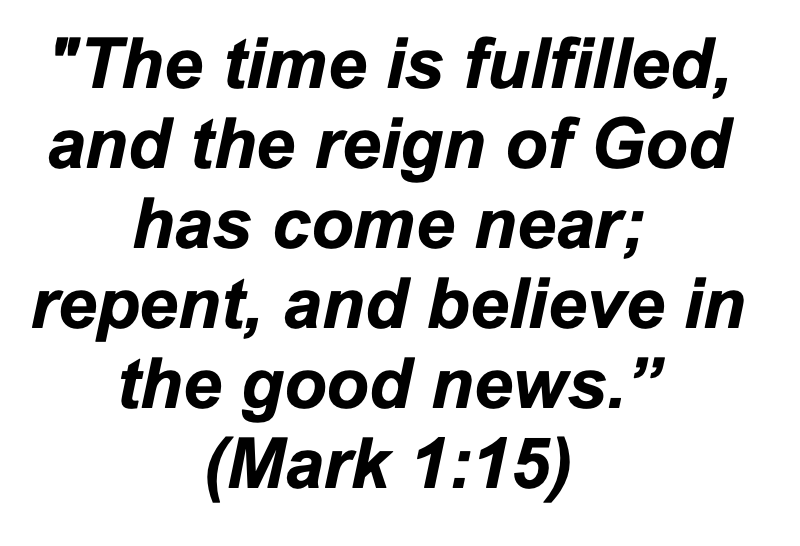
Now imagine this person that Borg has described. Perhaps there is already an image forming in your mind of what he looks like or what it might be like to be in the presence of such a person. Now, imagine that you’re meeting him for the first time, and he’s telling what he’s about — his mission statement. And this is what he says: “The time is fulfilled, and the realm of God has come near; repent, and believe in the good news.”
If you were going to memorize one sentence that represented the distillation of Jesus’ message, this is the one. Forget John 3:16. (Who can say it?) Scholars are pretty unanimous that this is Jesus’ good news, this is his reason for being, what he came to announce and enact. So, I think it’s important to dig into this this verse, and I’d like to do that by talking about its three main phrases: “the time is fulfilled,” “the realm of God has come near” and “repent and believe in the Good News.”
The time is fulfilled. Ancient — and present-day — Jews have a special way of shaping reality, which we see throughout the Bible. The scripture scholar Paula Fredricksen puts it this way: “History had a beginning. God creates the world and God has a certain moral relationship to the world. God creates things and sees that it’s good… therefore, God has a stake in social justice,” that is, in keeping it good. “A lot of what the laws of the Torah (the first five books of the Hebrew Scriptures) are about is social justice.”
About 200 years before Jesus’ life, there begins a growing expectation that this God invested in social justice will intervene in history and make sure that good triumphs over evil. Sometimes, Jews talk about this by saying that God will establish God’s kingdom, or kindom, on earth, a realm very much counter to the hierarchy and domination that they have experienced for centuries as they were colonized by one Empire after another. Some Jews believe that God or maybe a chief angel will do the fighting that allows God’s realm to come to pass. Others believe that a human Messiah will lead the forces of good. Some Jews expect that this revolution be a violent one, others believe that the revolution will come when a faithful remnant of people separate from society to establish God’s realm. (In Jesus’ time, these separatists were known as the Essenes.)
Jesus has a different understanding of how the kindom of God will come to be — which we will take about soon. But, by saying the time is fulfilled, Jesus is making a bold statement: That realm you’ve been waiting for? It’s happening; its here. This time when God intervenes in history to establish God’s realm — the time you’ve been waiting for for centuries? That time is now.
The kindom of God has come near. When Jesus talks about the “kindom of God” he is talking about “what this world would look like if God, not Caesar, sat on its imperial throne; if God, not Caesar, was openly, clearly and completely in charge,” according to another Jesus scholar named John Dominic Crossan. “It is, at the same time, an absolutely religious and absolutely political concept. It is absolutely moral and absolutely economic at the same time. How would God run the world? How does God want this world run?”
Crossan suggests that the word “compassion” is Jesus’ answer to this question of how God wants the world run. Compassion was not just an individual virtue. It was a “sociopolitical paradigm expressing Jesus’ alternative vision of human life in community.” (From Crossan’s book Who is Jesus? pages54-55.) It reminds me of something the theologian Cornel West said: “Justice is what love looks like in public,” when it’s enacted into public policy.
This is the social order that Jesus says is near, that is present now in our world. Incompletely, yes, but perceptible. You just have to have eyes to see it. And the metaphors he uses to describe this kindom are very familiar and close at hand. He doesn’t use metaphors about thrones or heavenly choirs or multitudes of heavenly hosts with chariots and spears — those metaphors are much used in other prats of Scripture, but he doesn’t use them. He says the kindom of God is like a field, or a vineyard, or a tiny mustard seed, or a woman cleaning her house. It is, in some ways, ordinary, familiar, close. You just have to have eyes to see it.
So, basically, Jesus says: Come and see. Follow me, and you will see how I see. He looks around and sees the mercy and goodness and generosity of God in creation and he says that we can be merciful and generous with each other and build a merciful and generous society because that is reality — because that is what God is offering us in every moment, with outstretched hands. Mennonite biblical scholar Ted Grimsrus puts it this way:
When “Jesus proclaims that the kindom ‘is at hand’… this is a reminder of what the Bible from Genesis onward affirms. Jesus reminds his listeners that God is the loving Creator and sustainer for us all and that God’s world is abundant in resources of mercy and caring, just as it is abundant in physical resources of beauty and food and the other goods we need.” (From God’s Healing Strategy page 98)
Repent and believe in the Good News. Wah, wah, wah. This message was so uplifting and now we get repentance. And it’s probably no wonder the call to repent may strike us as being a downer, because we just heard Jesus’ cousin John the Baptist calling for repentance and he was definitely preaching the “turn or burn” kind. Convert now and avoid the wrath to come. (That was certainly the message I got in childhood.) But Jesus is preaching a different kind of repentance — he is inviting people into a new way of seeing, to perceive life differently. He definitely expects that this new way of seeing will bring about different actions and attitudes, repentance. It can’t help but do so.
I was able to reclaim the idea of repentance when I learned that the Greek word for it in scripture, metanoia, suggests that repenting is a turning, which is very different than a shame or fear-based concept. Like, we were facing this way, and now we’re going to face another way because we see something different when we face a different way. And in fact, the early church’s baptism ritual embodied this turning. People would begin facing Rome, the seat of imperial power, and then turn their bodies physically toward Jerusalem, the symbolic seat of God’s power. They woold turn from dependence on or subjugation to imperial Rome and trust in the Creator and the Creator’s vision for the world.
This vision will not come about through violent force. This is not God’s vision, says Jesus. It will also not come about only in the individual recesses of each heart nor in a society separated from the world and sort of OK with letting that society be under imperial reign. Rather, this reign will be “established as followers of Jesus join God’s work in the world, as they do (the works that Jesus did), and proclaim the message of God’s reign.” (BCBC 424, Tim Geddert)
On Tuesday, 135 Mennonites got arrested for sitting in a circle in the Capitol rotunda in Washington D.C. to call for a ceasefire on all sides in Israel and Gaza. Pat, Joanna and I were texting as we watched a life feed of Mennonites singing and then, one by one, being put in zip ties with their behind their backs as they were being arrested — but still singing, of course. Other people presented petitions with thousands of names of Mennonites calling for a ceasefire to the Congresspeople. You may disagree with me, and it’s fine if you do, but, to me, this is an example of what it looks like when followers of Jesus join God’s work in the world, as they do the works that Jesus did, as they proclaim the message of God’s reign. Close sermon with this video…