Sermon: So We and Our Children May Live
Deut. 30: 11, 14, 15-19
When I was in my mid-20s, I began a graduate program in feminist liberation theology at the Episcopal Divinity School in Cambridge, Massachusetts. I was scared, kind of intimidated. I felt like I was in the big leagues now, and I wasn’t from the big league. The weekend before school started, I went for a hike alone in the Blue Hills south of Boston, to prepare myself. I got to the top of the Great Blue Hill and looked out over this rolling carpet of evergreen trees. It was a beautiful, warm late summer day and I lay down on this granite outcropping, feeling warmth of sun on my cheek. And I prayed. I wasn’t much of a pray-er back then. But I said — to whom I wasn’t sure — “will you help me?” As soon as I said that, these words sprang into my head, seemingly coming from the rock itself, “I will. Will you help me?”
That year was 1988. It turned out that three months before I heard that question, James Hansen appeared before a Congressional committee and said that the warming temperatures scientists had been noticing for years were due to something called global heating which was due to a buildup of carbon dioxide and other artificial gases in the atmosphere. The New York Times front-page headline said: Global heating has already begun. This was the first time climate change really burst into the national consciousness. I’ve since been struck by how climate change emerging into our consciousness and my vocation as a pastor have been intertwined from the very beginning.
Cut forward many years to the early 2000s. I had just started as the pastor at this church, and I’m trying to decide whether or not to have a child. It’s a complicated decision because even though the world is now aware that climate change has already begun, we are not doing very much at all to stop it. I know that the future into which I am bringing a child is uncertain.
During this time of decision-making, I was influenced by the activist and eco philosopher Joanna Macy, who talks about this time we’re in as the Great Turning — a time of transition from an unsustainable industrial-growth society to a life-sustaining civilization. In a way, she’s saying that we’re like the people of Israel from our Scripture passage and we’re being given the same choice. Are we going to follow the Creator’s instructions in how to live and choose the path that leads to life or are we going to adopt false gods — false priorities — and go down the way that leads to death?
I immediately resonated with this idea of the Great Turning. It felt true to what I saw happening around me. And while that scared me — it’s uncertain as to whether or not we will make the right choice — I also felt excited. What an interesting time to be alive. What good work there is do in this world, to be a part of that turning in my own small way. And maybe there’s a child who would also feel the same, who would like to be in this world at just such a time.
Friends, I had that child. Years go by. Patrick is growing. Our church is growing. I continue to engage the topic of climate change any way I can. For awhile, I did that in the way I think many of us do at first— we try to make individual choices that we think will help. We drive less or fly less or eat less meat. I started more than one small group at this church so that we could support each other in making these household changes. In one of them, we assessed our contribution to the climate crisis by using a carbon footprint calculator, which I later found out was the brainchild of a PR firm hired by British Petroleum. What a clever away to divert attention from what oil and gas corporations were doing by putting the “guilt” and onus of responsibility on individuals. Even at the time, I think I knew that “individual acts of thrift and abstinence” weren’t going to get us very far.
I knew collective action was needed. So, I went on a bunch of climate marches, and many of you went with me. I partnered with a couple of other Mennonite pastors to ask the Mennonite financial services company, Everence, to divest from fossil fuels. All this felt way better than changing light bulbs. But even this didn’t feel like it was really getting to the heart of the matter. Was this really as “simple” as asking oil and gas companies to stop drilling, or to even ask banks to stop funding oil and gas companies? It seemed that there were deeper, structural, systemic reasons for our dilemma.
In 2014, I met Sarah Augustine through a mutual friend, Anita. Sarah was fighting for Indigenous sovereignty and land justice; she framed this work as “resisting extraction.” Honestly, when I first met her, I wasn’t sure what extraction was or why it mattered in the fight against climate change. (Definition of extraction: The extraction of resources refers to the withdrawing of materials from the environment for human use, including fossil fuels (oil, gas, and coal), rocks and minerals, biomass via deforestation and fishing and hunting, and water. There are more and less sustainable ways of doing resource extraction — also comes with worldview that the earth is a resource not a relative.) But I trusted that the Spirit had brought us together and that working with Sarah on resisting extraction was what I needed to be doing, despite my inability to articulate this connection to climate change. That work led me to face the reality of colonization and how is a present reality, not just a historical fact. I began making the links between our economic system and colonization and extraction.
Throughout this time, I was going home with Patrick — I longed to connect him with the enchanted world of nature from my youth — but I was noticing changes there. One hot summer day, Patrick and I waded into the waters of Doughty Creek, which ran near my parents’ home — a creek I played in often as a child. Under the shade of maple trees, we found a pool with just enough water in it so Patrick could dog paddle. When I got back to my parent’s house and told my Mom of our adventure, she said, anxiously, that I should give Patrick a bath. “There’s a lot of chemicals in the water due to fertilizer and pesticide runoff,” she told me.
I also wanted to introduce him to fireflies. How many summer evenings did I spend as a child playing with them? Catching them, putting them in little “homes” I had constructed for them, letting them walk up my arm. Just watching them as they lit the night sky with their gentle, blinking lights. But there really weren’t fireflies anymore. An occasional one but nothing like the abundance of my youth. I learned later that fireflies are disappearing around the world due to light pollution, pesticide use, and loss of habitat from human development.
I remember when I found out about forever chemicals — toxic chemicals that appear in everything that don’t disappear from the environment. They are in our food, in our bodies, in breast milk. I learned that sperm counts are way down because of chemicals in our environment, including those forever ones. I learned about the gyres of plastic swirling in the ocean. Meanwhile, lots of social and political unrest. Meanwhile, still nothing was being done about climate change. What was happening?
In the summer of 2019, I read an essay written by Catherine Ingram called “Facing Extinction.” You can tell from the title that the author wasn’t optimistic about the future of humanity. The alarm I felt after reading that essay catapulted me into an intensive period of study, in which I discovered the work of ecological economists, systems thinkers, energy experts, complexity scientists, and deep historians. These thinkers helped me understand why were have been unable to take meaningful action on climate change and why I was seeing ecological breakdown in so many places and how colonization and our economic system were connected to all of this.
I’m going to state as succinctly as I can what I discovered, but keep in mind I did write several chapters about this! We live within a global economic system that demands perpetual expansion and economic growth to be stable. It actually has from the beginning — thus, colonization ad imperialism. Currently, our economy needs to grow at least 2-3 percent per year to stay healthy and keep us out of crises like recessions and depressions. Keep in ind that a 2-3% growth rate per year means that our economy roughly doubles every 25 years.
This growth over the last 100 years has been turbocharged by access to cheap oil. With this oil, we have been able to extract resources, make things, consume things at a level that kings and queens of old would marvel at. And lots of good has come from the growth made possible from this one-time burst of energy— modern medicine, loads of consumer goods that do make our lives more comfortable. Lots of bad things have also come from it —ecosystem degradation, climate change.
We are running out of that cheap oil. That’s why we have to frack and deepwater drill and to to squeeze oil out of tar sands. But we also know that we can’t keep using it. So the answer is: green growth. Just switch everything to green electricity and we can keep growing. There’s a whole host of reasons that I have come to believe this not possible. As one energy expert (Nate Hagens) summarized it, you can build a perfectly fine civilization with renewables, you just can’t build this one. But let’s just say we could. Let’s say we keep on trucking as usual with our growth and our consumption, just all without carbon dioxide emissions.
What I came to realize is that we would still be in trouble because climate change isn’t really the issue. Climate change is a symptom of a bigger issue which is ecological overshoot. Understanding ecological overshoot rocked the way I view the world. Overshoot occurs when humans (or any species) use resources in their environment faster than they can be replaced — like using up our topsoil or groundwater, both of which are happening, or when they dump waste into their environment faster than the ecosystem can assimilate it — like carbon dioxide emissions.
In 2009, an team of scientists gathered in Stockholm to quantify this concept of ecological overshoot so they could better determine the “safe operating space” for humanity. Theydetailed nine planetary boundaries that govern the stability and resilience of the earth system. If we surpass any these boundaries — especially climate change and biodiversity — we risk instigating large-scale, abrupt, or irreversible environmental change. As of last year, we’ve overshot on six of these nine boundaries: climate change, biodiversity integrity (since 1970, we’ve had almost a 70% decrease in populations of critters — insects, mammals, fish, reptiles & amphibians — that explains my fireflies), biogeochemical flows of nitrogen and phosphorus (that explains my Doughty Creek), freshwater use, land-system change, and environmental pollutants (forever chemicals, plastics). In other words, we could “solve” climate change and still not address the problem of ecological overshoot.
We cannot keep growing our economy, whether that growth is green or not. This growth-based system is threatening the survival of all life on this planet. This threat first impacted Indigenous and other vulnerable people but now it’s threatening all of us, including those who may have historically benefitted from this growth-based system. We cannot keep extracting resources from the earth and dumping waste into the earth’s soils, lands, waters and air. The earth is saying; Stop. I can’t take anymore. Will you help me?
And we are listening. Many of us are hearing this voice. Many of us realize we are in the midst of a Great Turning, that we must and we will (one way or another) transition from an unsustainable perpetual growth society to a more life-sustaining one. All around the world, economists and ecologists and scientists and governments and farmers and many others are realizing that we can’t go on the way we have, that that system is broken. And they are coming up with solutions, many of them locally based, a lot of them not hitting headline news. They are listening to the perspectives of Indigenous Peoples, many of whom still retain the knowledge about how to live sustainably. More and more people are realizing that we can meet human needs without destroying the world. As Macy says, “We have the technical knowledge, the communication tools, and material resources to grow enough food, ensure clean air and water, and meet rational energy needs.” We can and must and are shifting our economic, political and social goals from growth and wealth accumulation to well-being for people and the planet.
I am not saying this is not still a scary time. But what an unprecedented time to partner with the Spirit of Life, the Great Animator, to bring something new into the world! Or, something old that’s new again. What a time for imagination and creativity and innovation.
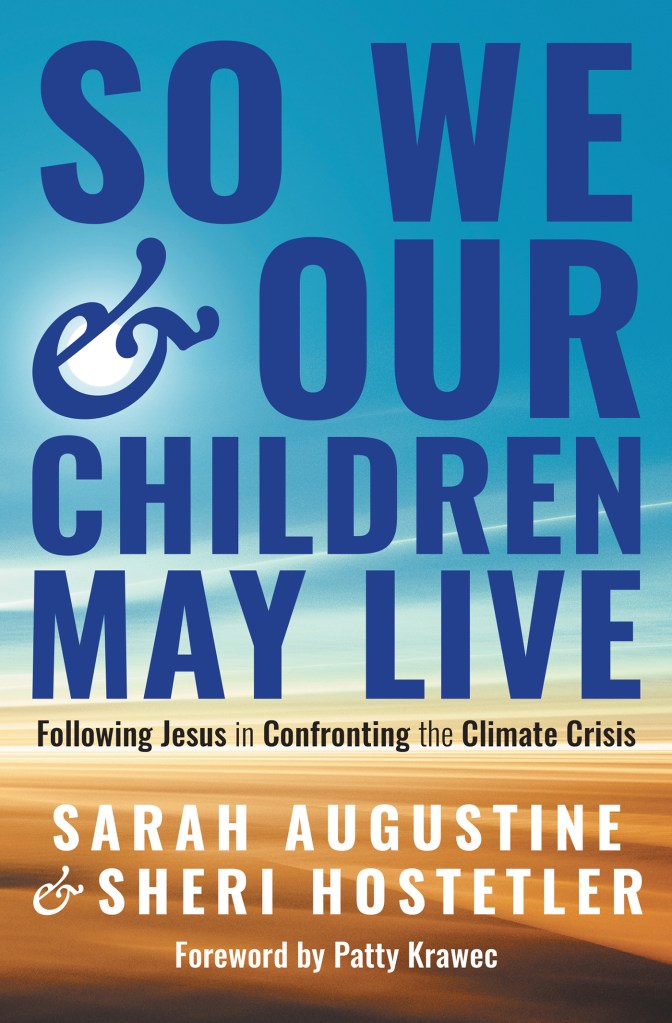
I’m going to read from the ending to my book: Friends, I am afraid. I am afraid of the world in which my son will come of age and grow up. But I am also hopeful because things are uncertain, because things are changing, because I don’t know what’s going to happen. I am excited because I am alive at this time of becoming. That uncertainty is where God is moving. That unknowing is where God is moving. That precariousness is where God is moving. That has always been the case. Throughout scripture, God beckons the faithful to step into the unknown, to trust that we will be guided by the Creator to our home, trust that God, like a mother eagle, will rise up from underneath us and support us as we take our fledgling flights into the unknown. Amen.