
Sermon: Maladjusted with Pride!
By Joanna Lawrence Shenk
Matthew 9:9-13, 18-26
Last Sunday Sheri exhorted us to claim the authority of compassion as followers of Jesus who are committed to personal and societal transformation. Compassion is not a sentimental pity for those deemed less fortunate. It means to “suffer with” or as Sheri said “to be moved in your inward parts.” Compassion can be gut-wrenching. I think compassion is what solidarity feels like.
In light of Sheri’s sermon and our recent re-wilding Jesus series, I was drawn to these passages in Matthew from our lectionary readings today. How was Rabbi Yeshua suffering with those who were outcast or in need of healing? How was his earthy trickster teaching frustrating those trying to maintain the status quo? How was Lady Wisdom–the great healing and creating Mother of us all–manifesting?
I want to begin by helping us locate these stories on the land. As we talked about in our final sermon of the rewilding series, much of Jesus’ ministry took place around the Sea of Galilee. The stories from this text take place in Capernaum.

This was a great distance from the center of religious and political power in Jerusalem (at least 70 miles). Jesus was building his movement among the rural, peasant population, outside the much more heavily surveilled urban center.
Already in Matthew’s account, Jesus has called fisherman to join him as disciples – Peter, Andrew, James and John. And he has delivered some of his central teachings through the sermon on the mount, along with irritating the religious leaders who are tracking his movement and seeking to build a case against him.
The text from chapter 9 begins with the calling of Matthew (also named Levi in Hebrew), who is a tax collector. It is a seemingly curious move on Jesus’ part to call a tax collector. They were Jewish and generally despised because of their collusion with the Roman occupation. It was their job to collect taxes from Jewish people on harvests of all kinds – grapes, grain, olives, fish – and tax collectors were often known to extort extra payment for themselves. They were a visible reminder in every village of the coercive power of the Roman occupation.
I found this image online which is a good illustration of their role in Jewish communities.
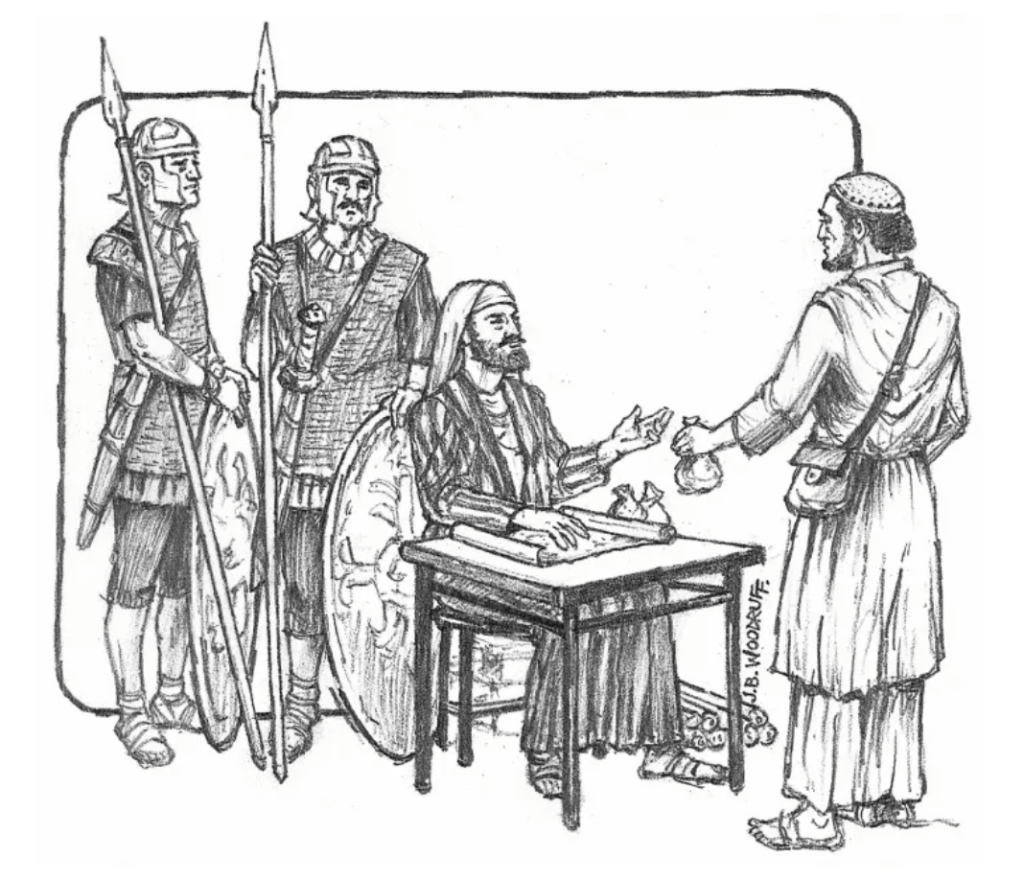
They were clearly backed by the force of empire. I didn’t have enough time to research how a person would become a tax collector… was it handed down from father to son? Was it something that was forced upon a person or did they have a say in choosing that line of work? I am not sure.
In the case of Matthew there isn’t any fanfare around his decision to leave this position. Jesus said “follow me” and Matthew got up and followed him. Maybe it was a welcome relief? Maybe he felt trapped and didn’t want to keep exploiting his community members?
He would have been someone who was collecting taxes from the fisherman that Jesus had also called to be disciples. So it’s not a stretch to imagine that the other disciples might have been like, “What the heck, Jesus? Why are you including that guy? He’s part of the system that has been impoverishing us!”
This reality makes the strangeness of the table fellowship in the following verses even more stark. And to really understand it, we need to be clear on what it means to be a “sinner” in this text. I’m curious what you were taught, implicitly or explicitly, about what made these people sinners?
As it turns out, sinning in this context was not about sex or personal moral failings, it was about money mostly. It was about people’s inability to pay their tithes and taxes. By and large it was the poor who were considered sinners because they could not pay their dues. Sounds eerily similar to the way poor people are still viewed today.
So if we adjust a few words in the text, I think the meaning becomes a lot more clear. Debtors is a much more accurate translation than sinners.
With this in mind, it’s not just that the people at the table with Jesus were all outcasts – the tax collectors and debtors – they were class enemies of each other. The leaders, religious and otherwise, seeking to uphold the status quo would have been deeply uncomfortable with this kind of cross class table fellowship. Rabbi Yeshua was bringing these people together and bringing them into his movement. He was healing social bonds that had been broken due to the traumas of occupation.
These people – the tax collectors and debtors – felt in their bodies the ways that the current system did not work and probably was literally making them sick in some cases. In verse 12, Rabbi Yeshua says “Those who are ‘well’ have no need of a physician, but those who are sick do.
In the past I’ve felt uncomfortable with this line of reasoning from Jesus, because it felt like he was saying that his followers were deficit (sick, sinners) and the people who were challenging him were fine (well, righteous). But upon further reflection I finally understood the reversal I had missed before. The reversal of trickster Rabbi Yeshua was an indictment on the status quo and all those upholding it. It was only the privileged who could be without debt, therefore making them “righteous.” But it was the debtors that showed the injustice of the system.
It’s like he was saying, I can’t help you if you don’t see there’s a problem here. If you don’t feel in your bodies the suffering of other bodies, I can’t convince you of that. These people here, they feel it and they want to be a part of something different.
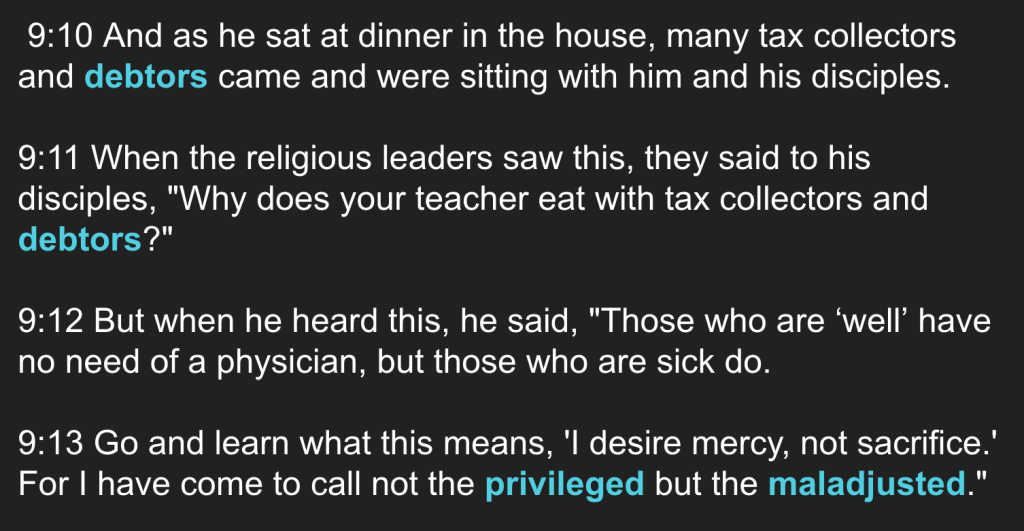
This reversal of Jesus brought to mind a quote from Dr. Martin Luther King Jr. about being maladjusted to injustice. I was able to find a short video clip online that I want to play for you now.
Dr. King, following in the way of Rabbi Yeshua, was calling on maladjusted people to join him in the movement for justice in this country. He was compassionate. He was feeling in his body the suffering of so many and was compelled to act. At a time in this country when it was still illegal in some places for Black and white people to eat together, Dr. King and other members of the Southern Freedom Movement held many a subversive dinner party.
But our scripture text doesn’t end at Jesus’ subversive dinner party. While he was still at the table, a leader from the synagogue in Capernaum named Jarius burst in and implored Jesus to come and revive his daughter who had just died.
This was a man of privilege who was coming in need of healing, and Jesus had compassion on him too. It’s interesting because this story shows up in multiple gospels and in other versions, the daughter is not yet dead, so there is a real urgency in Jesus getting to Jarius’ home as soon as possible.
However, another person in need of healing stops him in his tracks. The version of the story in Matthew is pretty bare bones, so I want to include some of the details from Mark and Luke. As Rabbi Yeshua was moving through the crowded streets to get to Jarius’ house, he was pressed upon from many sides. But then it happens that he feels some energy drain out of him and he turns and says “who touched me?” Kinda a funny question under the circumstances, but he felt something peculiar – healing power had gone out of him according to Mark.
A poor woman came forward, trembling. She was frightened because she, as an unclean woman – sick with hemorrhages and bleeding for 12 years – had reached out and touched a holy man. Such an action could have been punished with stoning. But she had tried every cure and spent all her money on treatments and still she suffered. So she told herself that if she just touched the hem of Rabbi Yeshua’s garment, she would be healed.
Just as Rabbi Yeshua felt the healing power go out of him, at that moment she knew the bleeding had stopped. I imagine when she came forward trembling, Yeshua bent down to meet her eyes. I imagine him looking at her with such care – really seeing her – a person who had been banished from community due to her sickness for 12 years.
In Mark’s version he says, “My daughter, your faith has healed you; go in peace and be free from your affliction.” She claimed her healing and Rabbi Yeshua affirmed it. In calling her daughter, he also affirms her place within the community, healing bonds of kinship. In the version in Luke he calls her a daughter of Abrahman and Sarah which is the only time this title is given by Yeshua. It was a powerful statement about the woman’s worthiness and would have shocked anyone listening.
From there he proceeds to Jarius’ house and revives his daughter, who in some versions of the story was said to have died while Jesus was healing the poor woman. We have this contrast of two daughters. One a poor and outcast woman, who interrupts Rabbi Yeshua on his way to heal the daughter of a privileged man.
Yeshua stops and prioritizes the healing of this sick woman even when it seems to doom the prospects of the privileged man’s daughter. Only a maladjusted person would have the audacity to do what this suffering woman did. She knew she needed healing and Rabbi Yeshua saw her and affirmed her in a powerful way.
I have not come for the privileged, for those who are comfortable and successful. I have come for those who are maladjusted, for those who mourn, for those who hunger and thirst, for those who are in debt, for those who are sick, and for those who are willing to claim their healing no matter the risk.
May we continue to walk in the compassionate way of Yeshua, joining subversive dinner parties, pissing off religious and political leaders, and claiming our maladjustment with pride!