
Jesus as Green Man
This is the first in an Eastertide mini-series called “Rewilding Jesus” that unearths fun and feral images/ideas about Jesus, the Jewish prophet deeply rooted in his place and his community and undomesticated by Empire.
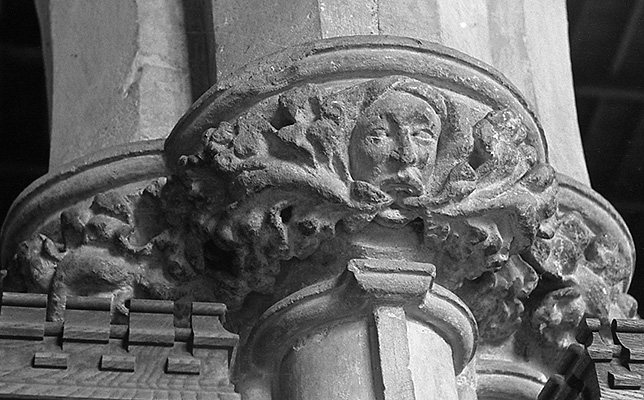
Almost a year ago, I was in Milan to officiate the wedding of one of our former MVSers, Alyssa Schrag, and Gio Bianchi. I confess I didn’t visit one art museum the entire time I was there. The truth is, I get tired of art museums pretty quickly, but I can spend all day staring at the weird stuff carved into European cathedrals. In a time when most people weren’t literate, the walls of these cathedrals, along with their statues and stained glass windows, were common people’s Sunday School; it was their religious education, the way their faith was formed. So it’s fascinating to decipher what faith is being communicated through all this art.
The huge cathedral called the Duomo that dominates the center of Milan is like several years of Sunday School all crammed into one building. It’s said there are more statues on this cathedral than on any other building in the world: 3,400, they think along with 135 gargoyles and 700 figures. Although the cathedral began to be built in 1386, it is still not finished! Stonemasons are still carving spires and statues and gargoyles and other decorative elements on its facade.
Among the many carvings on the Duomo is this one: the Green Man. Images of the Green Man are all over medieval cathedrals. It was a widely used symbol starting in the Middle Ages. (See Wikipedia article on the Green Man for many different images of these carvings.) There are 70 different carvings of the Green Man in the Chartres cathedral alone. He typically has vegetation coming out of his mouth, or he is depicted as having leaves or vegetation spring from his head, like hair. Images of the Green Man are not limited to Europe. You can find similar figures in Iraq, Borneo, Nepal and India.
The Green Man also shows up in various mythologies. We find see him in the myth of the Roman god Bacchus or the Greek god Dionysius, the god of grapes, wine and intoxication. We can see him in the Sumerian god Dumuzi, who is a god of grain. We can see the Green Man in the Egyptian god Osiris, whom writer Sophie Strand calls the original Green Man. Osiris is literally green; his father is the land god Geb and his mother is the sky goddess Nut. He is born of sky and dirt, just like plants.The crook represents his ability to work with animals, specifically sheep, while the flail he holds is used to thresh wheat. So, he’s closely tired to the agricultural cycle. (From her book The Flowering Wand: Rewilding the Sacred Masculine.)
So who is this Green Man who emerges as an archetypal symbol in so many places? To quote one mythologist: “He is the embodiment of vegetative life. He is the juiciness of the sap that rises and renews life each spring. He is the ‘blood’ of the plant kingdom that sustains all animal life.” He also symbolizes death and rebirth in the cycle of nature, the cycle whereby plants sacrifice their fruit at harvest so that animals may live, appear to die during the dark and cold winter, and then are reborn from either seed or root the following spring. In myths, the Green Man is often similarly sacrificed — like plants — for the good of all, his body returned to the Earth where he appears to be dead, and then is reborn. In many different cultures, “the return of the young god in the greening of the Earth… heralds the joyful news that life is reborn from death.”
Sound familiar? Of course, this archetypal pattern of death and rebirth is at the center of Christianity. We just celebrated Easter, where we heralded the Good News that life is reborn from death. In our ritual of communion that we held that day, we re-enacted Jesus’ last meal with his disciples before his “sacrifice.” With Jesus as our host, we ate and drank of the fruit of the land, the grain and the grape. In Catholicism, this association of Christ with grain and grape becomes literal. Orthodox Catholic teaching is that in the ritual of the Eucharist, the bread and wine “transubstantiate” — that means, they literally become — the body and blood of Christ. As Jesus says,
“I am the bread of life.” (John 3:35)
This is the same Jesus who says,
I am the vine, you are the branches. Those who abide in me and I in them bear much fruit, because apart from me you can do nothing. (John 15:5)
It is the same Jesus who uses the fields, the agricultural cycle, the birds of the air, the mustard seeds, the flowers to teach about God’s kindom:
He put before them another parable: ‘The kindom of heaven is like a mustard seed that someone took and sowed in his field; it is the smallest of all the seeds, but when it has grown it is the greatest of shrubs and becomes a tree, so that the birds of the air come and make nests in its branches.’ (Matthew 13:31-32).
It is the same Jesus who says, in the hours before his death,
Very truly, I tell you, unless a grain of wheat falls into the earth and dies, it remains just a single grain; but if it dies, it bears much fruit. (John 12:24)
The great medieval mystic Hildegard of Bingen was writing at about the time that the Green Man archetype really began emerging in Europe. She refers to Christ as a “green man,” since he brings wetness and aliveness to the human soul. She also refers to Christ as the “greening power in creation.” She called this greening power “viriditas” in Latin, and that’s the name of this contemporary piece of art by Elizabeth Hall. She taught that the only real sin in life is “drying up,” which is a metaphor for denying the greening power that wants to flourish in all of us.
Interestingly, the Green Man archetype starts appearing in Europe at the same time that the the Sacred Feminine in the guise of the Virgin Mary starts really becoming popular. Many of the great cathedrals of Europe are dedicated to the Blessed Virgin Mary. These same cathedrals sprouted carved Green Men all over the place, peering at people from the tops of columns, from choir stalls, from church facades.
The Green Man had a period of flowering in the Middle Ages, went underground during the “Age of Enlightenment,” and now is re-emerging. For the Green Man is experiencing something of a renaissance these days. You could say he’s trending. His name is on many a pub in England…. or breweries… or garden decor… He is even on the invitation to the coronation of King Charles! And think of how often the adjective green is being used these days. Green belts, green economics, green buildings, green politics, the Green Party, Greenpeace.
Now, one could scoff and say all this is a marketing ploy or a way to prop up a monarchy; one can cynically point to many instances of “greenwashing,” where something that is decidedly not Earth friendly — like mining or economic growth — is ethically cleansed by inserting the adjective “green”in front it. While there’s truth in this, I believe something deeper is happening in the Green Man emerging now. In an age where we are becoming so aware of how much we have damaged the Earth and how alienated we’ve become from nature, might the Green Man be emerging from our cultural toolbox of symbols to help us heal this alienation?
The Christian church bears a special a weight of responsibility in healing this alienation because the church caused it. Traditional Western Christianity has a dualistic view of the world. There’s a transcendent God up there who is separate from the “fallen” world of nature. In this view, when we die, we will be whisked out of this world to some other, better place. “This world is not our home,” say many of our hymns. This dualism has fed into a distrust of the body and its urges, of sexuality, of women (who were presumed to be more connected to nature and the body), and of a view of nature and animals as “resources” given to humans to dominate and exploit.
Yet, there have always been strains within Christianity that provide possibilities for a truly ecological faith. And because Christianity still wields such great influence in the world, we need to bring forth those aspects of Christianity that honor nature and heal our alienation from it.
In bringing forth the green Jesus from within our tradition, might we remember our fundamental debt to plants? The vining, flowering, branching, sappy, juicy green life upon which all animal life depends? If we imagine Jesus as deeply embedded within this green life, as a wild man with leaves for hair and vegetation sprouting from his mouth, might we remember our rightful place within green creation? Not as dominators or exploiters, but as co-creators of the wild garden— like the wonderful children’s book. Maybe even calling us co-creators elevates us too much. We would die without plants. We are dependent on them, not really the other way around. They are pure gift to us, the gift of Life.
In conclusion, I want to say a bit more about this icon on our altar. It’s called “The Tree of Life” and it’s by the wonderful Franciscan icon painter, Robert Lentz. Here’s what he says about this icon:
In the first centuries after Jesus’ death, he was never depicted suffering on the cross. (He was often shown as the Good Shepherd in the Garden of Eden, a garden of green and growing plants and fruits.) When artists finally began depicting him on the cross, he was shown either in a peaceful repose or as a king in glory…. (Another) type of cross was the Tree of Life, filled with vegetation and harkening back to the Green Man revered in the old religions of northern Europe…
In this icon Jesus is the Tree of Life. He shines at the center of four arms that stretch to the four sacred directions — reminiscent of the Native American medicine wheel. He is the center of creation. Exotic vegetation coils from him, or towards him, depending on one’s perspective. He is the…vine spoken of in John’s Gospel… Having become part of creation, and unjustly executed, he is the advocate of all those who have been trampled underfoot. Slain on the cross, but risen, he declares that God’s greatest miracle is to bring life and light even out of injustice and death.
May this greening, liberating power of God continue to emerge in us and in our world, and may we be healed.